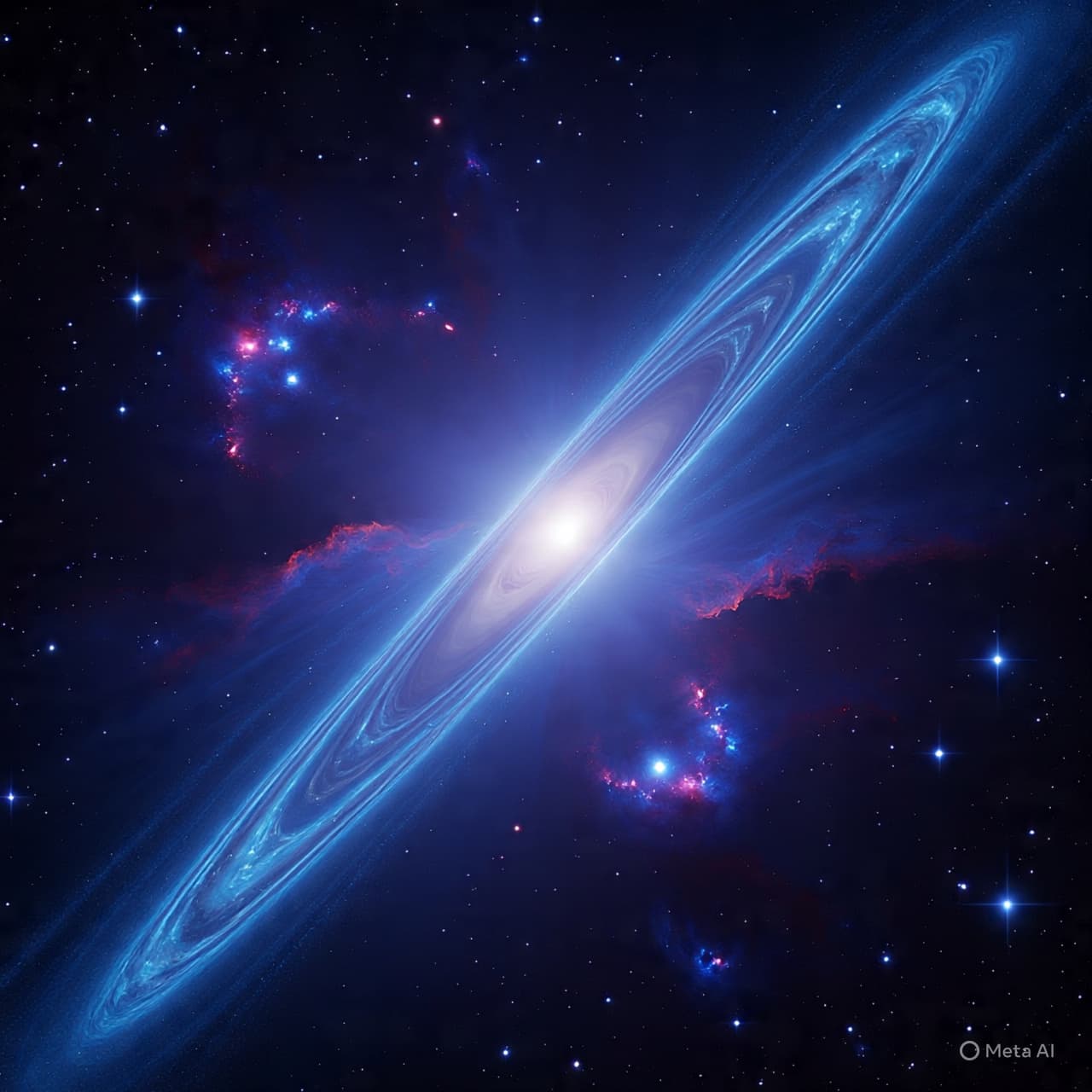
There are nights when the sky feels lived in — gentle stretches of darkness that suggest depth and memory more than mere emptiness. In such skies, stars do not merely shine; they echo centuries of motion and creation. One such beacon, known to observers since the early years of the twentieth century as Nova Persei 1901, radiated so brightly at its eruption that it was visible to the unaided eye. More than a century later, that same stellar neighbor continues to whisper its stories through the light and matter it has cast off into the cosmic sea.
This eruptive remnant, identified as GK Persei in telescope catalogs, lies nestled in the constellation Perseus — a celestial region rich with lore and ongoing scientific discovery. In 1901, a sudden thermonuclear flash on the surface of a white dwarf star, fed by its companion star in a close binary system, sent a shell of material hurtling into space, brightening the night. Over the ensuing decades, astronomers have watched the expanding nebula — sometimes called the Firework Nebula for the pattern of gas and dust it shows — evolve like embers drifting from a long‑spent fire.
Now, through observations with NASA’s SPHEREx space telescope, a larger and subtler structure emerges from this familiar scene: a bipolar shell of molecular hydrogen that spans roughly 18 by 10 arcminutes across the sky, co‑existing with the familiar nova remnant. Like a faint ring of mist lingering on a summer night, this shell is rich in hydrogen — the simplest and most abundant element in the cosmos — and reveals a shape that resonates with the structures known as planetary nebulae, the glowing shells of gas cast off by aging stars in the late stages of their evolution. Astronomers suggest this may be just that: a planetary nebula surrounding the nova’s remnant.
Planetary nebulae, despite their name, are not related to planets at all but are indeed the shimmering exhalations of stars similar in mass to our Sun as they approach the ends of their lifespans. These nebulae host expanding shells of ionized gas, sometimes with pronounced bipolar shapes, bearing gentle patterns etched by stellar winds and magnetic forces. Their masses tend to fall within a range that aligns with what is now estimated for the newly revealed hydrogen shell around GK Persei — about 0.28 to 0.38 times the mass of the Sun — which further enhances the planetary nebula interpretation.
Yet this cosmic tapestry is not unambiguous. The expected dense equatorial structure that often shapes the bipolar outline of planetary nebulae — a torus of material that pinches the outflow into twin lobes — does not appear clearly in the current SPHEREx images, leaving room for alternative interpretations. Moreover, because a true planetary nebula would likely have faded from visibility long before the 1901 nova eruption, the coexistence of a fresh nova remnant and an older nebular shell raises questions. Perhaps the shell is not a relic of asymptotic giant branch evolution at all, but instead a reservoir of pre‑existing gas that was energized and ionized by the nova’s flash, now entering a slow phase of recombination and cooling.
The scene thus invites both wonder and humility. In the quiet interplay between exploded material and ancient envelopes of gas, the boundaries between one cosmic phase and another blur, revealing how intertwined stellar life cycles can be. Whether this hydrogen shell proves to be a genuine planetary nebula or a relic of a different origin, its discovery extends the narrative of Nova Persei 1901, reminding us that even well‑studied neighbors can surprise and deepen our sense of the vast, evolving universe.
In scientific terms, astronomers using SPHEREx have detected a large, bipolar molecular hydrogen shell around GK Persei that may represent a planetary nebula, with shell mass consistent with typical planetary nebulae. However, the absence of some structural features and timing considerations leave its classification unresolved and highlight the need for further spatial and kinematic studies.
AI Image Disclaimer: Illustrations were created using AI tools and are not real photographs.
Sources: Phys.org reporting based on SPHEREx observations, astronomical research preprint.
Published by Banx Network. This article is part of the Banx decentralized media programme, powered by the BXE token on the XRP Ledger.