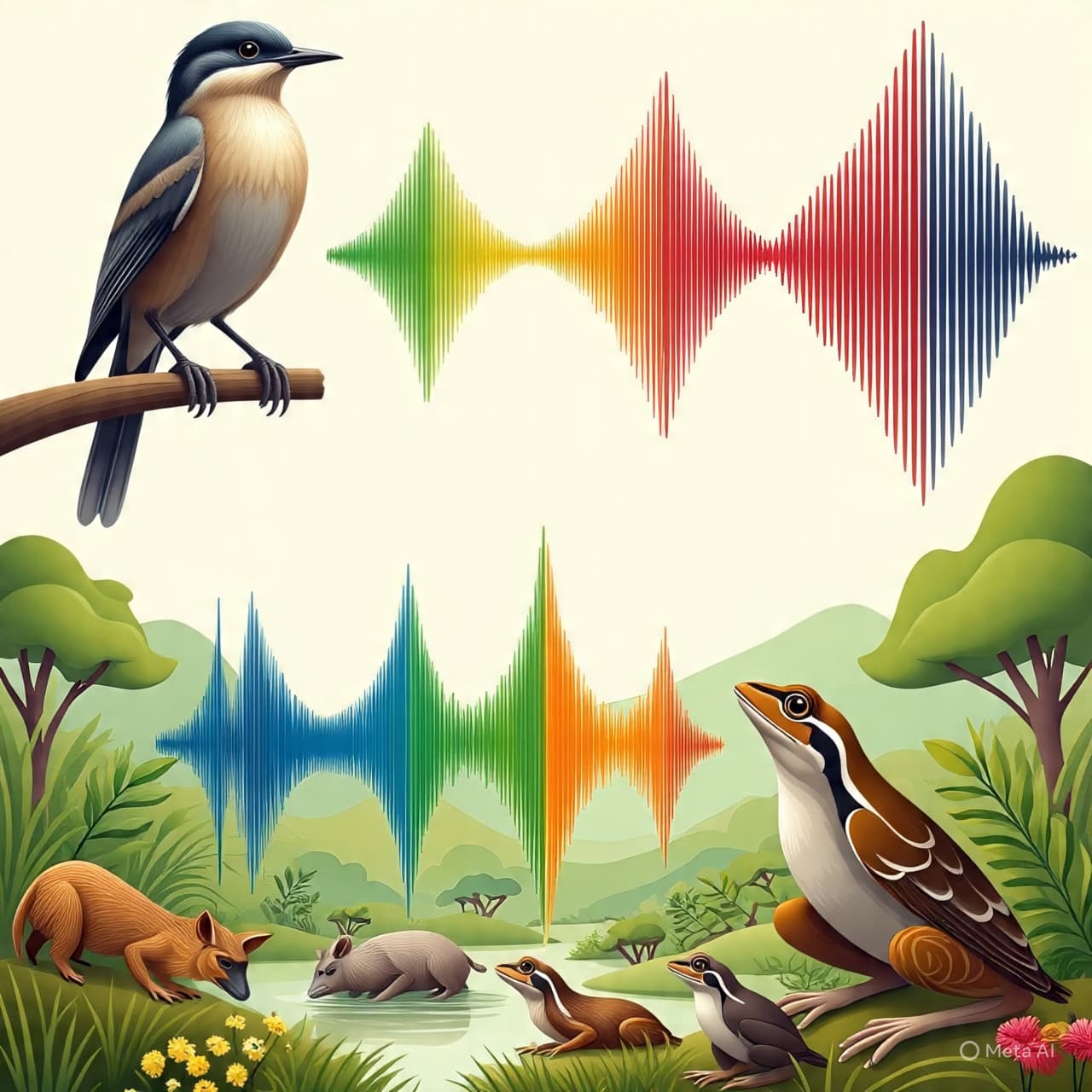
There are sounds that seem to carry more than their immediate meaning, tones that linger not just in the ear, but somewhere deeper, where recognition precedes explanation. Across forests, fields, and open spaces, animals call to one another in patterns shaped by rhythm, pitch, and repetition. These calls are not random; they are signals, tuned over time to attract attention, to invite response.
For humans, listening to such sounds often feels like an act of observation, a moment of distance between species. Yet there are times when that distance narrows, when a call—though unfamiliar—seems to carry a certain appeal. It is not understood in words, but sensed in form.
This subtle overlap has drawn scientific attention, echoing an idea first suggested by Charles Darwin. He proposed that preferences for certain sounds, particularly those related to attraction, might not be entirely unique to humans. Instead, they could reflect deeper patterns shared across species, shaped by evolutionary processes that extend beyond any single lineage.
Recent studies have begun to explore this possibility more directly. By comparing human responses to animal mating calls with the preferences observed within those species, researchers have found points of convergence. Certain acoustic features—such as specific pitch ranges, tonal qualities, or rhythmic structures—appear to be favored both by animals selecting mates and by humans listening without prior context.
These findings do not suggest that humans interpret these calls in the same way animals do. Rather, they indicate that the underlying qualities of the sounds may align with broader perceptual tendencies. What is attractive or attention-grabbing in one species may resonate, in a different form, with another.
The reasons for this alignment are not fully resolved. One possibility lies in shared biological constraints—how auditory systems process sound, how certain frequencies or patterns are more easily detected or preferred. Another possibility points toward evolutionary continuity, where traits that signal vitality or fitness in one context carry analogous significance in another.
There is also the role of pattern itself. Repetition, variation, and harmony are features that recur across many forms of communication, both human and animal. They create structures that can be recognized even when their meaning is not explicitly understood.
What emerges from this research is not a merging of human and animal experience, but a suggestion of overlap—a space where preferences intersect without becoming identical. The calls of animals remain rooted in their own ecological and social contexts, while human perception continues to be shaped by culture and learning. Yet within these differences, there are traces of common ground.
The idea, once a quiet hypothesis, gains a measure of support through observation. Darwin’s suggestion was not framed as a certainty, but as a possibility worth considering. The current findings do not conclude the matter, but they add weight to the notion that attraction, even in its most subtle forms, may follow patterns that extend across species boundaries.
There is a certain stillness in this realization. It does not change how animals call, nor how humans listen, but it reframes the act of hearing. What seems distant may carry familiar elements, and what appears unique may share roots with something older.
Studies indicate that humans may prefer certain acoustic features in animal mating calls that align with the preferences of the animals themselves, lending support to an idea originally proposed by Charles Darwin. The research highlights potential shared patterns in how sound is perceived across species.
AI Image Disclaimer
These images are AI-generated and serve as conceptual representations rather than real-life recordings or observations.
Source Check Nature Science BBC The Guardian Scientific American
Published by Banx Network. This article is part of the Banx decentralized media programme, powered by the BXE token on the XRP Ledger.