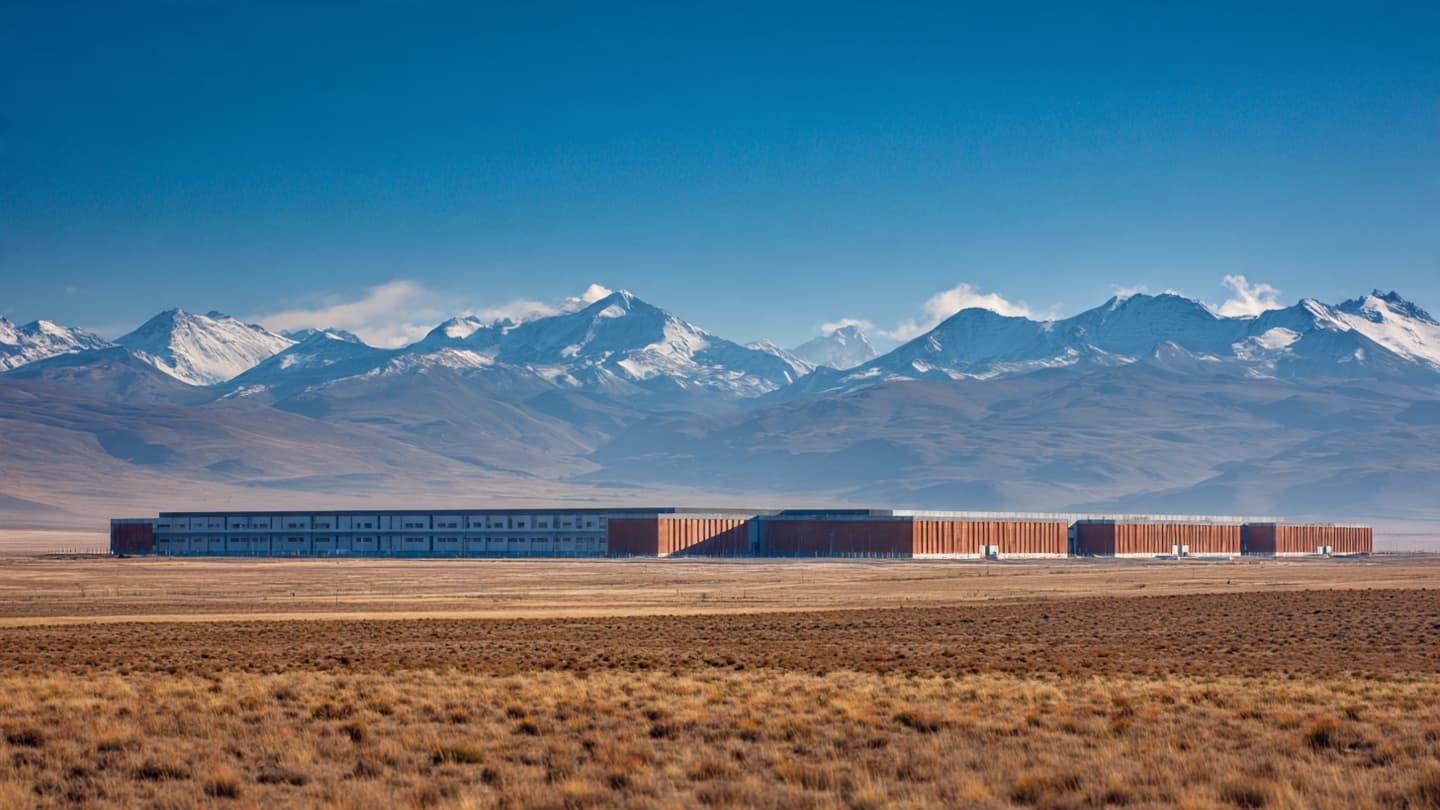
Patagonia has long been a landscape measured in distances: long roads, wide skies, powerful winds, and stretches of land where the horizon seems to move farther away. Now another kind of infrastructure is beginning to appear in conversations about the region. Beneath the quiet landscape, investors are looking at the possibility of building enormous facilities designed to store and process the digital weight of the artificial intelligence era.
Technology companies and investors are increasingly examining Patagonia as a potential location for large-scale data centers. The region offers several characteristics attractive to operators, including relatively cool temperatures, renewable energy resources, shale gas, and large areas of sparsely populated land.
The appeal of cooler weather is practical. Data centers contain thousands of servers that generate substantial heat, creating a continuous need for cooling. A naturally cooler environment can help reduce part of the energy required for that process, although the overall efficiency of any project depends on its design, power source, water use, and local infrastructure.
Neuquén has emerged as one of the areas attracting particular attention. Pampa Energía has proposed a data-center facility with a capacity of around 500 megawatts near its Loma de la Lata power plant, while nearby Vaca Muerta provides access to significant shale-gas resources.
The projects are arriving at a moment when demand for computing capacity is expanding rapidly. Artificial intelligence systems require powerful computing infrastructure, and technology companies around the world are searching for locations where electricity, land, cooling, and network connectivity can be brought together at enormous scale.
Argentina is also developing additional fiber-optic infrastructure that could strengthen Patagonia’s digital connections. For a data center, physical distance from major population centers is less important when high-capacity networks can reliably connect the facility to users, cloud platforms, and other computing centers.
Yet the landscape is not without practical challenges. Large data centers require enormous quantities of electricity, dependable transmission networks, high-capacity telecommunications, and long-term investment. Some proposed projects in Argentina remain at early stages, with financing, agreements, and construction still ahead.
The scale being discussed varies considerably. Some proposals are measured in tens of megawatts, while others could eventually reach several hundred or even thousands of megawatts. Such numbers place data centers closer to industrial infrastructure than conventional technology offices, turning questions about electricity and connectivity into central parts of the planning process.
For Patagonia, the arrival of these proposals adds a new layer to an already changing economic landscape. Wind, gas, agriculture, mining, and energy infrastructure have shaped the region for decades. Data centers introduce something different: an industry whose primary raw material is electricity and whose final product is largely invisible, moving through networks rather than roads.
Most projects remain works in progress rather than completed facilities. But the attention itself marks a subtle shift. As artificial intelligence pushes computing demand higher, the wide spaces of Patagonia are beginning to be viewed not only as a remote landscape, but as potential ground for the digital infrastructure of the coming years.
AI Image Disclaimer The accompanying visuals were generated with AI technology and are conceptual representations of Patagonia’s potential data-center infrastructure, not photographs of actual facilities.
Sources Reuters The Japan Times The Next Web MarketScreener Argentina energy and technology industry sources
Published by Banx Network. This article is part of the Banx decentralized media programme, powered by the BXE token on the XRP Ledger.