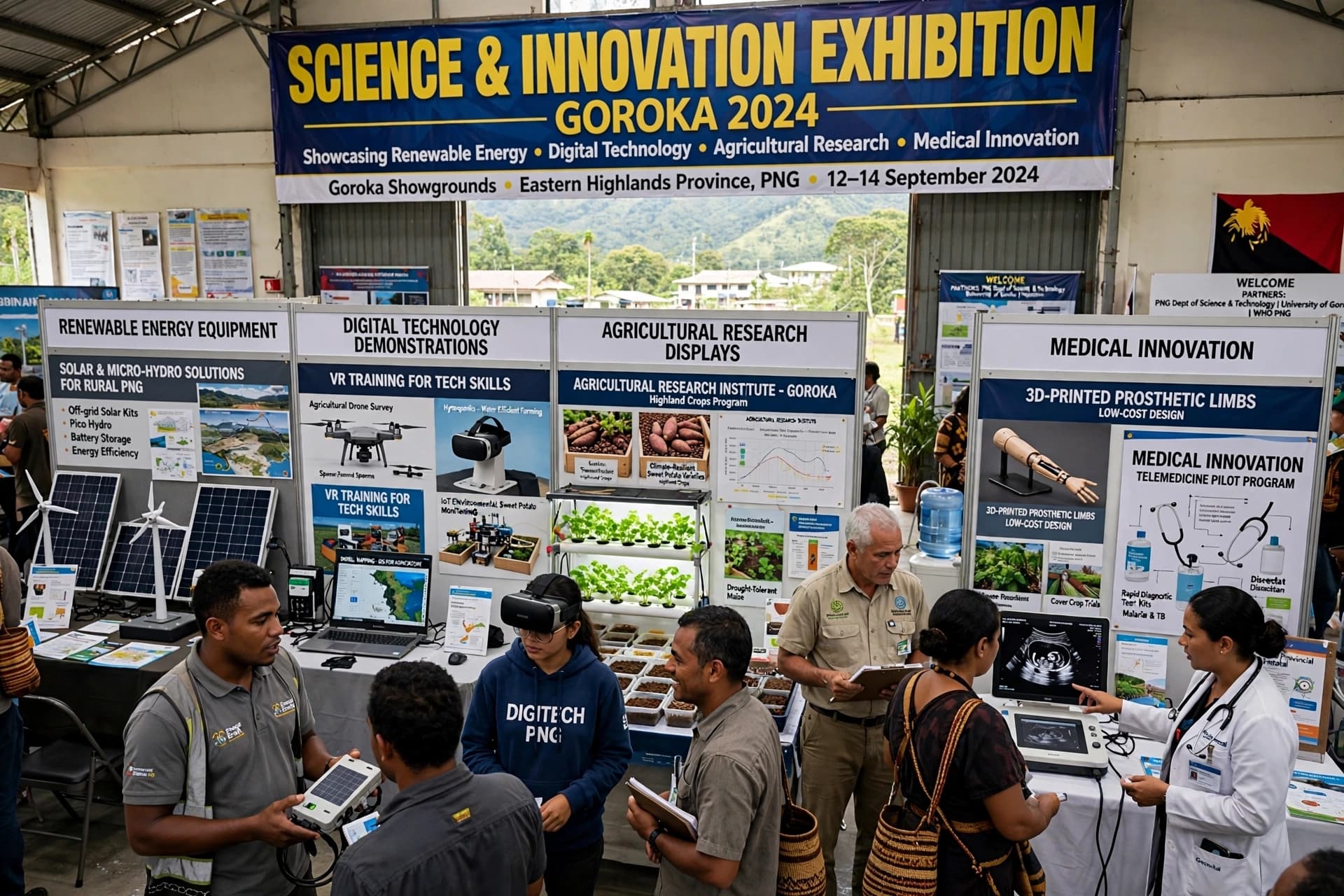
In Goroka, ideas recently moved beyond the pages of research papers and into a more visible space. Exhibitions, demonstrations, and discussions brought together researchers and students to show how scientific work might eventually become something practical for communities.
The eighth National Science Research and Technology Conference was held at the University of Goroka in Eastern Highlands Province, with an exposition designed to showcase products and services developed from scientific research.
The event represented a change from earlier conferences, according to Papua New Guinea Science Research and Technology Secretariat acting director Jordan Dean. Previous gatherings had largely focused on papers and concepts, while the latest conference placed greater attention on demonstrating practical innovations.
The range of subjects reflected some of the country’s most persistent development challenges. Projects addressed renewable energy, health, sustainable agriculture, climate resilience, alternative medicine, and digital information and communication technology.
That mixture is important because scientific research rarely exists in isolation. A renewable-energy project can affect how communities access electricity. A digital platform can change how information is shared. Medical research can influence diagnosis or treatment, while agricultural innovation can shape food production and rural livelihoods.
The conference also provided a platform for younger researchers and students. An innovation award went to a University of Natural Resources and Environment researcher, while other recognition included a language application developed by students from the University of Technology and a home-automation project from the University of Goroka.
The event was hosted by the University of Goroka in partnership with the PNG Institute of Medical Research and supported through the country’s research and science institutions. Researchers, academics, students, and other participants gathered to present work connected to national development challenges.
The emphasis on practical innovation also points to a broader question facing scientific communities: how can research move from an idea into something that survives outside the laboratory? A prototype may be promising, but turning it into a useful service or product can require funding, technical support, infrastructure, training, and sustained testing.
For Papua New Guinea, these questions carry particular weight. The country’s geography and infrastructure challenges can make conventional development pathways difficult, creating a need for solutions adapted to local conditions rather than simply imported from elsewhere.
The Goroka conference therefore offered more than an exhibition of technology. It provided a glimpse of researchers attempting to connect knowledge with everyday needs. In the quiet movement from a research paper to a working prototype, science becomes easier to see—not as something distant and abstract, but as a process through which communities can explore different ways of meeting the future.
SEO SLUG
papua-new-guinea-science-technology-innovation-conference-2026
HASHTAGS
#PapuaNewGuinea #Science #Technology #Innovation #RenewableEnergy #HealthResearch #DigitalTechnology #SustainableDevelopment
IMAGE DISCLAIMER
This AI-generated visual is an editorial representation of a science and technology exhibition and does not depict a specific researcher, prototype, or actual conference photograph.
SOURCES
The National EMTV Online University of Goroka PNG Institute of Medical Research
Published by Banx Network. This article is part of the Banx decentralized media programme, powered by the BXE token on the XRP Ledger.