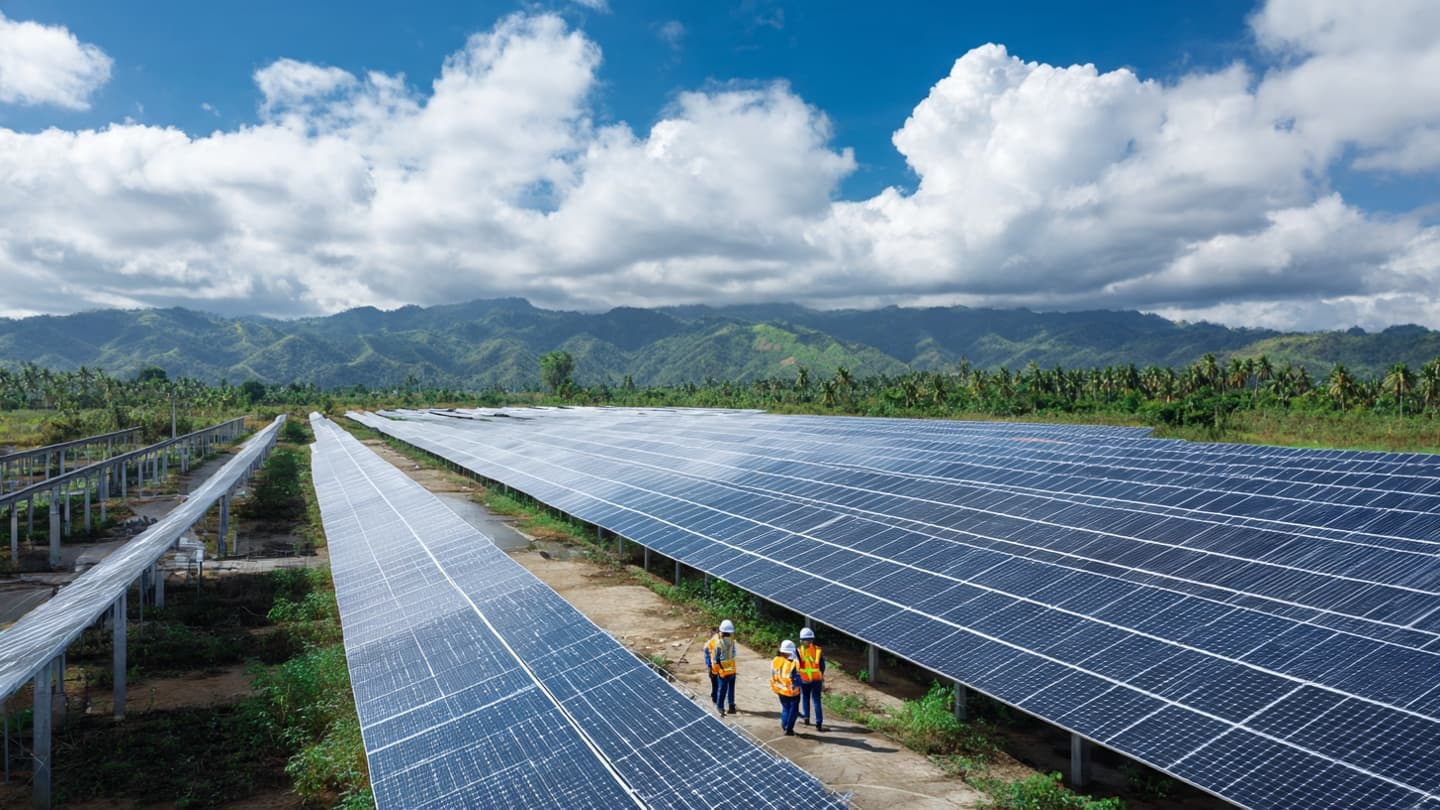
Across Indonesia, sunlight arrives almost every day with a familiarity that makes it easy to overlook. Yet the same steady light is increasingly being treated as infrastructure. On August 25, fourteen solar-power projects were launched, adding another visible chapter to Indonesia’s effort to expand renewable electricity.
The projects have a combined capacity of 5.3 gigawatts. Two are already operating, six are under construction, and another six are being prepared for investors, according to Reuters. The projects form part of Indonesia’s broader goal of adding 100 GW of solar capacity by 2029.
The scale is significant for a country spread across thousands of islands. Electricity demand varies widely between regions, while building and maintaining energy infrastructure across an archipelago presents logistical challenges that are less visible on a conventional map.
Solar power offers one potential way to diversify that system. Photovoltaic panels can be deployed at different scales, from utility-size installations to smaller projects serving local communities and commercial facilities. Their modular character can make them suitable for a country where geography plays such a large role in energy planning.
The new projects also arrive as Indonesia seeks to reduce dependence on fossil fuels. Coal remains an important part of the country's electricity system, while oil and gas continue to influence the wider energy economy. Increasing renewable generation therefore represents a gradual change in the structure of national power supply.
The 100-GW target creates a much larger horizon than the fourteen projects launched this week. Reaching it would require sustained investment in generation, transmission, storage, grid management, and supporting infrastructure, as well as continued access to financing.
There is also a question of how quickly solar capacity can translate into reliable electricity. Solar generation varies with daylight and weather, meaning a larger solar share requires grids capable of balancing fluctuations. Energy storage and complementary generation can become increasingly important as renewable capacity grows.
For investors, the six projects still seeking investment provide another indication of how Indonesia is attempting to attract private capital into the energy transition. Government participation can establish direction and infrastructure, while private financing can provide additional resources for construction and operation.
The projects also carry a broader economic dimension. Building solar facilities can create demand for construction, engineering, logistics, maintenance, and equipment. Over time, renewable-energy development may therefore influence not only electricity generation but also parts of the industrial and services economy.
For now, fourteen projects totaling 5.3 GW represent a concrete step within Indonesia’s much larger solar ambition. The country's tropical sunlight is abundant, but turning that natural resource into dependable electricity will depend on investment, infrastructure, technology, and the steady expansion of the national grid.
AI Image Disclaimer The images were produced using AI tools as conceptual visualizations and should not be interpreted as photographs of the newly launched projects.
Sources Reuters PLN Ministry of Energy and Mineral Resources Antara The Jakarta Post
Published by Banx Network. This article is part of the Banx decentralized media programme, powered by the BXE token on the XRP Ledger.