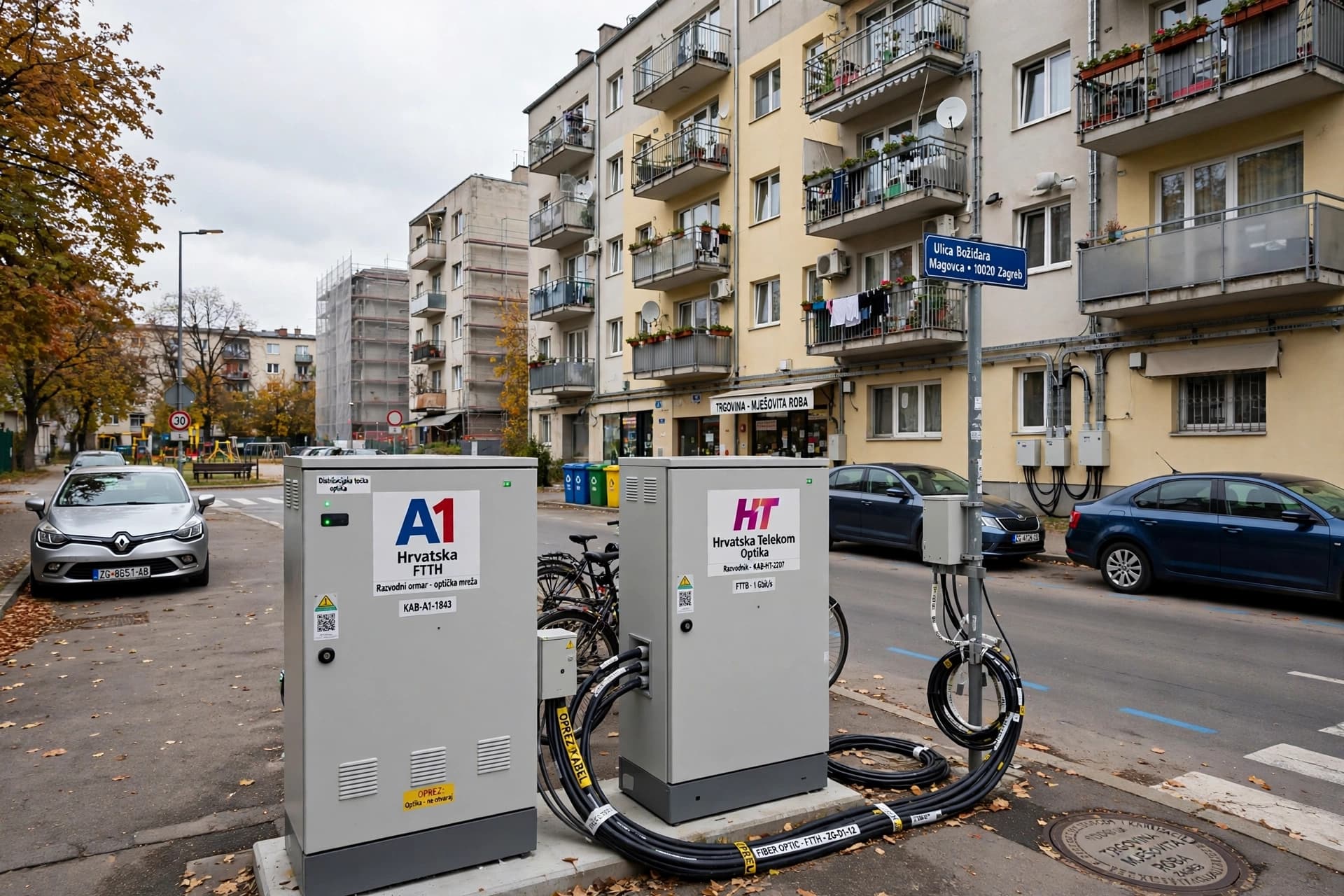
Across Croatia, the physical landscape of communication is gradually changing. Fibre cables extend deeper into neighborhoods, broadband connections increase, and digital services continue to occupy a larger share of everyday life.
That expansion was reflected in Croatia’s electronic communications market during the first half of 2026. The market generated approximately €920 million in revenue, representing a 3.5% increase compared with the same period of 2025, according to Croatia’s telecommunications regulator HAKOM.
The growth was accompanied by continued expansion of high-capacity broadband infrastructure. HAKOM reported that the number of fibre-optic connections reached 523,888 in the second quarter, while the number of very-high-capacity network connections reached 665,267.
At the end of the second quarter, Croatia had 1,208,441 broadband internet connections. The figures illustrate how connectivity is increasingly becoming part of the country's underlying digital infrastructure rather than simply a consumer service.
Another area showing movement was over-the-top, or OTT, television services. HAKOM reported growth in connections using operators’ own OTT services, reflecting the continuing shift toward internet-based distribution of television and entertainment.
At the same time, not every traditional communications service followed the same direction. The regulator said SMS use on mobile networks and outgoing traffic on fixed networks continued to decline. The contrast shows how the telecommunications market is changing through substitution as much as through expansion.
Consumers are increasingly using data connections for activities that once depended on separate communication channels. Messaging applications, streaming platforms, cloud services and online work have gradually changed the way networks are used, placing greater importance on broadband capacity and reliability.
For telecom operators, that creates a continuing need to invest in network infrastructure. Fibre connections can support higher speeds and larger amounts of data traffic, while very-high-capacity networks provide the underlying infrastructure for increasingly data-intensive services.
The Croatian market is also part of a wider European movement toward faster digital connectivity. As households and businesses rely more heavily on cloud applications, video services, digital commerce and remote communication, network infrastructure becomes increasingly connected to economic activity itself.
The first-half figures therefore tell a story larger than a 3.5% increase in revenue. They show a market gradually changing shape, with fibre, high-capacity networks and internet-based services gaining ground while older communication patterns become less central.
Croatia’s telecommunications sector enters the second half of 2026 with that transition continuing. Behind every percentage point is a physical network of cables, towers, data connections and digital services — quietly expanding beneath the country's increasingly connected daily life.
Image Disclaimer:
Visuals are AI-generated conceptual representations of Croatia’s telecommunications infrastructure and are not photographs of specific network installations.
Sources:
SeeNews HAKOM Croatian Regulatory Authority for Network Industries European Commission Croatian Ministry of the Sea, Transport and Infrastructure
Published by Banx Network. This article is part of the Banx decentralized media programme, powered by the BXE token on the XRP Ledger.