High above our heads, in low Earth orbit (LEO) — the region roughly 100 to 2,000 kilometers above Earth’s surface where most satellites and space stations operate — scientists are now warning of an unsettling new reality: just a few days without active control could lead to catastrophic collisions that fundamentally disrupt space operations. According to a recent study, if satellite operators were suddenly unable to command avoidance maneuvers, a major collision between satellites could occur in roughly 2.8 days — a stark indicator of how precarious the orbital environment has become.
This counterintuitive metric — known as the Collision Realization and Significant Harm (CRASH) Clock — reflects the growing density and complexity of LEO. The study’s authors describe the current system as a “house of cards”: thousands of satellites, many part of so-called megaconstellations, weave around each other with tight margins and frequent adjustments required to avoid collisions.
Mega-constellations such as SpaceX’s Starlink alone now number in the tens of thousands of objects in LEO when you include both active satellites and warily tracked debris, and in some orbital “shells” there may be nearly as much debris as active hardware. In this cluttered sky, satellites routinely perform avoidance maneuvers — thousands in the first half of 2025 alone — to maintain safe separation.
But continuous monitoring and control are the only things preventing collisions today. The CRASH Clock estimates the imminent risk if command authority is lost — whether due to a massive solar storm disrupting communications and navigation systems, or extended outages in ground-based tracking. If satellites cannot be steered, positional uncertainty and atmospheric drag — which can increase unpredictably during geomagnetic storms — could rapidly turn close approaches into direct impacts.
Solar activity is not trivial: historical events like the 1859 Carrington Event show that extreme space weather can disrupt electronics and communications over vast regions. If a storm of that scale occurred today, it could knock out control systems for more than three days, potentially launching the CRASH Clock toward catastrophe.
Collision risk in LEO carries consequences far beyond losing a few satellites. The well-known Kessler syndrome — where debris from an initial collision begets more and more fragments in a cascading chain reaction — could render large swaths of orbit unusable for years or decades by increasing the density of fragments that travel at tens of thousands of kilometers per hour.
The implications reach back to life on Earth as well. Modern society relies on satellites for GPS navigation, weather forecasting, telecommunications, environmental monitoring, and more. A dense debris cloud triggered by even a few collisions could devastate these systems, disrupting services people use daily.
Efforts to manage this growing risk include tracking programs that catalog tens of thousands of objects, collision-avoidance coordination between satellite operators, and proposals for international space traffic management rules. But the narrow margin underscored by the CRASH Clock suggests that reactive management alone may soon be insufficient, and highlights the urgency of proactive debris mitigation and coordinated global policy if humanity hopes to sustain safe, long-term use of near-Earth space.
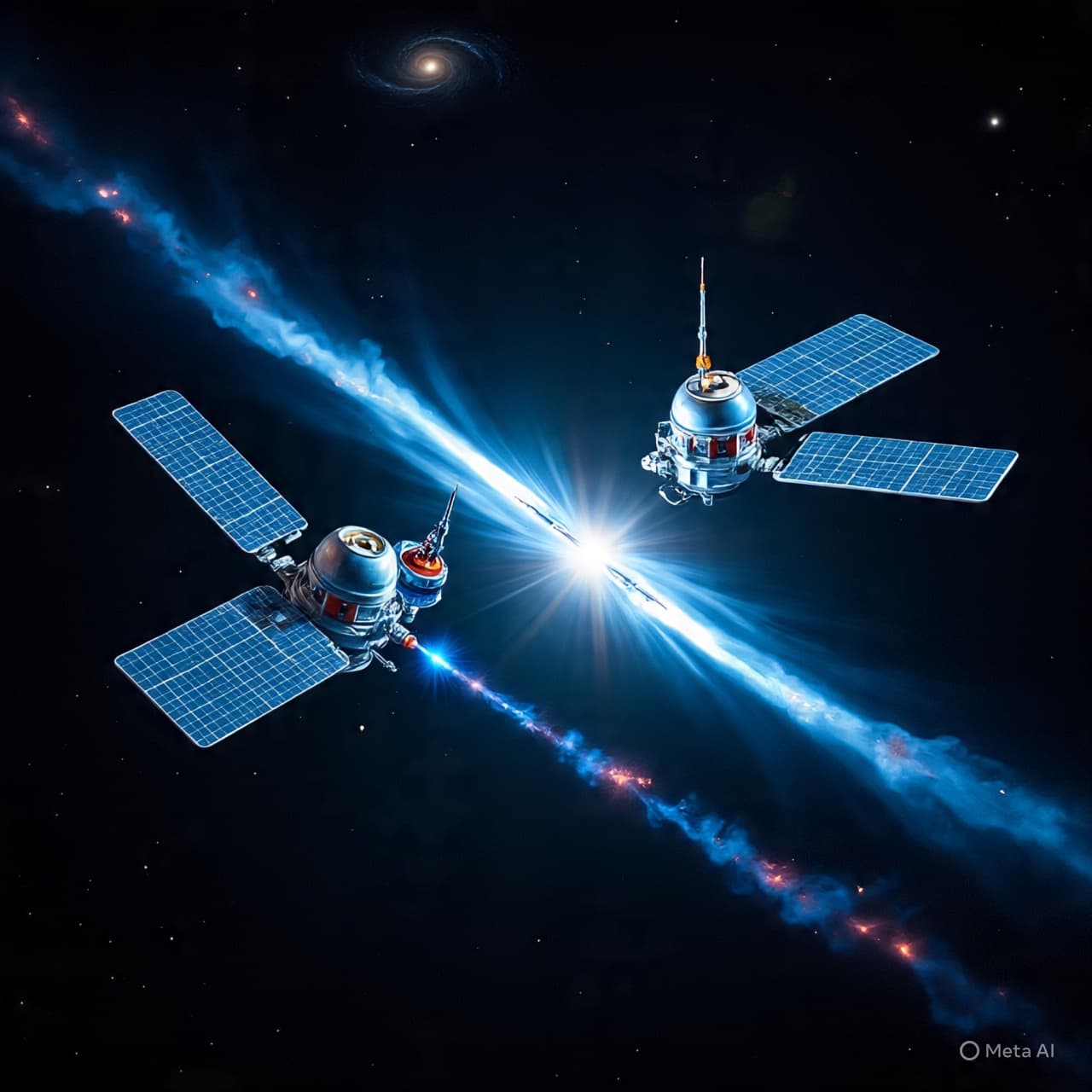
AI Image Disclaimer Visuals in this article are AI-generated illustrations, intended for conceptual representation only; they are not real photographs.
Sources (Credible & Recent)
• Universe Today / Phys.org — 2.8 days to disaster: Why we are running out of time in low Earth orbit.
• Space.com & The Verge coverage of satellite near-miss and orbital congestion.
• ESA space debris risk reporting.
• Wikipedia on Kessler syndrome and space debris ecology.
Published by Banx Network. This article is part of the Banx decentralized media programme, powered by the BXE token on the XRP Ledger.