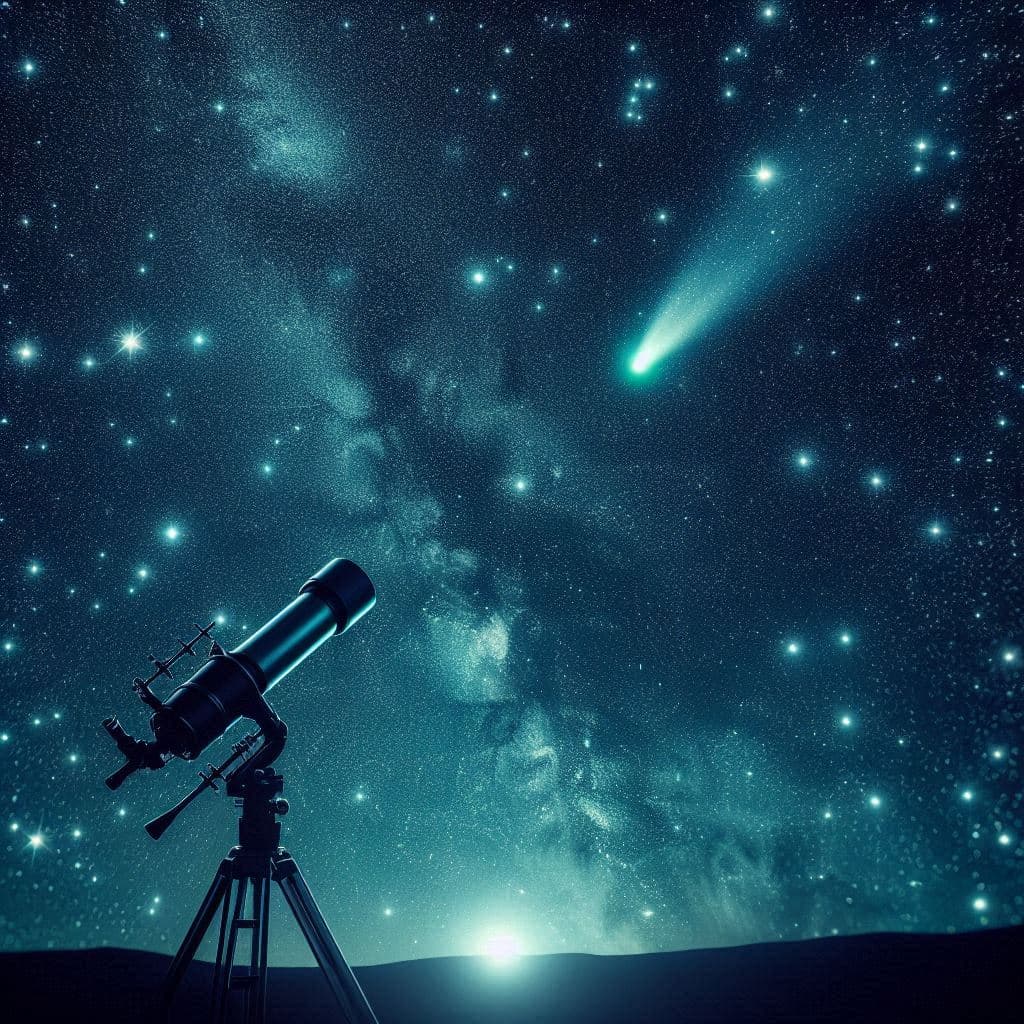
In the early evening of an ordinary December sky, a celestial visitor whispers its passage across the vast ocean of space. Like a lone ship on an endless sea, Comet 3I/ATLAS carries stories from distant realms — silent and steadfast, yet beckoning us to look up and ponder. Its journey, traced across starfields and telescope lenses, offers a quiet reminder of the immensity beyond our everyday horizons, and the shared human tradition of looking outward in wonder.
This week, that interstellar nomad is at a sort of crossroads with our home planet. On December 19, 2025, 3I/ATLAS will make its closest brush with Earth’s solar neighborhood, passing at about 1.8 astronomical units from us — roughly 168 million miles away, a comfortable but meaningful distance in cosmic terms. It is a moment not of drama, but of connection: a chance for astronomers and skywatching enthusiasts alike to glimpse something that was born around another star, perhaps billions of years ago, before it embarked on this long voyage.
Since its discovery on July 1, 2025, by the ATLAS telescopes in Chile, 3I/ATLAS has been the focus of scientific study and wonder. Its interstellar origin — what sets it apart from the familiar comets that circle our Sun — means that every bit of data collected is a rare piece of a much larger puzzle. Scientists point their instruments skyward, tracking the comet’s dimming glow and subtle colors, trying to learn about its makeup and what that tells us about material from beyond our solar neighborhood.
Though unbound by the Sun’s gravity and set on a path back into the deep galaxy, the comet’s presence here is a moment of collaboration: from backyard telescopes to professional observatories, the night sky becomes a shared place of discovery. The comet itself remains too faint to see without optical aid a quiet companion to the stars rather than a blazing spectacle but its passage is still a gift to those who watch and study.
Importantly, this encounter carries no risk to life on Earth. At its nearest, 3I/ATLAS will be well beyond the orbit of Mars and safe in the cosmic expanse, a visitor to our solar neighborhood but not an intruder. Like many great phenomena in nature, its grandeur lies not in threat but in perspective: an interstellar messenger passing quietly by, inviting reflection on our place in the galaxy.
AI Image Disclaimer (Rotated Wording)
“Visuals are created with AI tools and are not real photographs.”
Sources
The Associated Press
Space.com
TimeandDate.com
NASASpaceNews
Wikipedia
Published by Banx Network. This article is part of the Banx decentralized media programme, powered by the BXE token on the XRP Ledger.