In the silent void between stars, there drifts more than just dust and debris; there are the chemical precursors of life itself. For decades, scientists have suspected that asteroids and comets act as cosmic couriers, carrying complex organic molecules across the solar system. Now, thanks to advanced imaging and spectroscopic techniques, we have not only confirmed their presence but captured visual evidence of these intricate compounds on the surfaces of space rocks. This discovery transforms our understanding of the universe from a barren expanse into a vast, chemically rich garden waiting to be explored.
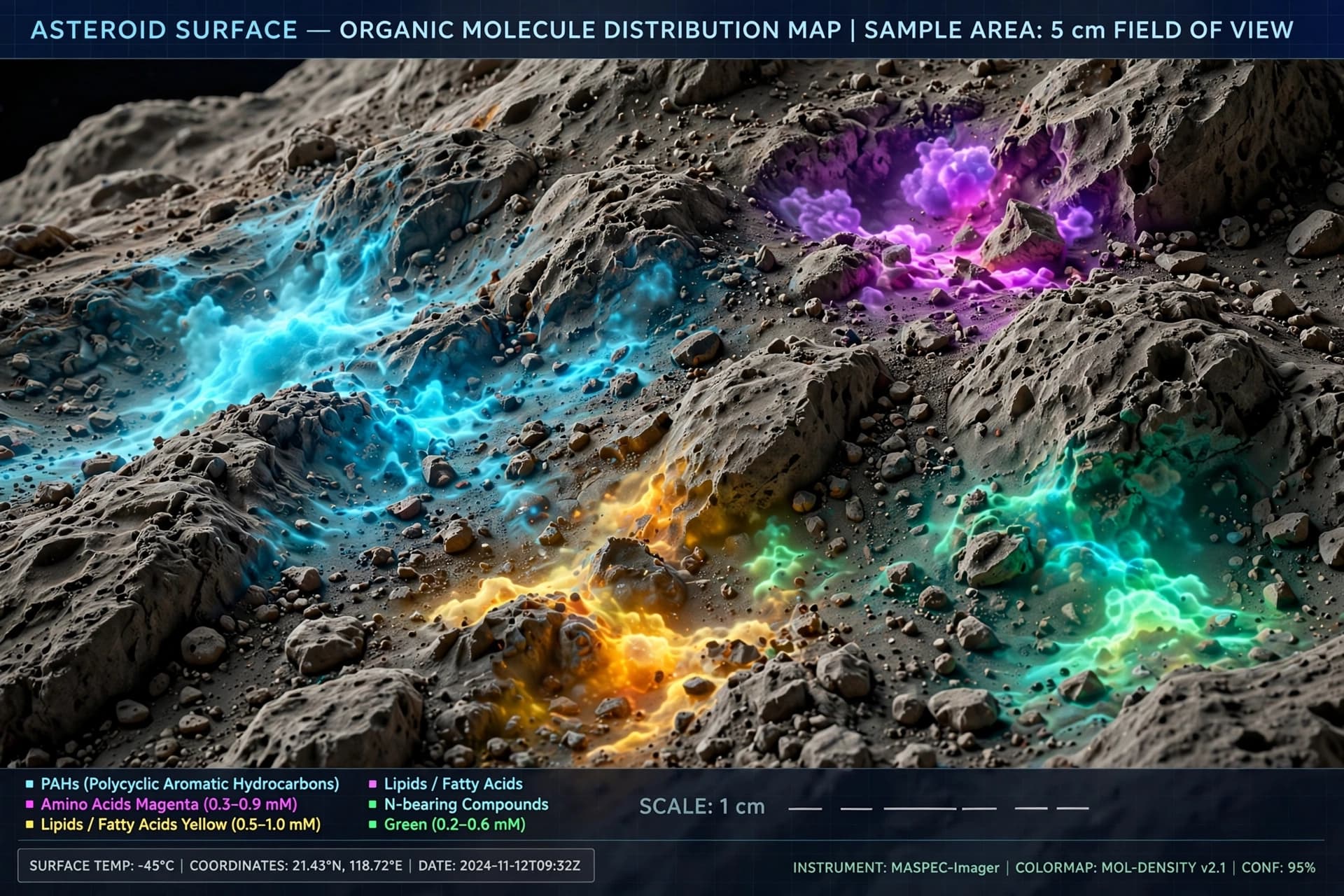
The breakthrough comes from recent missions and observational studies that have analyzed the spectral signatures of various asteroids. By breaking down the light reflected off these rocky bodies, researchers identified distinct patterns corresponding to hundreds of thousands of complex organic molecules. These are not simple carbon chains but sophisticated structures that form the building blocks of amino acids and nucleobases, the fundamental components of life as we know it. The ability to "photograph" these molecules refers to mapping their distribution through high-resolution spectral imaging, creating a visual map of chemical diversity.
This finding significantly bolsters the theory of panspermia, which suggests that the ingredients for life may have been delivered to Earth by extraterrestrial impacts. If asteroids carry such a rich inventory of organics, they could have seeded our planet with the necessary materials for biological evolution billions of years ago. It shifts the narrative of life’s origin from a purely terrestrial event to a cosmic collaboration, where Earth played host to visitors from the deep dark.
The complexity of these molecules is staggering. They include polycyclic aromatic hydrocarbons and other stable compounds that can survive the harsh conditions of space travel, including intense radiation and extreme temperatures. Their preservation on asteroid surfaces suggests that these space rocks act as protective capsules, shielding delicate chemistry from destruction. This resilience offers hope that similar molecules might exist on other worlds, preserved in ice or rock.
For astrobiologists, this is a moment of profound validation. It confirms that the chemistry required for life is not rare or unique to Earth but is a common feature of our solar system. The sheer quantity of molecules detected implies that the universe is teeming with potential. It invites us to look at every asteroid not just as a rock, but as a library of chemical history, holding clues to how matter organizes itself into life.
The technology enabling this discovery represents a leap forward in remote sensing. Instruments aboard spacecraft like OSIRIS-REx and Hayabusa2, as well as ground-based telescopes, have become sensitive enough to distinguish subtle chemical fingerprints. This precision allows scientists to differentiate between various types of organic matter, providing a detailed catalog of what exists in the asteroid belt. It is a testament to human ingenuity in peering into the smallest details of the largest scales.
As we prepare for future sample return missions, these images serve as a guide. They help identify the most promising targets for collection, ensuring that we bring back materials that offer the greatest scientific value. The journey from distant observation to physical analysis is closing, bringing us closer to answering the age-old question of whether we are alone in the universe. The photographic evidence of complex organic molecules on space rocks marks a pivotal moment in astronomy. It reveals a universe far richer in chemical potential than previously imagined. As we continue to explore, each discovery brings us closer to understanding the cosmic origins of life, reminding us that we are made of star stuff, quite literally.
AI Image Disclaimer: The visual representations in this article are AI-generated illustrations depicting spectral mapping and asteroid surfaces, not actual raw data images from specific space missions.
Sources: NASA Goddard Space Flight Center Science Magazine The Planetary Society
Published by Banx Network. This article is part of the Banx decentralized media programme, powered by the BXE token on the XRP Ledger.