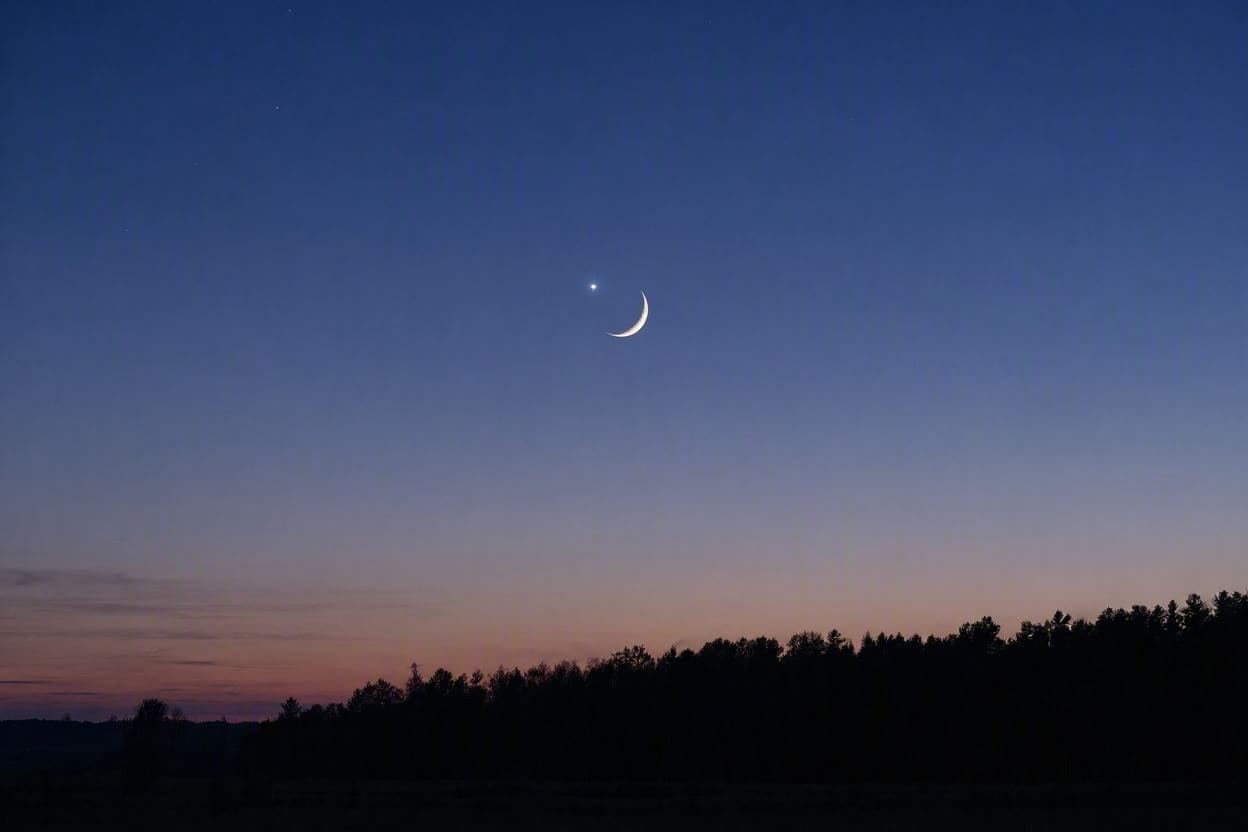
As the sun dips below the western horizon, painting the sky in hues of twilight, a celestial dance begins that has captivated observers for millennia. On this Monday evening, skywatchers are invited to witness a stunning conjunction between the slender crescent Moon and the brilliant planet Venus. This alignment, visible shortly after sunset, offers a moment of quiet beauty and a reminder of the predictable rhythms that govern our solar system.
Venus, often referred to as the Evening Star, is currently near its peak brightness, outshining all other stars and planets in the night sky. Its intense glow is due to its proximity to Earth and its highly reflective cloud cover, which bounces sunlight back into space with remarkable efficiency. When paired with the delicate, earthshine-lit crescent of the Moon, the contrast creates a visually striking scene that is easily visible even from light-polluted urban areas.
The Moon, in its waxing crescent phase, appears as a thin sliver of light, with the rest of its disk faintly illuminated by sunlight reflected from Earth. This phenomenon, known as earthshine, adds a ghostly depth to the lunar surface, allowing observers to see the darkened portions of the moon’s face. The juxtaposition of the bright, sharp Venus against the soft, diffuse glow of the crescent Moon is a testament to the diverse ways light interacts with celestial bodies.
For astronomers and casual observers alike, this event is an opportunity to appreciate the geometry of the inner solar system. Venus orbits closer to the sun than Earth, which is why it never strays far from the sun in our sky, appearing only in the morning or evening twilight. The Moon, orbiting Earth, moves quickly through the zodiac, regularly passing near planets and creating these fleeting but memorable alignments.
Finding the pair is simple. Look to the west-southwest shortly after sunset, when the sky is still bright enough to provide context but dark enough for Venus to shine. The two objects will appear close together, separated by only a few degrees, which is roughly the width of a few fingers held at arm’s length. Binoculars can enhance the view, revealing more detail on the lunar surface and the steady, non-twinkling light of Venus.
Such conjunctions are common, occurring every few months, but each one offers a unique perspective. The changing phases of the Moon and the varying brightness of Venus ensure that no two events are exactly alike. For many, these moments serve as a gentle pause in the day, encouraging a look upward and a connection to the broader cosmos.
As the evening progresses, the pair will set below the horizon, ending the display until their next encounter. But for those who take the time to look up, the memory of this luminous pairing remains. It is a simple pleasure, requiring no equipment other than one’s eyes, yet it offers a profound sense of wonder and continuity with the generations of humans who have watched the same sky before us.
AI Image Disclaimer: The visual representations in this article are AI-generated illustrations designed to convey the beauty of the night sky and planetary conjunctions.
Sources: NASA, Fox Weather, The Planetary Society
Published by Banx Network. This article is part of the Banx decentralized media programme, powered by the BXE token on the XRP Ledger.