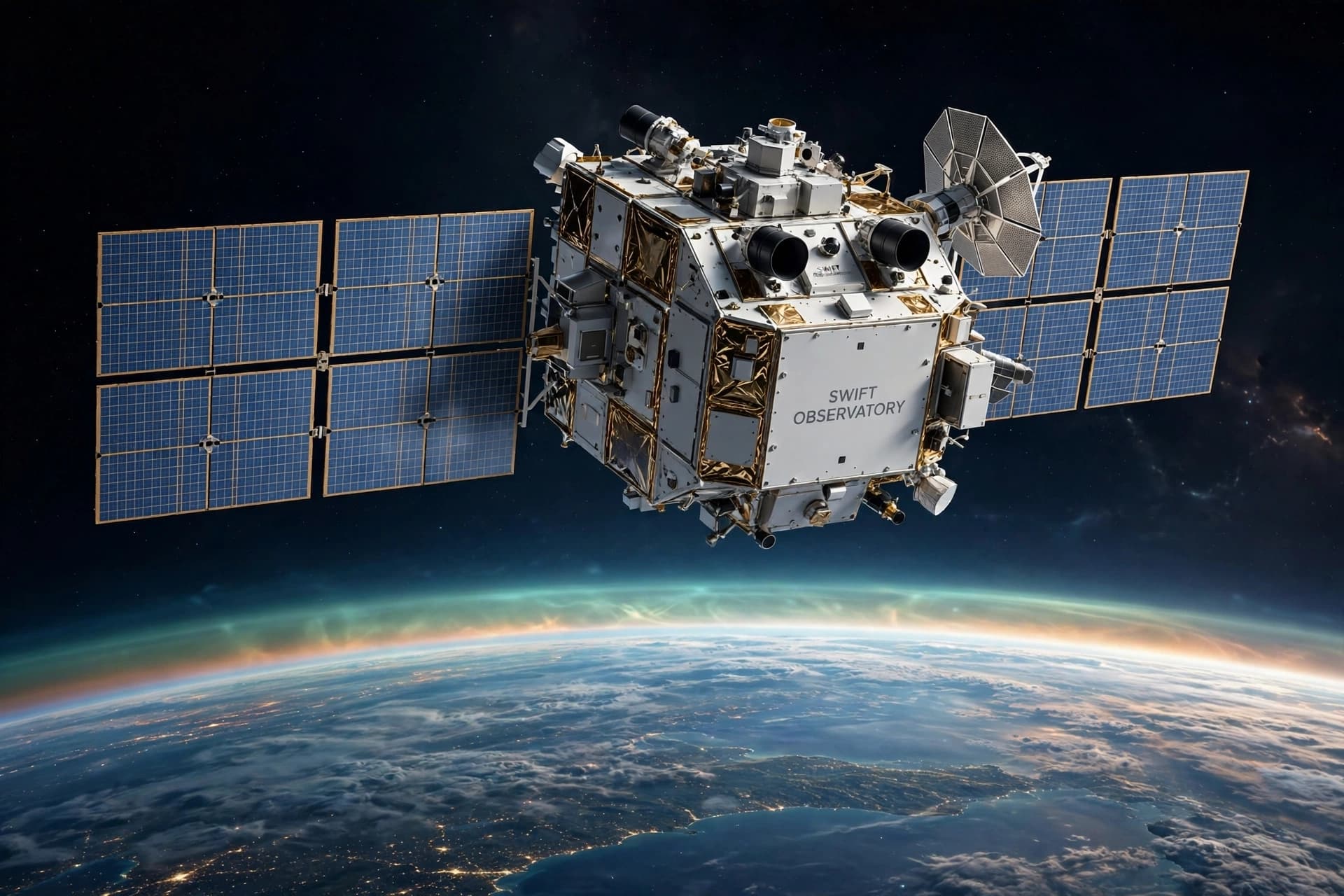
There is a particular sadness in watching something fall. The Swift Observatory has spent twenty-two years watching the universe's most violent events—gamma-ray bursts, the deaths of giant stars, the flashes of light from cataclysmic collisions. It was built to look outward, to catch the briefest signals from the deepest reaches of space. It was not built to be caught.
In August, NASA announced that a high-risk rescue mission to save the aging telescope had failed. The Swift Observatory, launched in 2004, has been steadily losing altitude due to atmospheric drag, intensified by solar activity. NASA predicted it would reenter Earth's atmosphere and burn up once it dipped below an optimal altitude of about 185 miles (300 kilometers) . The agency hired Katalyst Space Technologies, an Arizona-based company, for $30 million to build a rescue spacecraft on an extremely rushed schedule. In about nine months, Katalyst built Link, a refrigerator-sized satellite designed to grab Swift and push it into a higher orbit .
Link launched on July 3. By late July, it had started tumbling. Katalyst regained control, and officials were initially optimistic that the delay would be only a couple of weeks . But the attitude control issues persisted. In August, NASA and Katalyst announced that Link would not attempt the capture and boost. Swift's science mission would come to an end, and the observatory would likely burn up in Earth's atmosphere later this year .
"This is not the outcome we were working toward, but it does not change why this mission was worth attempting," NASA Administrator Jared Isaacman said in a statement . The agency emphasized that the lessons learned from Link's journey would inform future satellite servicing missions. Link will still rendezvous with Swift—not to rescue it, but to demonstrate capabilities that could be used in the future .
Swift's value lies in its versatility. It has served as an astrophysics multitool in low-Earth orbit, quickly pivoting to observe celestial objects and cosmic events as they occur . It has no established observational replacement waiting. The agency will rely on the rest of its fleet of active observatories to fill the gap, and NASA officials said they will continue to prioritize finding new options to react rapidly to cosmic events .
What remains, as Swift's orbit decays, is a kind of quiet arithmetic. A telescope that spent two decades watching explosions will end its life in one—a brief, bright passage through the atmosphere, unseen by most, marked by no ceremony. The science it gathered will outlast it. The capability it helped prove—that a small company could build and launch a rescue mission in nine months—will inform the next attempt, and the one after that.
"We were all hoping for more science from Swift," said Shawn Domagal-Goldman, director of NASA's astrophysics division. "But we knew the takeaways from this mission would be worthwhile either way" .
The telescope will fall. The work continues.
The images in this article are AI-generated and are not actual photographs of the Swift Observatory or the Link spacecraft.
Sources: The New York Times, CNN, NASA
Published by Banx Network. This article is part of the Banx decentralized media programme, powered by the BXE token on the XRP Ledger.