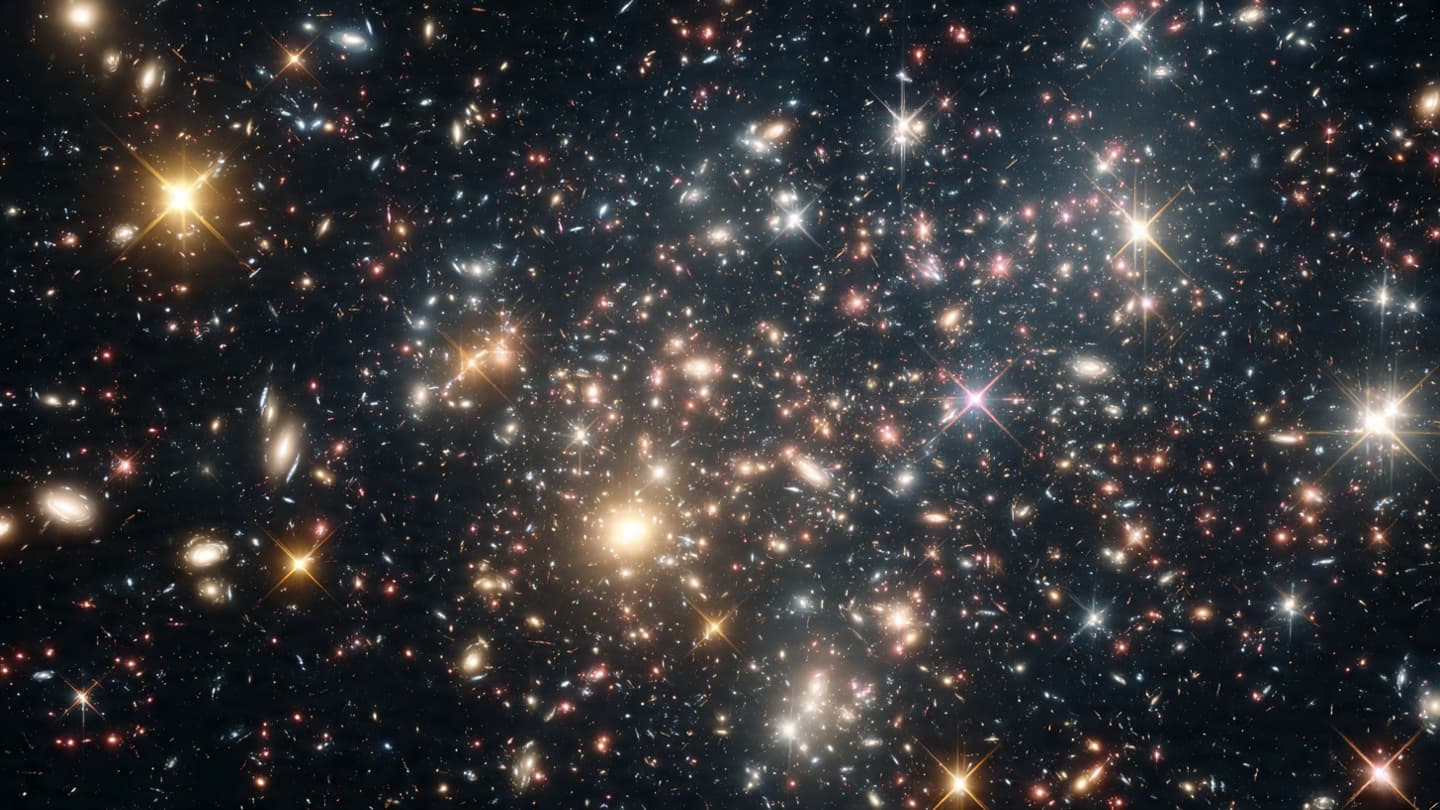
The universe often reveals itself not in single points of light, but in vast gatherings that stretch imagination beyond familiar scales. Like cities seen from a great height, galaxies cluster together across immense cosmic distances, forming patterns that hint at the deeper architecture of space itself. A newly released image from the Hubble Space Telescope offers another glimpse into that extraordinary landscape.
The image captures a massive cluster of galaxies, bringing together countless stars, clouds of gas, and invisible reservoirs of dark matter within a single field of view. While each galaxy contains its own history, the cluster as a whole tells a broader story about the evolution of the universe.
Galaxy clusters are among the largest gravitationally bound structures known to science. Their immense mass allows them to influence surrounding space, shaping the movement of neighboring galaxies and affecting the path of light traveling across the cosmos.
Astronomers use observations like these to better understand how matter is distributed throughout the universe. By studying the arrangement and behavior of galaxies within clusters, researchers can test theories about cosmic evolution and the role of dark matter.
The Hubble Space Telescope has played a central role in such investigations for decades. Since its launch, it has transformed humanity's view of the universe by providing images and measurements that were once impossible to obtain.
One particularly valuable aspect of galaxy clusters is their ability to act as natural gravitational lenses. Their enormous mass can bend and magnify light from more distant objects, allowing astronomers to observe regions of space that might otherwise remain hidden.
Researchers believe these observations may help refine existing models of galaxy formation. Understanding how clusters grow and interact over billions of years remains an important challenge in modern astronomy.
Beyond their scientific value, images of galaxy clusters also offer a visual reminder of the scale of the cosmos. What appears as a single photograph may contain light that began its journey long before human civilization emerged.
As astronomers continue exploring the universe, each new image adds another piece to an ever-expanding puzzle. The latest Hubble observation serves as both a scientific resource and a reminder of how much remains to be discovered beyond our cosmic neighborhood.
AI Image Disclaimer: The supporting visuals for this article are AI-generated interpretations inspired by astronomical observations and should not be mistaken for official telescope imagery.
Source Verification Check: NASA, Hubble Space Telescope mission team, astronomical research institutions
Published by Banx Network. This article is part of the Banx decentralized media programme, powered by the BXE token on the XRP Ledger.