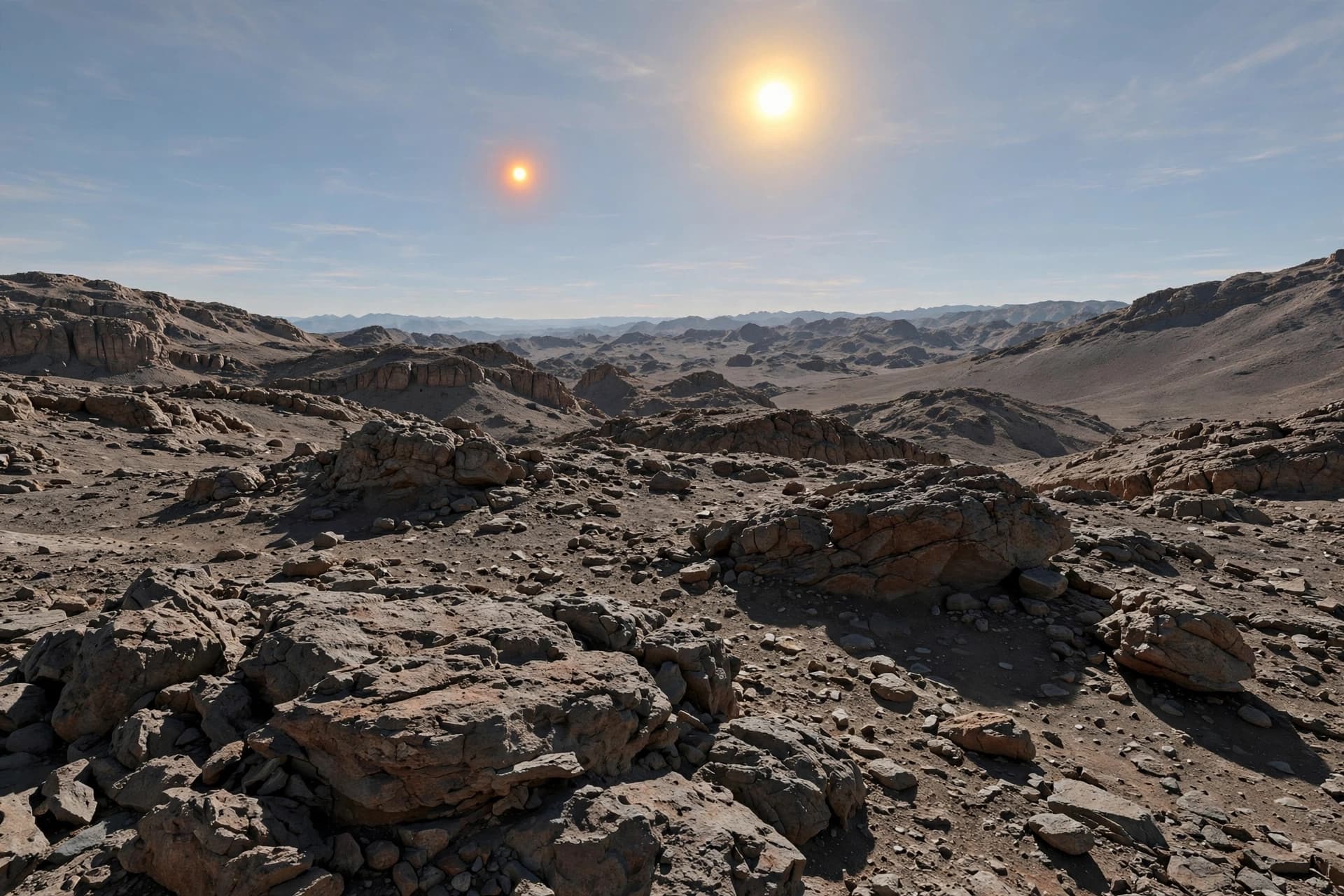
There is a comfort in the singular warmth of our Sun, a solitary star that has cradled life on Earth for billions of years. Yet the universe is not so tidy. More than half of all Sun-like stars are born with companions, orbiting in pairs or small groups, and the question of whether planets could find stable homes in such systems has long intrigued astronomers. New research suggests that there are indeed places between two stars where an Earth-like planet could survive, provided the geometry is right.
The study, published in the Monthly Notices of the Royal Astronomical Society, examined the dynamical stability of terrestrial planets in the Alpha Centauri system—the nearest stellar neighbor to our own, comprising three stars: Alpha Centauri A, Alpha Centauri B, and the distant Proxima Centauri . Using a stability criterion based on the restricted three-body problem, researchers identified regions within the habitable zones of both A and B where hypothetical planets could maintain regular orbits for lengths of time compatible with the evolution of life.
The key finding is that planetary motion inside the habitable zones is regular, regardless of high eccentricities, for inclinations smaller than 40 degrees. The variation of the planet's orbital distance from its host star is comparable to that of Earth, provided the planet is close to what is called a "Mode I stationary solution"—a stable orbital configuration that minimizes the gravitational perturbations from the companion star . This brings positive expectations for finding habitable planets in binary systems.
Earlier work by researchers at the University of Texas at Arlington reached similar conclusions through numerical simulations of terrestrial planet formation. They found that when the periastron of the binary—the closest approach between the two stars—is larger than about 10 astronomical units, terrestrial planets can form over essentially the entire range of orbits allowed for single stars . About 50 percent of binaries are wide enough to permit both the formation and long-term stability of Earth-like planets, the simulations suggested.
The Alpha Centauri system is particularly interesting because it is close enough to observe in detail. Alpha Centauri A and B orbit each other with a period of about 80 years, their separation varying from 11 to 36 astronomical units. Proxima Centauri, a red dwarf, orbits much farther out. The habitable zones of A and B—the regions where liquid water could exist on a planet's surface—are well-defined, and the new research maps the "safe zones" within them where a planet could remain stable for billions of years.
The findings do not guarantee that such planets exist, only that they could. No Earth-like planet has yet been detected in the Alpha Centauri system, though Proxima Centauri hosts at least one planet, Proxima b, which orbits within its star's habitable zone. The search continues, with new instruments and missions planned that could detect smaller planets around these nearby stars. If a stable, Earth-like world were found between two suns, it would be a profound discovery—a second home in a binary embrace, proof that habitability is not limited to the familiar solitude of our own solar system.
AI Image Disclaimer: The visual content in this article was generated by artificial intelligence and is for illustrative purposes only.
Published by Banx Network. This article is part of the Banx decentralized media programme, powered by the BXE token on the XRP Ledger.