There is a particular charm in seeing the familiar from an unfamiliar angle. The Moon, which we have watched for all of human history from the ground beneath our feet, appears differently when viewed from a vantage point that is itself part of the sky. A weather satellite, built to monitor clouds and storms, recently turned its gaze just enough to catch a glimpse of something beyond its usual work.
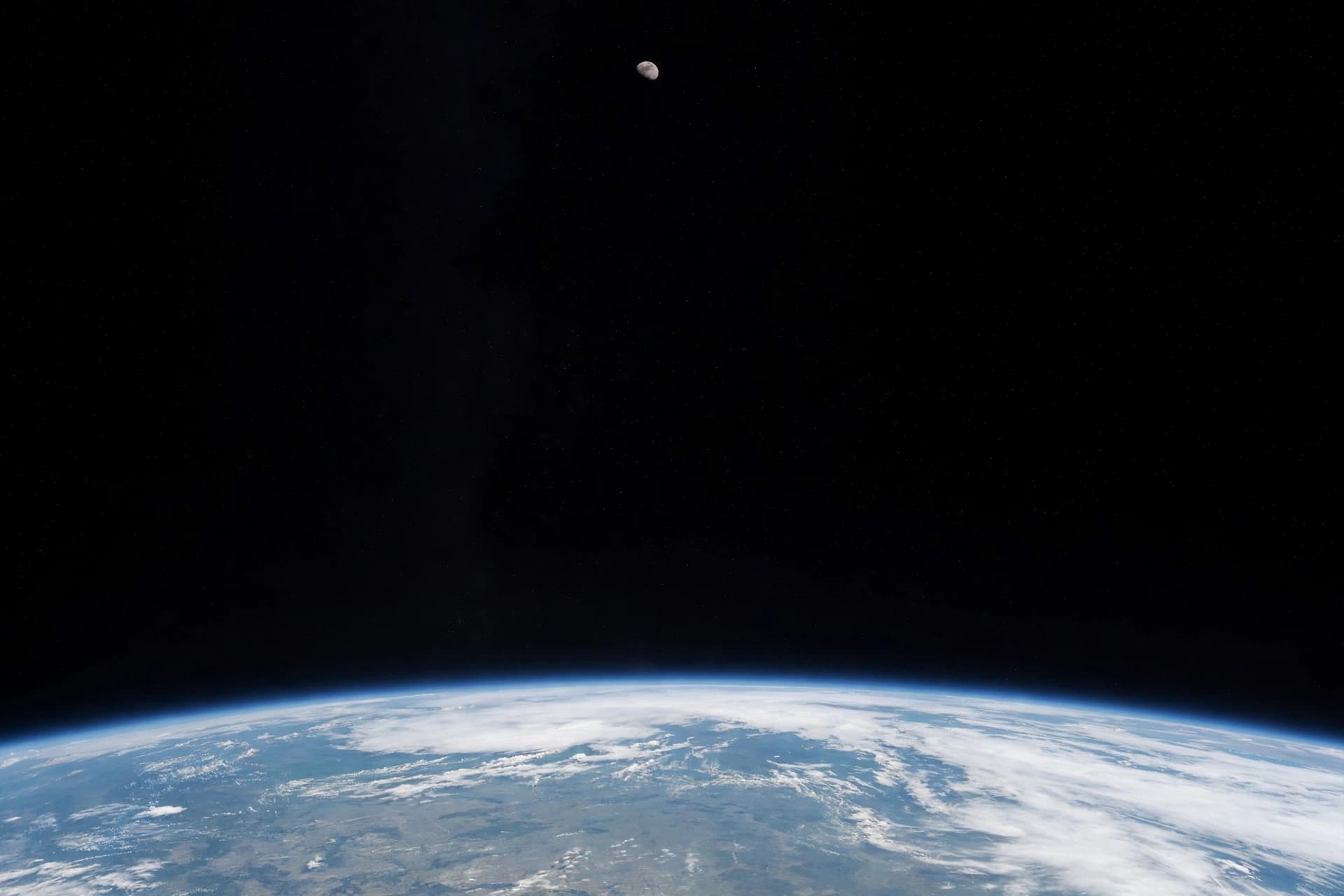
The image was captured by Himawari-9, a geostationary weather satellite operated by the Japan Meteorological Agency. The Cooperative Institute for Research in the Atmosphere at Colorado State University, which processes imagery from the satellite, shared the view on social media on October 24 . The Moon appears as a small, pale disc peeking out from beyond the curve of Earth’s horizon, a quiet visitor in a frame usually devoted to weather systems.
Himawari-9 sits in geostationary orbit, keeping a fixed view over the same region of the Earth as it monitors the atmosphere below . From that height, the Earth fills most of the frame, its curvature visible at the edges, its clouds and oceans rendered in the muted tones of satellite imagery. The Moon, distant and small, seems almost incidental—a reminder that the satellite’s steady gaze is directed at something far larger than the weather.
Such images are not scientific breakthroughs. They do not alter our understanding of lunar geology or atmospheric science. But they offer something else: a shift in perspective, a chance to see the relationship between Earth and its companion from a vantage point that is neither ground nor deep space. The satellite, built for practical purposes, becomes for a moment a witness to something quieter.
CIRA described the image simply, noting that the Moon “peeks out to say hello” . The phrasing is gentle, almost playful, and it fits. There is no urgency in this view, no crisis or discovery. Just a weather satellite, doing its work, and a moon that happened to be in the right place at the right time.
The image joins a small tradition of spacecraft capturing Earth and Moon together—views from deep space probes, from lunar orbiters, from the edges of the solar system. Each offers a variation on a theme: that our world is one among many, and that the space between them is not empty but filled with light and shadow, with the ordinary workings of satellites and the silent passage of moons.
Himawari-9 will continue its watch over the Pacific, tracking storms and clouds, its instruments focused on the atmosphere below. But for one frame, it looked up. And in doing so, it offered a reminder that even the most practical machines can catch moments of unexpected beauty.
Image note: The image described in this article is an AI-generated illustration, not the actual satellite photograph.
Sources: Yahoo, CIRA/Colorado State University, Japan Meteorological Agency
Published by Banx Network. This article is part of the Banx decentralized media programme, powered by the BXE token on the XRP Ledger.