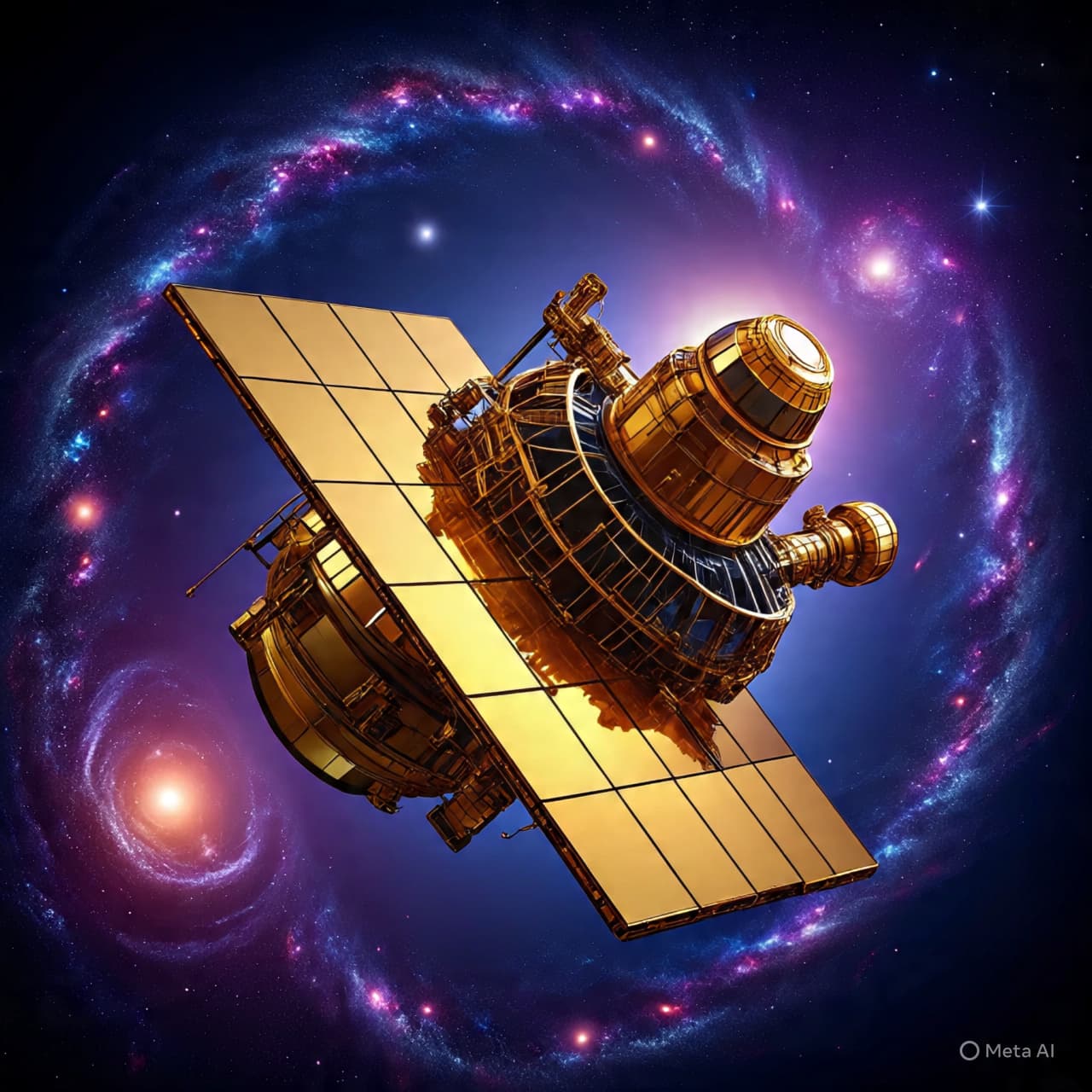
There are moments in astronomy when the universe seems almost anatomical, as if space itself were a living form waiting to be understood. Nebulae drift like luminous organs in the dark, their filaments glowing with memory and motion. When the James Webb Space Telescope turns its golden eye toward such a structure, it is less an act of observation and more a careful incision — not to wound, but to reveal.
Recently, NASA’s James Webb Space Telescope focused its instruments on what astronomers have informally dubbed the “Exposed Cranium Nebula,” a striking cosmic formation whose shape evokes the contours of a skull suspended in space. The name, poetic and slightly uncanny, reflects its visual resemblance rather than any official classification. Yet behind the imagery lies serious science: a detailed investigation into the life cycle of stars and the sculpting forces of stellar winds and radiation.
Using its advanced infrared capabilities, the James Webb Space Telescope — often abbreviated as JWST — captured high-resolution imagery that penetrates dense clouds of dust and gas. Unlike visible-light telescopes, Webb can peer into the obscured interiors of nebulae, detecting faint structures and chemical signatures previously hidden from view. In this case, its instruments mapped intricate arcs, cavities, and shock fronts within the nebula’s expanding shell.
Planetary nebulae form when a dying star sheds its outer layers, releasing material into surrounding space. Over time, stellar winds and radiation shape this ejected matter into elaborate patterns. The so-called Exposed Cranium Nebula appears to display pronounced symmetrical features, giving it the skull-like impression that sparked its nickname. Webb’s observations suggest that interactions between fast stellar winds and slower-moving gas may have carved out the nebula’s hollow “eye sockets” and elongated ridges.
Scientists describe the process metaphorically as a kind of “cosmic surgery,” not because anything is being altered, but because the telescope’s precision allows astronomers to dissect the structure layer by layer. Spectroscopic data collected by Webb helps identify elements such as hydrogen, oxygen, and carbon within the nebula. These elements, forged in the heart of the original star, are now dispersed into space — raw material for future generations of stars and planets.
The data also provides insight into how stars similar in mass to our Sun conclude their lives. By studying the geometry and chemical composition of nebulae like this one, researchers refine models of stellar evolution. They can better understand how mass loss occurs, how radiation interacts with expelled material, and how cosmic dust contributes to galactic ecosystems.
There is something quietly profound in the image: a skull-shaped cloud glowing in infrared hues, born from a star’s final act. It is a reminder that endings in the universe often serve as beginnings. The matter scattered across light-years may one day gather again, forming new systems and perhaps even new worlds.
In practical terms, the James Webb Space Telescope continues to demonstrate its capacity to reveal structures once beyond reach. Its infrared instruments provide clarity where previous telescopes saw only shadows. Each observation adds precision to our cosmic map, filling in details of processes that unfold over millions of years.
NASA scientists note that further analysis of the nebula’s spectral data is ongoing. As researchers continue to interpret the findings, the images offer both aesthetic wonder and scientific value. The telescope’s recent observations deepen understanding of planetary nebula formation while highlighting the intricate architecture shaped by dying stars.
AI Image Disclaimer Visuals are created with AI tools and are not real photographs.
Sources
NASA Space.com BBC News CNN Live Science
Published by Banx Network. This article is part of the Banx decentralized media programme, powered by the BXE token on the XRP Ledger.