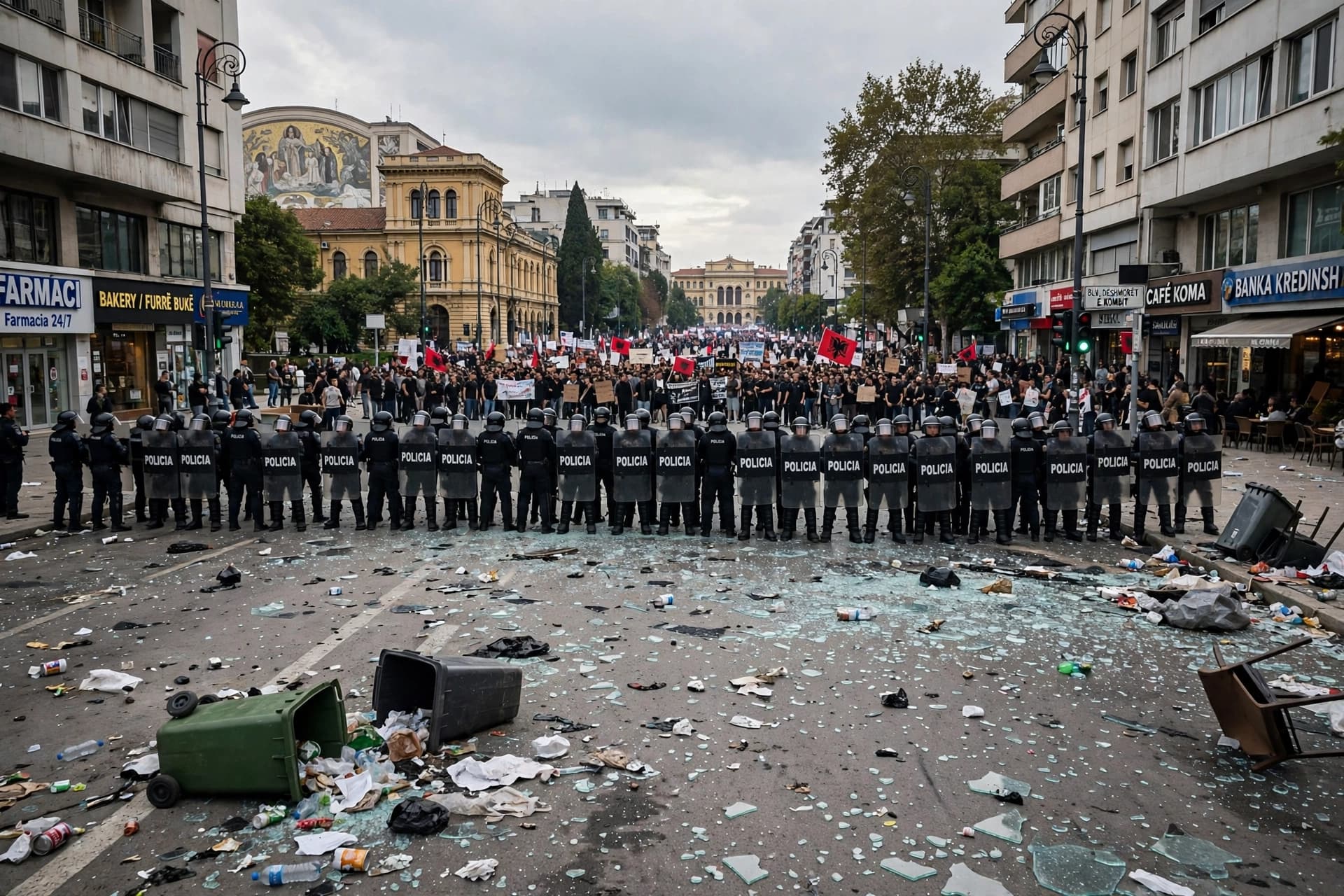
There is a particular stubbornness that settles into a capital after a week of unrest—the shuttered storefronts, the swept-up glass, the pavements stripped of their stones so they cannot be thrown. Tirana has worn that look for six days now, and on Sunday, neither the protesters nor the Prime Minister showed any sign of yielding.
Prime Minister Edi Rama again refused to resign, using a live address on Facebook to reframe the crisis not as a challenge to his government but as a threat to Albania's future. "I am not being challenged, the government is not being challenged," he said. "A path is being challenged, a mission is being challenged" . He then posed a question to the nation: "Albanians need to think very clearly: Do they want this, do they want that, or do they want the EU?" .
The protests began as student-led demonstrations over poor university conditions, high tuition fees, and corruption, but they have expanded into the most serious challenge to Rama's thirteen-year rule . On Sunday, hundreds gathered outside the Education Ministry chanting "Rama, resign" before clashes erupted. Police responded with tear gas, water cannon, and rubber bullets after protesters threw rocks and firecrackers . A police station and the entrance to the Interior Ministry were set on fire, and windows at the Socialist Party headquarters were smashed .
The human toll is substantial. Since Tuesday, 272 people have been injured, including 169 police officers . On Saturday alone, 65 people were hurt, 37 of them police, with 12 hospitalized . The Health Ministry reported that Sunday's clashes added 28 more injuries, including 19 officers, four protesters, four passersby, and a journalist . Police said 388 people had been charged with criminal offenses during the demonstrations .
Rama has blamed "a foreign hand" for the unrest, claiming without evidence that outside interests are fueling the violence . He also invited students to dialogue, even as excavators removed paving stones outside his office in preparation for further protests . The opposition and protesters have dismissed his overtures, demanding accountability for corruption and improved conditions in education and employment .
The European Commission condemned the violence while urging that the response remain "proportionate," noting that "in a candidate country firmly committed to the EU accession process... grievances should be handled through constructive dialogue and in a peaceful manner" . The US embassy in Tirana urged "restraint and calm on all sides" . Albania, alongside Montenegro, is among the Balkan states seeking EU membership by 2030, and Rama has framed the protests as a threat to that ambition rather than to his mandate .
What remains unresolved is whether the anger in the streets can be separated from the question of Albania's direction. For the protesters, the two are inseparable—they see corruption and poor governance as obstacles to the future they want. For Rama, the protests are a distraction from the path he insists he is protecting. Neither framing has produced a resolution, and the seventh day is already being prepared.
AI Image Disclaimer: The images accompanying this article were generated by artificial intelligence and are intended for illustrative purposes only.
Sources: DW, AFP (via Ahram Online, Arab News), Al Jazeera, The Jerusalem Post, RTS
Published by Banx Network. This article is part of the Banx decentralized media programme, powered by the BXE token on the XRP Ledger.