Imagine a room filled with fog so thick that nothing beyond your own hand is visible. Then imagine a light so persistent, so concentrated, that it begins to burn the fog away, not in an instant but over hundreds of millions of years, until the air clears and the first stars stand revealed. This is roughly the story of the universe's reionization, a period when the cosmos transitioned from opaque to transparent, and it has long been one of astronomy's most difficult puzzles. Now, the Hubble Space Telescope has offered a glimpse of one of the lights that did the burning.
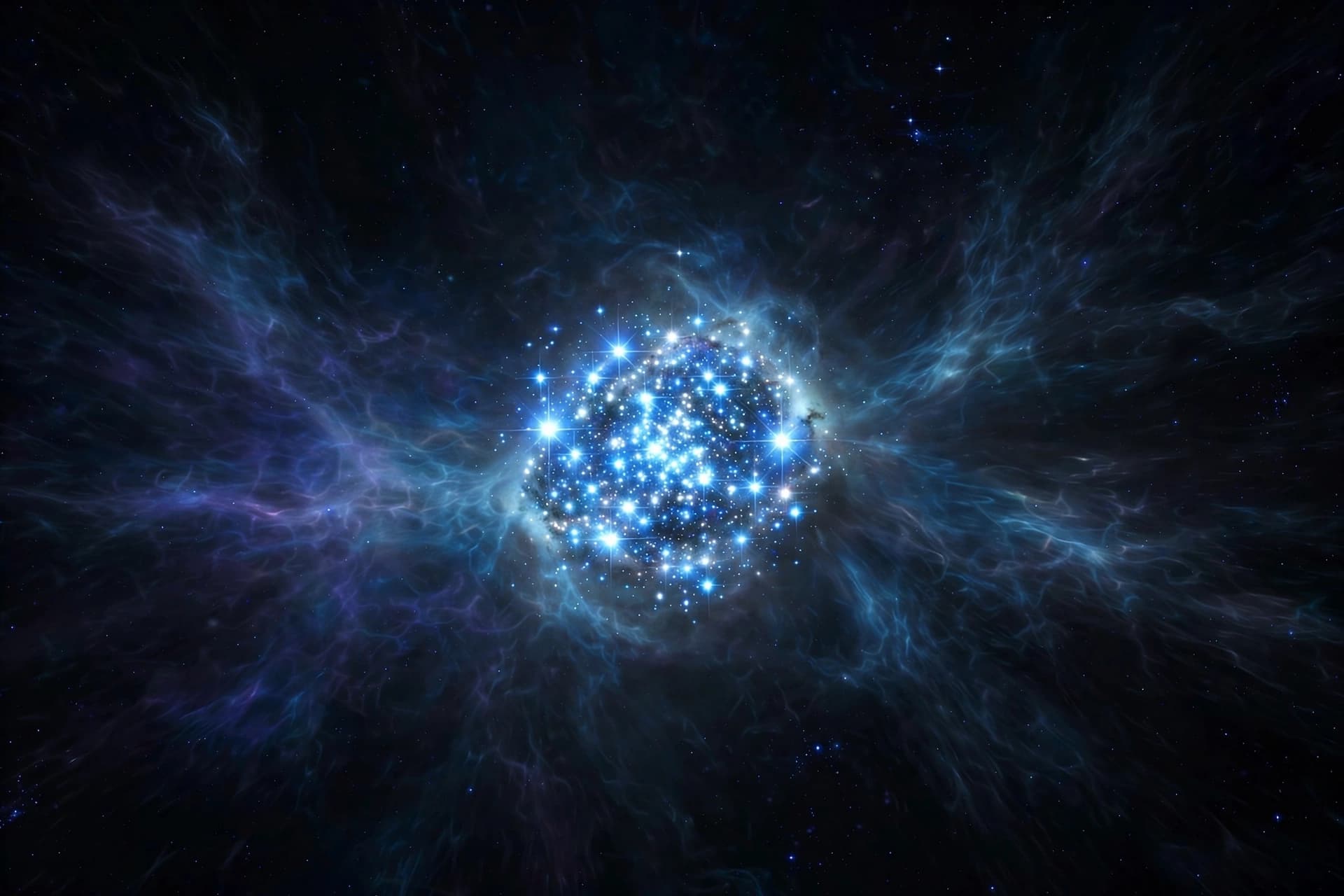
The galaxy is called MXDFz4.4, and it existed roughly 1.4 billion years after the Big Bang, near the end of the reionization era . What makes it remarkable is not its size—it is about one hundred times smaller than the Milky Way—but its intensity. Its young, massive stars are packed tightly together and forming at a rate ten times faster than our galaxy's, producing a flood of ultraviolet light energetic enough to strip electrons from hydrogen atoms. That ionizing light is what clears the neutral fog that once filled the cosmos.
The challenge in observing such a galaxy is that the very fog it helped clear should have blocked our view of it. For years, researchers assumed that the neutral hydrogen of the early universe would be too thick to allow ionizing photons from a galaxy like this to reach us . But Hubble's sensitivity and its vantage point above Earth's atmosphere allowed it to detect the ultraviolet light, redshifted by the expansion of space into visible wavelengths. Ilias Goovaerts, the lead author, described the observation as something thought to be impossible .
The data suggest that between fifty and one hundred percent of the ionizing light produced by MXDFz4.4's young stars is escaping the galaxy's gas . This high escape fraction is likely aided by the galaxy's compactness and its bursty star formation. Massive stars live short lives and explode as supernovae, and those explosions carve cavities in the surrounding gas, creating channels through which light can travel more freely. A hundred small stars in a small space, Goovaerts explained, do a better job of blasting through opaque gas than a scattered population would.
The findings were made possible by combining Hubble's ultraviolet observations with data from the James Webb Space Telescope in infrared and the Very Large Telescope in visible light . Each instrument contributed a different piece of the picture: Webb helped determine the galaxy's mass and star formation history, the VLT pinpointed its distance, and Hubble captured the ionizing light itself. The collaboration reflects a broader pattern in modern astronomy, where no single observatory can answer a question of this scale alone.
What makes MXDFz4.4 particularly valuable is its timing. Before this discovery, researchers had identified only a handful of galaxies emitting ionizing light, and most existed later in cosmic history, when the universe was already largely transparent. MXDFz4.4 sits at the tail end of reionization, a moment when the fog was thinning but not yet gone . It offers a direct look at the process in action, rather than its aftermath.
The larger question of how reionization unfolded remains open. Was it driven by many small galaxies like this one, or by fewer, larger sources? What role did quasars play? How did the process vary across different regions of space? MXDFz4.4 does not answer these questions, but it provides a data point that constrains the possibilities. It is a single lamp in a vast and fading fog, and from its light, researchers can begin to infer the shape of the room.
The universe, in its earliest ages, was not dark in the way we usually mean. It was full of light that could not travel far, trapped and scattered by the gas around it. The galaxies that broke that trap did so not with a single flash but with a long and cumulative effort, generation after generation of stars burning through the fog. Hubble has now seen one of those galaxies directly, and in its ultraviolet glow, there is a hint of how the cosmos became transparent.
Image note: The images accompanying this article are AI-generated and do not represent actual Hubble observations.
Sources: ESA/Hubble, NASA/STScI, The Astrophysical Journal
Published by Banx Network. This article is part of the Banx decentralized media programme, powered by the BXE token on the XRP Ledger.