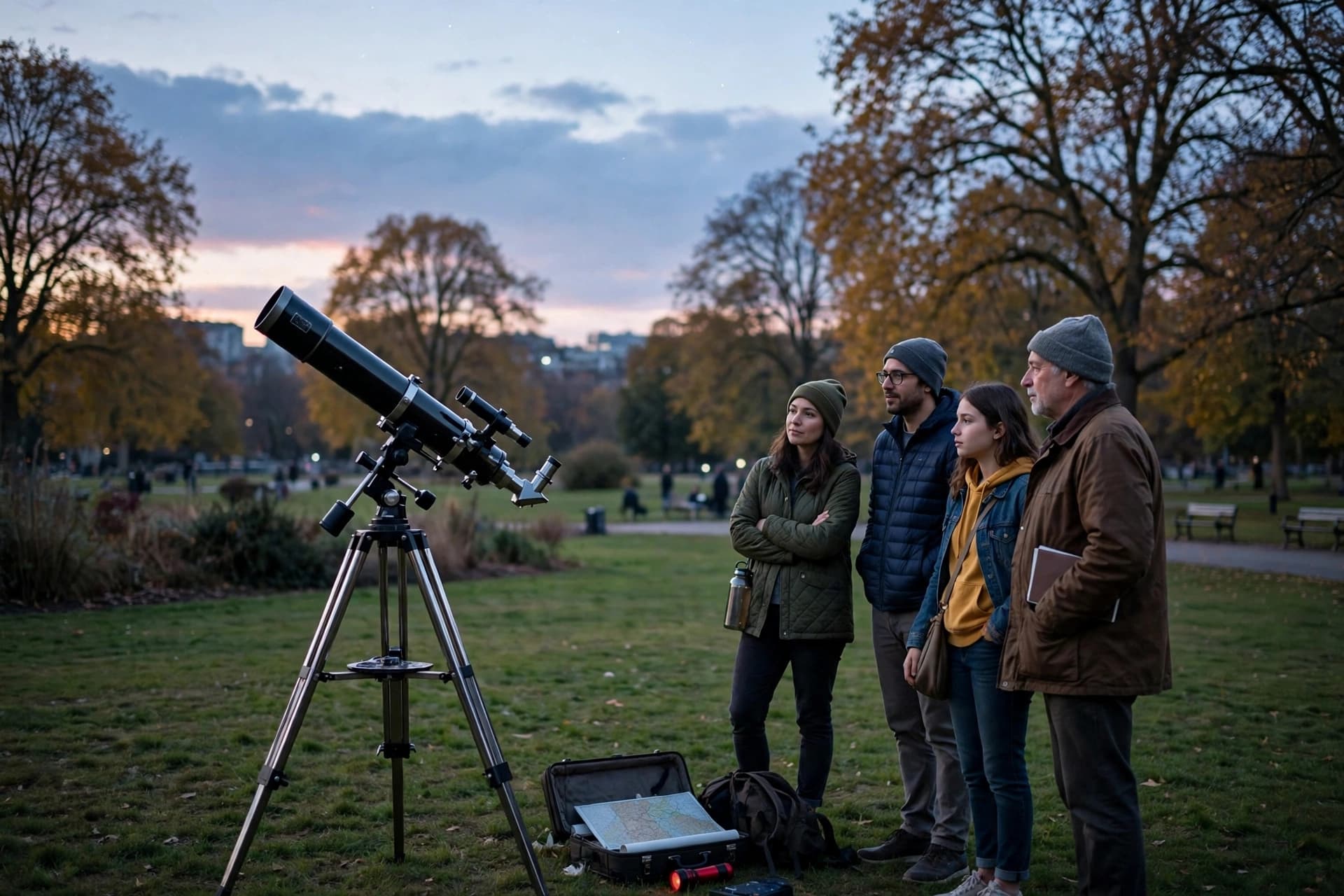
There is a particular kind of generosity that asks nothing in return but your attention. It is the generosity of someone who has looked through a telescope at a ringed planet hanging in the dark and decided that others should see it too. In Chatham, a man has made that decision, and the result is an invitation to the public: come, look, and let Saturn be more than a photograph or a word in a textbook.
The details of the event are modest, as such offerings tend to be. A telescope, an evening, a location where the sky is dark enough and the horizon clear enough. But the invitation carries a weight that is easy to overlook in an age when images of Saturn are a search query away. To see the rings with one's own eye—to watch the planet shift in the eyepiece as the Earth turns, to wait for a moment of steady air—is a different kind of knowing. It is the difference between seeing a photograph of a place and standing in it.
Saturn is, for many, the first object in a telescope that produces something like wonder. The rings are real, visible, and strange. They resolve the planet from a bright point of light into a small, tilted disk encircled by a thin band, and the sight has been known to draw gasps from people who had no particular interest in astronomy before they looked. It is not a dramatic object in the way that a nebula or a galaxy might be. It is quiet, precise, and stubbornly itself.
For the man offering the view, the motivation is likely simpler than any philosophy of science. Amateur astronomers are, as a group, among the most patient and generous of enthusiasts. They set up their equipment in parks and parking lots, they explain what you are seeing, they adjust the focus for your eyes, and they ask nothing but that you look. The tradition is old, and it persists because the experience of shared discovery is its own reward.
There is something worth noting in this small act of civic offering. In a season of news that often arrives with weight and complication, an invitation to look at Saturn is an invitation to pause. It does not solve anything. It does not argue a position or advance a cause. It simply says: here is something beautiful and far away, and you are welcome to see it.
For those who attend, the evening will likely be brief and unceremonious. There will be a line, perhaps, or a small cluster of people waiting their turn. Someone will ask a question about the rings, and the answer will involve ice and rock and distance. A child will look and say something obvious and true. And then the line will move, and the next person will bend to the eyepiece, and Saturn will be there, waiting as it has been for billions of years, to be seen again.
Image Disclaimer: The visual for this article was created by artificial intelligence and is not a photograph of the actual event or the organizer.
Sources: Local community reporting (Chatham)
Published by Banx Network. This article is part of the Banx decentralized media programme, powered by the BXE token on the XRP Ledger.