
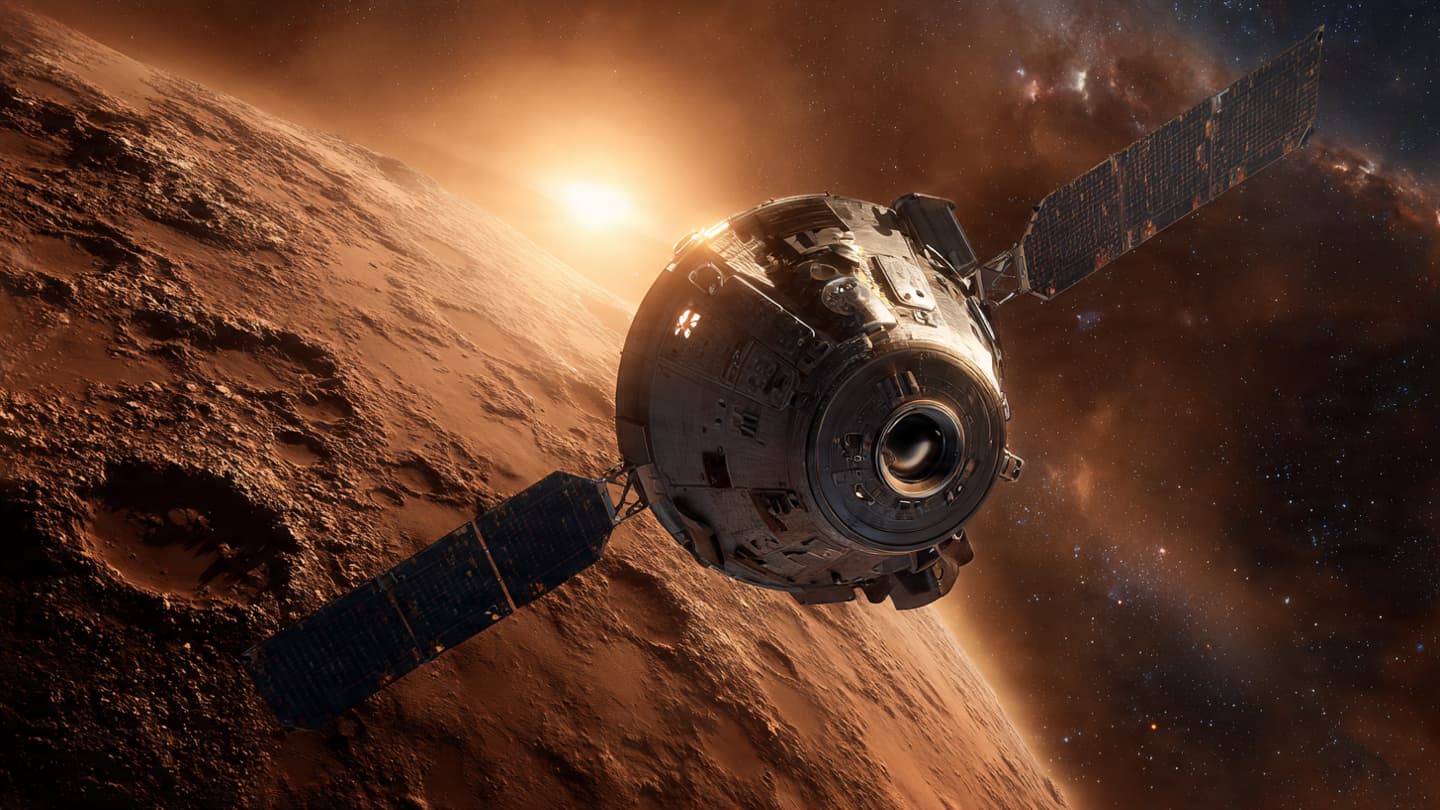
Space exploration often unfolds not in dramatic moments alone, but through long periods of patience and quiet precision. Millions of miles from Earth, NASA’s Psyche spacecraft recently completed a crucial flyby of Mars as it continues its years-long journey toward one of the solar system’s most unusual destinations—a rare metal-rich asteroid known simply as Psyche.
The spacecraft used Mars’ gravitational pull to adjust its trajectory and gain additional speed, a technique commonly called a gravity assist. By carefully navigating near the planet, mission engineers were able to conserve fuel while redirecting the spacecraft deeper into the asteroid belt located between Mars and Jupiter.
Scientists are especially interested in asteroid Psyche because it differs significantly from many rocky or icy asteroids previously studied. Researchers believe the object may contain large amounts of iron and nickel, raising the possibility that it could represent the exposed core of an ancient protoplanet formed during the early solar system.
Understanding such an object could provide valuable insight into planetary formation. On Earth and other rocky planets, metallic cores remain buried beneath thick layers of crust and mantle. Psyche may offer scientists a rare opportunity to study material similar to a planetary core directly, without drilling through an entire world.
NASA officials described the Mars flyby as a major technical milestone for the mission. During the maneuver, engineers also tested several onboard systems while capturing images of Mars from space. The data collected will help ensure the spacecraft remains stable and fully operational during the remainder of its journey.
The mission reflects a broader era of increasingly ambitious robotic exploration. Space agencies around the world continue launching spacecraft toward asteroids, moons, and distant planets in an effort to better understand how the solar system evolved billions of years ago.
Public fascination with asteroid missions has grown steadily over recent decades. Once viewed mainly as isolated rocks drifting through space, asteroids are now recognized as important scientific records preserving clues about the earliest stages of planetary history. Some researchers also study them for future resource potential and planetary defense strategies.
Psyche itself is expected to reach its destination later this decade. Once in orbit around the asteroid, the spacecraft will conduct detailed mapping and chemical analysis using advanced scientific instruments designed to examine surface composition, magnetic properties, and geological structure.
For now, the spacecraft continues moving silently through deep space, carrying with it a small but remarkable extension of human curiosity. In the darkness between planets, missions like Psyche remind the world that exploration often advances one careful step at a time.
AI Image Disclaimer: Certain space visuals in this article were generated using AI-assisted imagery to illustrate astronomical environments.
Sources: NASA, Associated Press, Space.com, Jet Propulsion Laboratory, Scientific American
Published by Banx Network. This article is part of the Banx decentralized media programme, powered by the BXE token on the XRP Ledger.



