The Moon has always been a keeper of memories. Its surface, untouched by wind or rain, preserves the marks of passing time with quiet patience. Footprints linger for decades, shadows remain fixed, and even the smallest objects can rest undisturbed for generations. Now, within this vast and silent archive, scientists believe they may have glimpsed a forgotten visitor, resting exactly where history left it.
In early 1966, the Soviet spacecraft Luna 9 became the first human-made object to achieve a soft landing on the Moon. It transmitted grainy but revolutionary images back to Earth, offering humanity its first close look at another world’s surface. Then, after only a few days of communication, Luna 9 fell silent. Its mission ended, and its exact resting place slowly faded from record, becoming a footnote in the long story of space exploration.
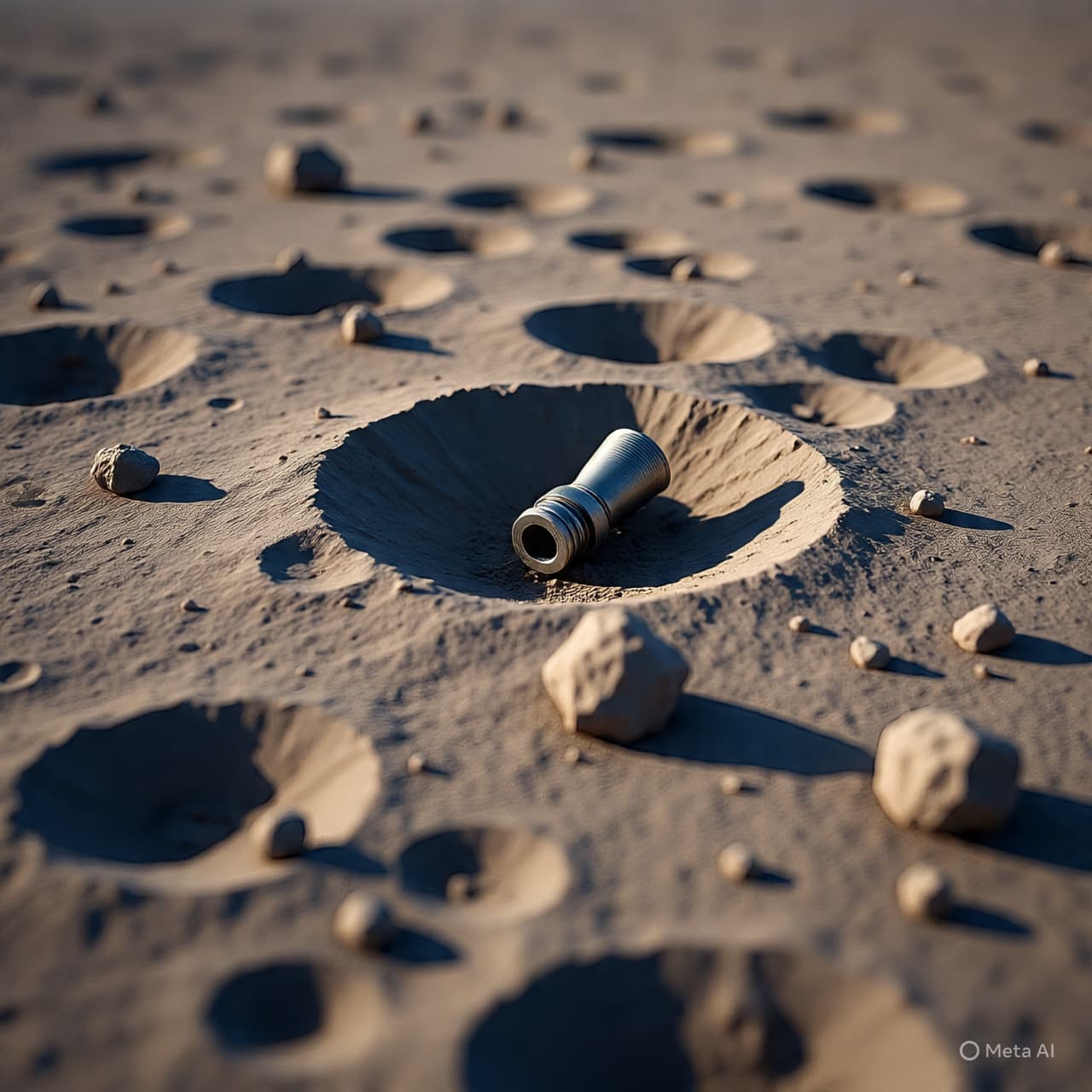
Decades later, NASA’s Lunar Reconnaissance Orbiter continues its steady survey of the Moon, capturing extraordinarily detailed images of the lunar surface. Among the countless craters, boulders, and shadows, researchers recently identified a small, unusual feature near the Procellarum region, close to where Luna 9 was believed to have landed. The object’s size, shape, and reflectivity appear consistent with a spacecraft resting on the lunar regolith.
The identification is cautious rather than conclusive. At such scales, a single bright pixel or shadow can suggest many things. Yet the location aligns closely with historical landing estimates, and nearby disturbances in the soil resemble patterns expected from a descent and impact sequence. The Moon, it seems, may have preserved the moment more faithfully than any archive on Earth.
This possible rediscovery bridges two eras of exploration. Luna 9 emerged during the early days of the space race, when engineering courage often outpaced certainty. The Lunar Reconnaissance Orbiter belongs to a quieter age of precision mapping and long-term observation. Together, they form a dialogue across time, connecting analog ambition with digital clarity.
If confirmed, the sighting would not alter scientific understanding of the Moon, but it would add texture to its human story. It would remind us that space exploration is cumulative, layered with efforts that do not disappear when missions end. They remain, sometimes unseen, waiting for better eyes and patient inquiry.
NASA researchers continue to analyze imagery, comparing angles, lighting conditions, and historical data. Further observations may help strengthen or revise the identification. For now, the finding remains a careful possibility rather than a declaration.
Still, there is something quietly powerful in the idea that a small machine, sent across space six decades ago, may still be resting where it first touched another world. The Moon has not forgotten it. And perhaps, with time and careful study, neither will we.
AI Image Disclaimer “Graphics are AI-generated and intended for representation, not reality.”
Credible Sources (media names only):
NASA Reuters Space.com Phys.org Scientific American
Published by Banx Network. This article is part of the Banx decentralized media programme, powered by the BXE token on the XRP Ledger.