There is a particular kind of wonder that comes from watching something vast unfold in miniature—a cosmos poured into a supercomputer, a history written in particles and light. For decades, astronomers have pieced together the early universe from fragments: a microwave background here, a distant galaxy there, a theoretical model that strained to hold the pieces together. Now, a new simulation called Lumina offers something closer to a continuous narrative.
Developed by researchers at MIT, Harvard, and collaborating institutions, Lumina is the largest cosmological radiation-hydrodynamics simulation of its kind ever created. It follows a cube of space roughly 1.5 billion light-years on each side through the universe’s first two billion years, tracking dark matter, gas, stars, and radiation as they interact across scales both cosmic and intimate . The work was published in the Monthly Notices of the Royal Astronomical Society.
What makes Lumina remarkable is not merely its size, though it covers over 100 times the volume of previous comparable simulations. It is the first to capture both hydrogen and helium reionization as they unfolded, allowing the effects of each to feed back into the evolving model in real time . Hydrogen reionization, driven by ultraviolet light from early galaxies and stars, lifted the veil of neutral gas that had shrouded the cosmos since the dark ages. Helium reionization, which required far more energetic radiation from accreting supermassive black holes, followed later, its higher-energy photons stripping electrons that were held more tightly .
The simulation required more than 15,000 graphics processing units running on Frontier, one of the world’s fastest supercomputers, at Oak Ridge National Laboratory . Its half-trillion individual elements resolve the formation of individual galaxies while simultaneously modeling the reionization of gas across vast distances—a dual perspective that previous simulations could not achieve.
For the scientists involved, Lumina is less a final answer than a laboratory for testing theories. The James Webb Space Telescope has opened the early universe to direct observation, revealing galaxies that sometimes appear brighter, more massive, or more structured than models predicted. Lumina offers a way to translate theory into predictions that can be compared with those observations . Where they match, confidence grows. Where they diverge, new questions emerge.
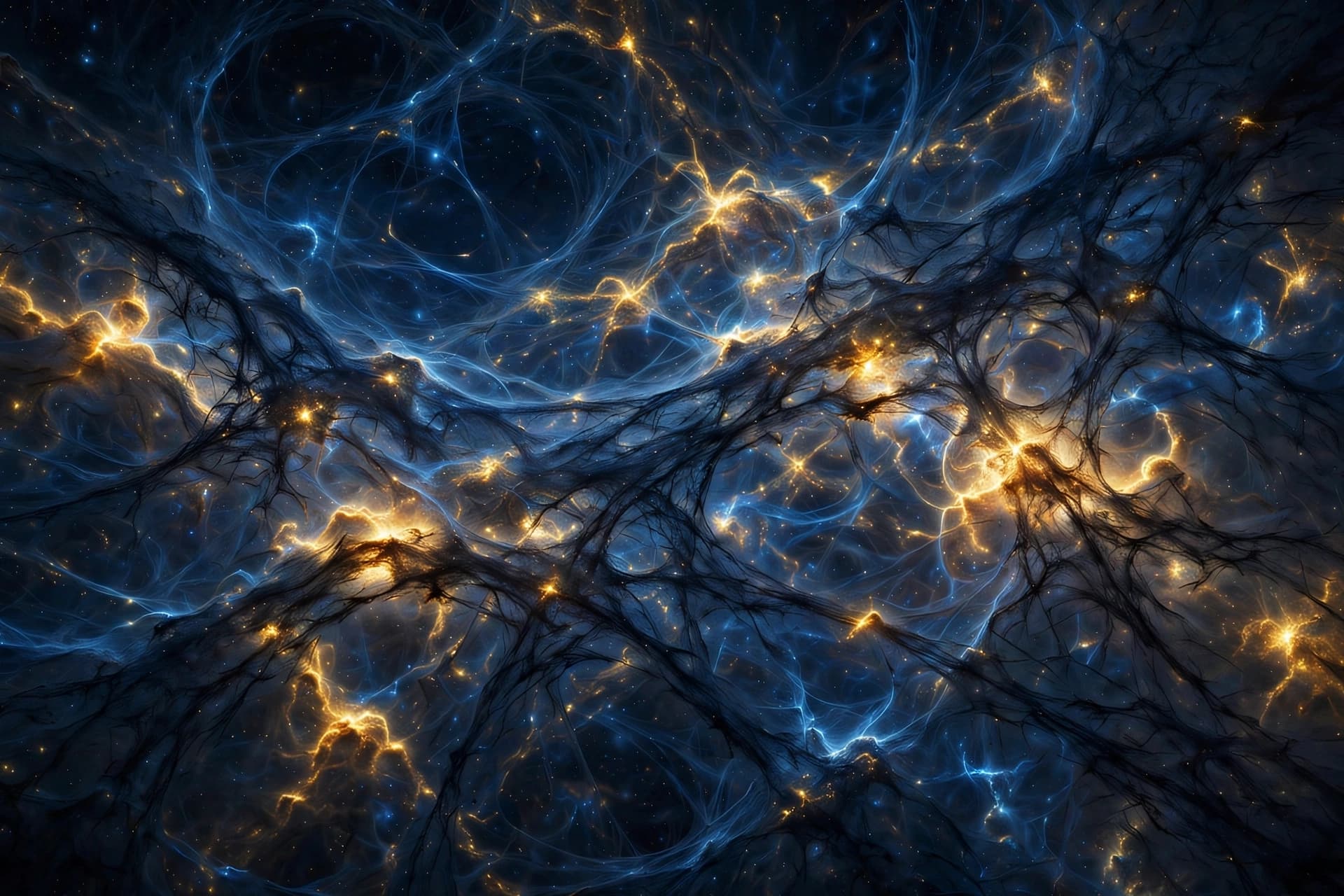
There is something quietly moving about this enterprise. The universe’s first billion years were a time of transformation on a scale almost impossible to imagine: hydrogen atoms split apart by starlight, helium stripped by the fury of black holes, the first galaxies assembling from filaments of dark matter. Lumina does not make these processes simpler. It makes them visible, which is a different kind of understanding.
The researchers have made the simulation available to the scientific community, and its outputs—images, videos, data—invite both scrutiny and wonder . What emerges is not a perfect replica of creation, but a carefully constructed shadow of it, precise enough to argue with, rich enough to learn from.
In the end, Lumina is a testament to a patient kind of science: the willingness to build something enormous and intricate, not to prove a point, but to ask better questions. The early universe, it seems, is no longer content to remain in the dark.
Image note: The visuals accompanying this article are AI-generated illustrations and do not represent actual simulation output.
Sources: MIT News, Smithsonian Institution, Monthly Notices of the Royal Astronomical Society, Universe Space Tech, Daily Mail
Published by Banx Network. This article is part of the Banx decentralized media programme, powered by the BXE token on the XRP Ledger.