There is a particular kind of patience required to photograph the sky—the willingness to wake before dawn, to drive hours into darkness, to wait for a moment that lasts less than a second and may not come at all. For AJ Smadi, that patience was rewarded on a Sunday morning north of Seattle, when the International Space Station streaked past Jupiter and, for a brief instant, the two objects appeared to share the same small patch of sky.
The photograph, captured at 6:03 a.m. Pacific time in Burlington, Washington, shows the ISS as a bright, structured silhouette passing directly beside Jupiter, with the gas giant's cloud bands and four Galilean moons visible in the same frame . The coincidence of scale is striking: Jupiter is approximately 1.3 million times wider than the space station, but it was also approximately 1.3 million times farther away at the moment of capture, making the two objects appear nearly identical in angular size .
Smadi had been planning the shot for nearly two years. Roughly once a month, he checked the ISS's orbital path to see whether it would pass close enough to a planet to align from a location within Washington State . This particular transit—the ISS passing Jupiter—was the culmination of that methodical search. He calculated the exact observation point, drove over an hour north of Seattle, and set up a 9.25-inch Celestron Schmidt-Cassegrain telescope with a ZWO ASI662MC camera and a UV/IR filter to capture the pair .
The resulting image is not a composite of separate exposures stitched together after the fact. It is a single frame, captured in the brief window when the ISS's path crossed Jupiter's position. Within that frame are seven human beings aboard the station—Jessica Watkins, Luke Delaney, Joshua Kutryk, Sergey Teteryatnikov, Pyotr Dubrov, Anil Menon, and Anna Kikina—and, far beyond them, a detailed view of Jupiter's storms and belts, accompanied by the moons Io, Europa, Ganymede, and Callisto .
Smadi calls the ongoing project "ISS Meets." He has previously photographed the station alongside Venus, Saturn, and Mars, and believes he holds the only known ISS-Venus transits ever recorded . Mercury is the only planet remaining on his list, aside from the distant Uranus and Neptune. The work is a form of astronomical portraiture, an attempt to place human infrastructure and celestial bodies in the same visual sentence, to remind the viewer that the space station is not somewhere else—it is here, moving through the same sky we see, passing the same planets we watch.
For most people, the ISS is a point of light, a moving star noticed briefly on an evening walk. In Smadi's photograph, it becomes something more specific: a machine with people inside it, crossing the face of a world that has been watched for all of human history. The image is a technical achievement, but it is also a quiet act of perspective, a reminder of how much can be seen when someone is willing to wait for the right moment.
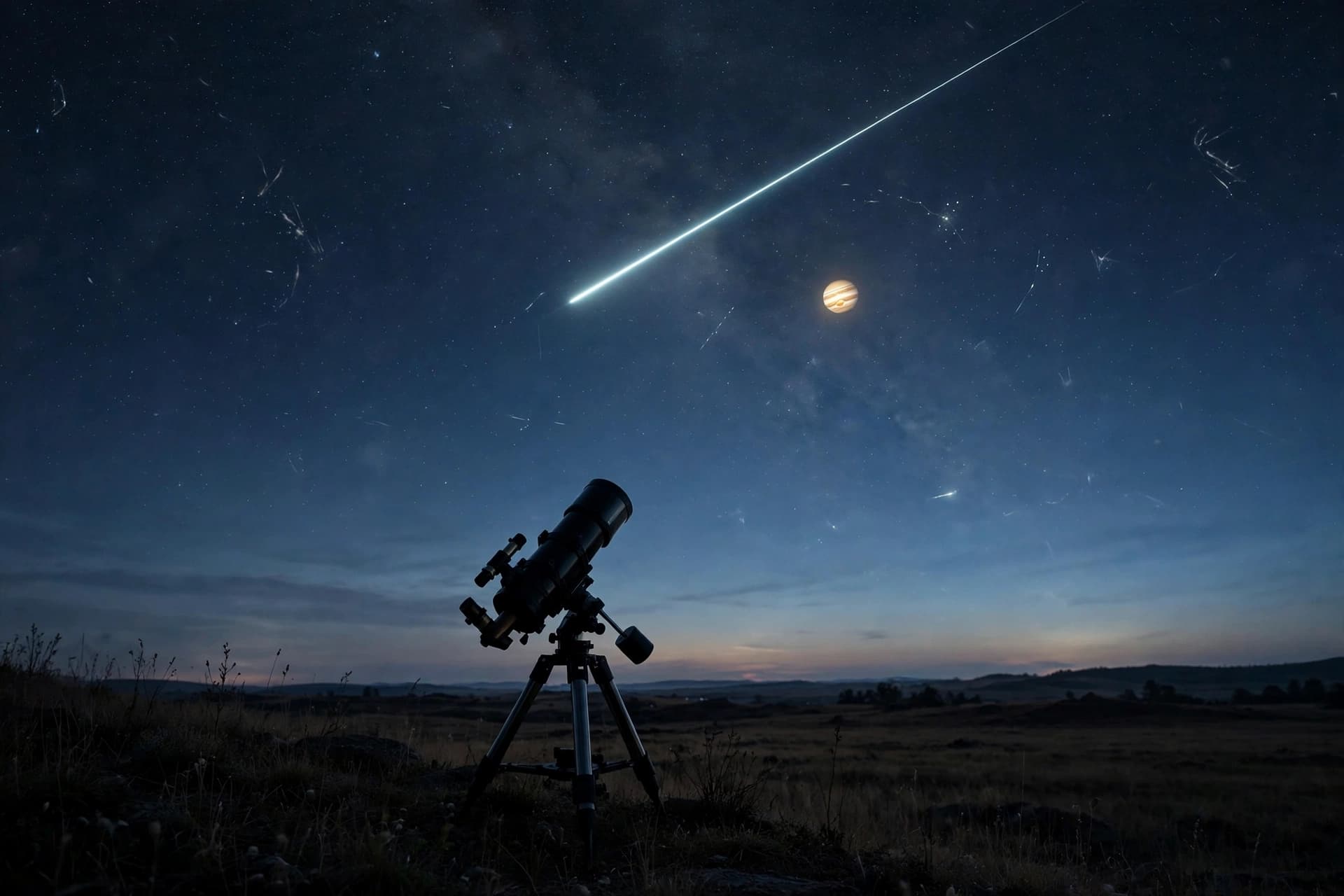
Image Disclaimer: The visuals accompanying this article were generated by artificial intelligence and do not depict the actual photograph by AJ Smadi.
Sources: PetaPixel
Published by Banx Network. This article is part of the Banx decentralized media programme, powered by the BXE token on the XRP Ledger.