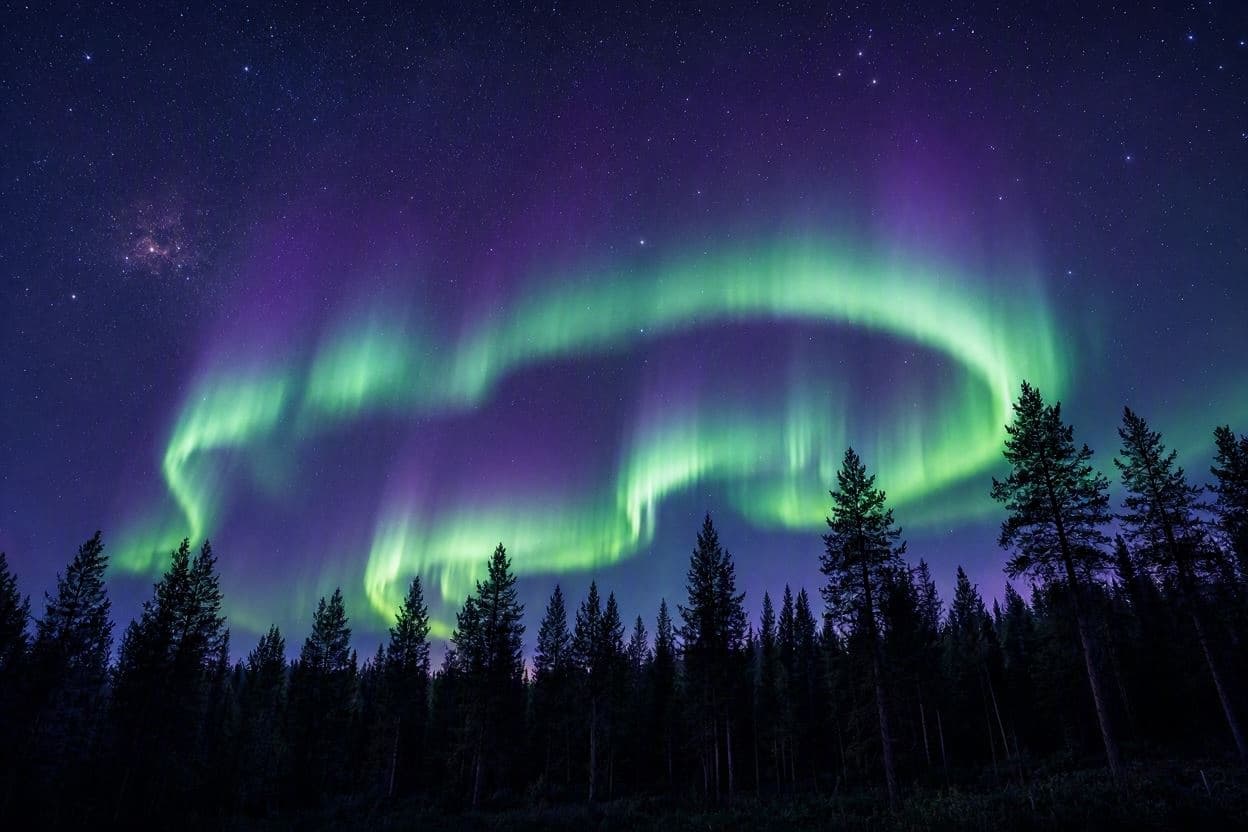
There is a rare magic in the night sky when the aurora borealis descends far south of its usual Arctic domain, painting the heavens in ribbons of emerald and violet. For residents across a dozen U.S. states, tonight offers a fleeting opportunity to witness this celestial dance without leaving home. As solar activity intensifies, geomagnetic storms are pushing the northern lights into lower latitudes, transforming ordinary evenings into extraordinary spectacles of natural light. This phenomenon serves as a gentle reminder of the dynamic relationship between our planet and the sun.
The current display is driven by a series of coronal mass ejections from the sun, which send charged particles hurtling toward Earth. When these particles collide with gases in our atmosphere, they ignite the shimmering curtains of light that have captivated humans for centuries. While the aurora is typically confined to high-latitude regions like Alaska and Canada, strong geomagnetic storms can expand the visibility zone significantly, reaching as far south as Alabama and California under optimal conditions.
For those hoping to catch a glimpse, timing and location are crucial. The best viewing window usually occurs during the darkest hours of the night, away from the glow of city lights. Observers in states such as Washington, Montana, North Dakota, Minnesota, Wisconsin, Michigan, New York, Vermont, Maine, Idaho, Wyoming, and Alaska are particularly well-positioned. However, even those in neighboring regions may see faint glows on the northern horizon if the storm intensity remains high.
Clear skies are the most important factor for successful viewing. Cloud cover can easily obscure the delicate details of the aurora, so checking local weather forecasts is essential. Finding a spot with an unobstructed view to the north will maximize the chances of seeing the display. Parks, open fields, or lakeshores often provide the ideal vantage points, offering both darkness and a wide perspective of the sky.
Photography enthusiasts may find that their cameras capture more detail than the naked eye. Long-exposure settings can reveal colors and structures that are too faint to see directly, allowing viewers to preserve the memory of the event. Even without professional equipment, smartphones with night mode capabilities can sometimes record the vibrant hues, making it easier to share the experience with others who might not be able to look up at the same moment.
Beyond the visual beauty, the aurora represents a powerful scientific event. It highlights the protective role of Earth’s magnetic field, which shields us from harmful solar radiation while creating this stunning side effect. Watching the lights ripple across the sky is not just a leisure activity but a connection to the broader cosmic environment in which we live. It invites a sense of wonder and humility in the face of nature’s grandeur.
As the night progresses, the intensity of the display may fluctuate, with bursts of brightness followed by quieter moments. Patience is key, as the aurora can appear suddenly and vanish just as quickly. Those who take the time to wait in the cold are often rewarded with the most spectacular views, as the sky transforms into a living canvas of light and color.
Whether you are a seasoned aurora chaser or a first-time observer, tonight’s event is a gift from the cosmos. It encourages us to step outside, look up, and appreciate the intricate beauty of our universe. In a world that often feels hurried and disconnected, the silent majesty of the northern lights offers a moment of peace and shared awe.
AI Image Disclaimer: The visual representations included here are AI-generated illustrations designed to depict the aurora borealis and night sky scenes, not actual photographs of the specific event or locations.
Sources: NASA NOAA Space Weather Prediction Center Space.com
Published by Banx Network. This article is part of the Banx decentralized media programme, powered by the BXE token on the XRP Ledger.