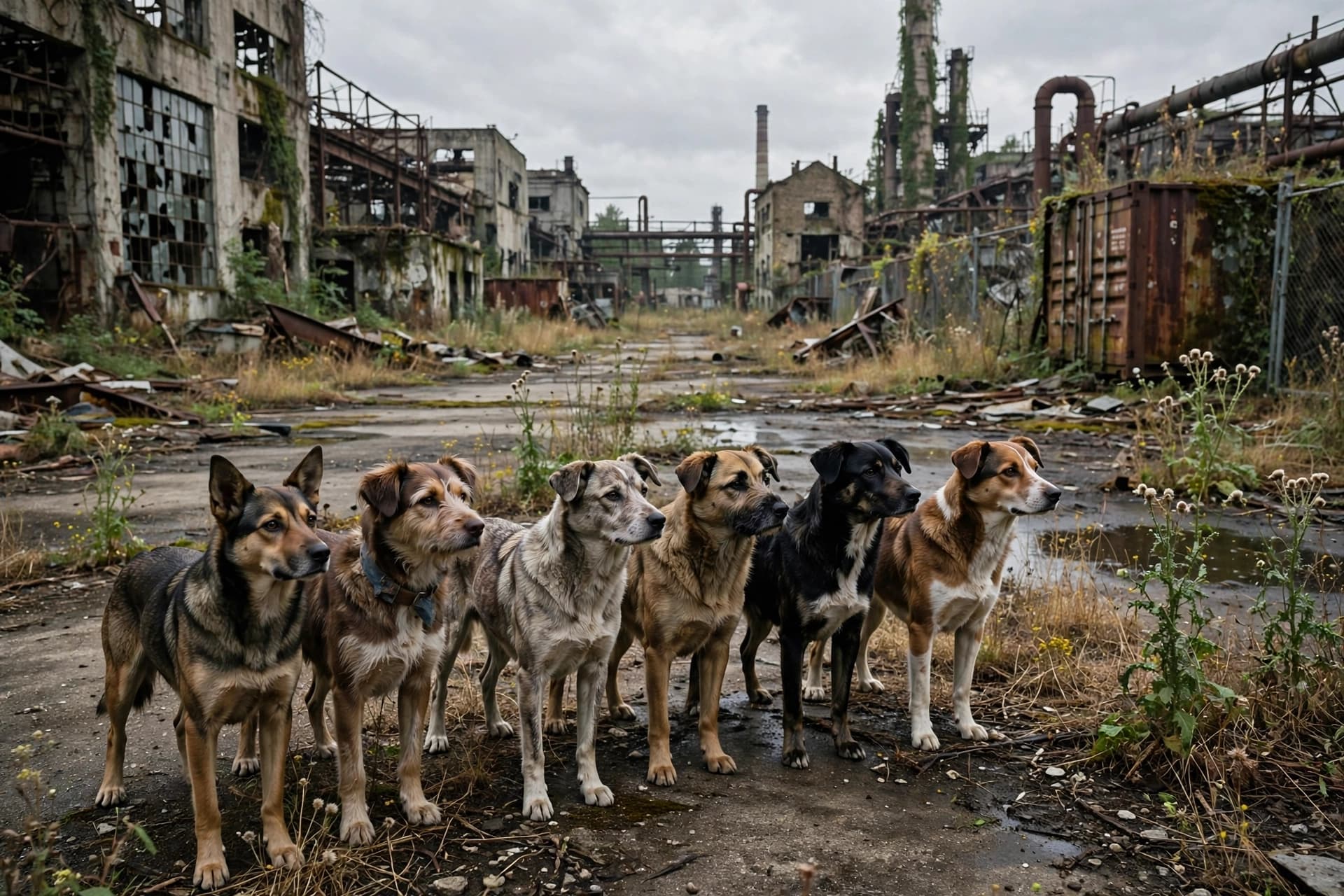
For nearly four decades, the Exclusion Zone around the Chernobyl Nuclear Power Plant has been a place where human absence and human error meet in uneasy silence. Yet life has persisted there, not only in the tangled forests and abandoned buildings but in the descendants of pets left behind during the frantic evacuation of 1986. A new study suggests that these free-breeding dogs may carry something more than memory in their blood—subtle genetic signatures that hint at how prolonged exposure to a contaminated environment might shape a population over generations.
The research, published in the journal Genes, compared two groups of dogs living roughly ten miles apart: one population dwelling near the reactor site itself, and another in the town of Chornobyl City. Earlier work had already revealed an unexpected finding—that despite their geographic proximity, these two populations were genetically distinct, with little evidence of interbreeding between them. The new analysis went further, asking whether this divergence could be attributed to simple genetic drift, the random fluctuations that often occur in small, isolated populations, or to something more directed.
What the researchers found was a pattern more consistent with directional selection than with chance. At over one hundred locations across the genome, the nuclear power plant dogs showed signatures suggesting that certain traits had been favored over time. The genes near these loci were not random; they clustered around functions related to DNA repair, cell cycle regulation, immune response, and cancer suppression. In plain terms, these are the biological systems one might expect to be under pressure in an environment marked by ionizing radiation and other toxic exposures.
The study’s authors are careful not to overstate their case. As lead author Megan Dillon noted, the findings are suggestive rather than definitive, and it remains possible that the dogs who survived the initial exposures simply possessed a level of underlying genetic diversity that allowed them to endure. The distinction matters—between a genome that changed in response to the environment and a genome that was already equipped to withstand it. Both stories speak to resilience, but they are not quite the same story.
What makes this work particularly resonant is its choice of subject. Dogs have long served as sentinels for human environmental health, sharing our spaces and, sometimes, our exposures. The Chornobyl dogs are not laboratory animals in controlled conditions; they are creatures of a real and damaged landscape, living out the consequences of a disaster they had no part in causing. Their bodies carry a record of thirty-some generations of life in a place that remains, in measurable ways, hostile.
The researchers also compared the Chornobyl dogs to isolated populations elsewhere, including free-breeding dogs of the Galápagos Islands. The nuclear plant dogs stood apart, their genetic profile distinct from other isolated groups in ways that isolation alone could not easily explain. This comparative approach lends weight to the selection hypothesis, though the authors are forthright about the limits of what genomic signatures can prove.
Matthew Breen, a corresponding author on the study, offered a characteristically measured view. The consequence of living in Chornobyl, he suggested, may not have been a wholesale rewriting of the dogs’ genome; it may be that those who survived already carried variants offering a higher degree of fitness. This is a humbler interpretation than the headline might invite, but it is also a more honest one. Science rarely delivers clean narratives, and the Chornobyl dogs are no exception.
The findings do not resolve the larger questions about radiation’s effects on wildlife, nor do they offer easy lessons for human health. What they do provide is a careful, incremental step toward understanding how prolonged exposure to environmental hazards might leave its mark on a population over time. In a zone where so much remains uncertain, even a modest piece of clarity feels worth holding onto.
The dogs of Chornobyl continue to live as they have for decades—scavenging, breeding, enduring. Their story is not one of triumph or tragedy, but of the quiet, persistent work of survival in a landscape that asks much of those who remain.
Image note: The visual accompanying this article was generated by artificial intelligence and is not a photograph of the researchers or the dogs described.
Sources: NC State News, Genes (MDPI), National Institutes of Health (PMC)
Published by Banx Network. This article is part of the Banx decentralized media programme, powered by the BXE token on the XRP Ledger.