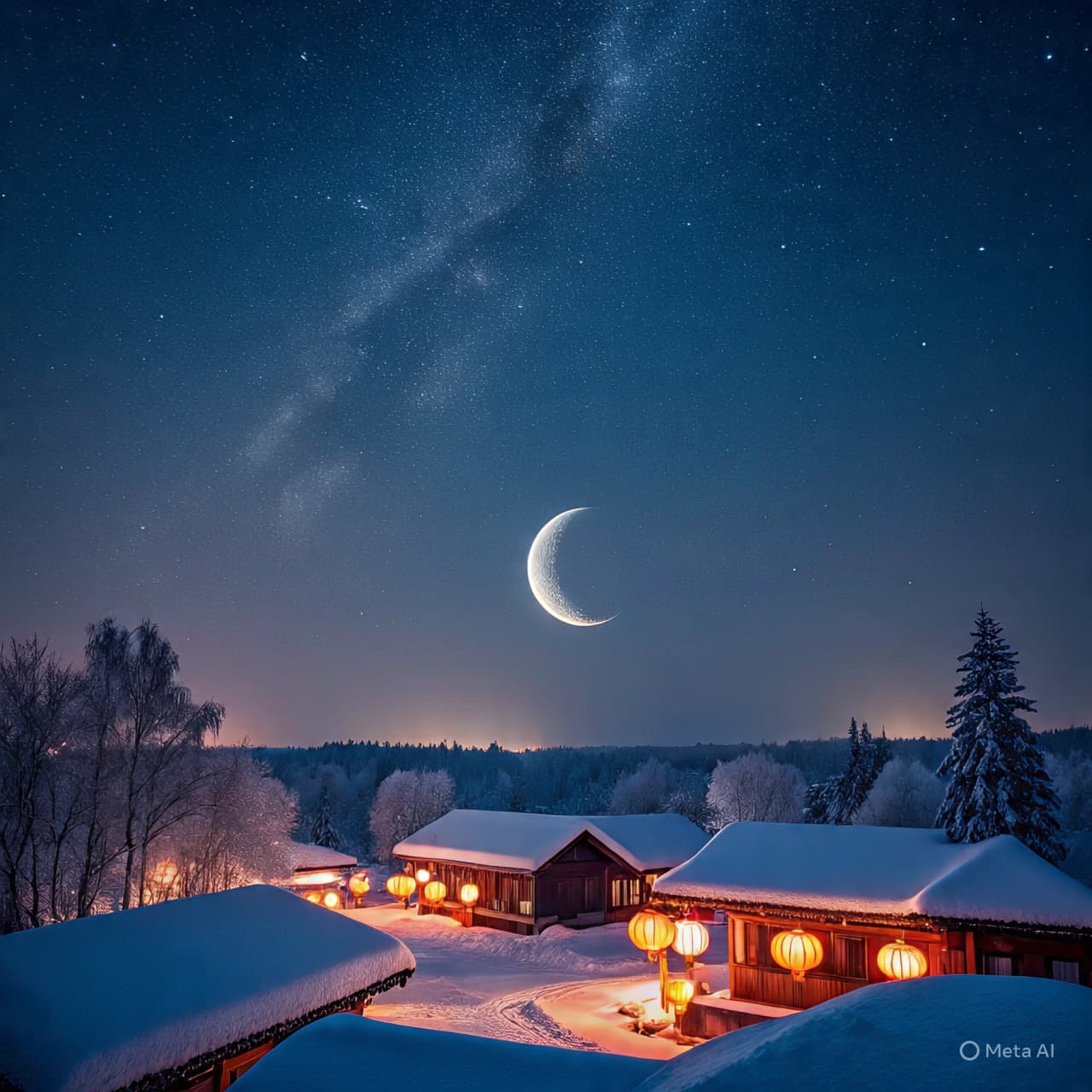
There are evenings when the sky feels closer than usual, as if the vast architecture of the universe has leaned gently toward Earth to whisper something ancient. In the northern reaches of China, where winter air hangs crisp above the forests of Heilongjiang, such a moment unfolded over Jagdaqi. There, beneath a darkened canopy of stars, the planet Jupiter appeared to rest beside the Moon, two celestial companions sharing the same quiet frame.
The sight was not a collision, nor a cosmic rarity in the strictest scientific sense, but a conjunction — an alignment from Earth’s perspective. Yet to those who looked up from the streets and snow-lined rooftops of Jagdaqi, it felt less like geometry and more like poetry. Jupiter, luminous and steadfast, shone with a steady brilliance. The Moon, pale and contemplative, offered its familiar glow. Together, they created a scene that felt both intimate and immense.
Jupiter, the largest planet in our solar system, is often described as a guardian. Its immense gravity shapes the architecture of space around it, shepherding asteroids and influencing orbital paths. Though more than 600 million kilometers away at times, it can appear strikingly bright in Earth’s night sky. When it draws near to the Moon in apparent proximity, the effect is magnified — a pairing of scale and familiarity. One is a wandering giant of gas and storms; the other, Earth’s steady companion.
Such alignments are part of the patient rhythm of the cosmos. The Moon circles Earth roughly every 27 days, while Jupiter follows its slower, grand path around the Sun, completing a single orbit in nearly 12 Earth years. From time to time, their paths, as seen from our vantage point, seem to converge. Astronomers call this a conjunction, a reminder that much of what we perceive in the heavens is shaped by perspective.
In Jagdaqi, a city surrounded by forests and known for its cold northern climate, the clarity of winter skies often allows celestial events to reveal themselves with unusual sharpness. The absence of heavy urban light pollution in some areas enhances the view, turning ordinary nights into observatories. Photographers and skywatchers captured the moment as Jupiter gleamed near the lunar crescent, a pairing that seemed almost deliberate in its composition.
Events like this are gentle invitations. They ask little of us beyond attention. No telescope is strictly required; the naked eye can often trace the brightness of Jupiter beside the Moon. And yet, behind the simple act of looking lies a complex choreography of orbital mechanics, gravitational forces, and vast distances measured in astronomical units.
Still, the science does not diminish the wonder. If anything, it deepens it. To understand that the apparent closeness of Jupiter and the Moon is a matter of alignment — that they remain separated by hundreds of millions of kilometers — adds another layer of humility. What appears intimate is, in reality, separated by unimaginable expanses. And yet, from Earth, they seem to share the same sky, the same silence.
In recent years, interest in skywatching has grown, aided by accessible technology and widespread sharing of astronomical imagery. Social media and local news outlets frequently highlight such conjunctions, encouraging communities to step outside and reconnect with the night sky. In places like Heilongjiang, where winter nights stretch long, the heavens offer a quiet spectacle against the cold.
As the Moon continues its orbit and Jupiter proceeds along its grander path, the pairing will dissolve. The sky will rearrange itself, as it always does. But for a brief evening over Jagdaqi, the two worlds appeared side by side — a reminder that even in the vastness of space, moments of apparent closeness can feel profoundly human.
There was no fanfare, no thunderous announcement. Only a clear sky, a bright planet, a patient Moon, and those who chose to look upward. And sometimes, that is more than enough.
AI Image Disclaimer Images in this article are AI-generated illustrations, meant for concept only.
SOURCE CHECK
Credible mainstream / niche media that have covered astronomical sky events involving Jupiter and the Moon:
NASA Space.com Sky & Telescope China Daily Xinhua News Agency
Published by Banx Network. This article is part of the Banx decentralized media programme, powered by the BXE token on the XRP Ledger.