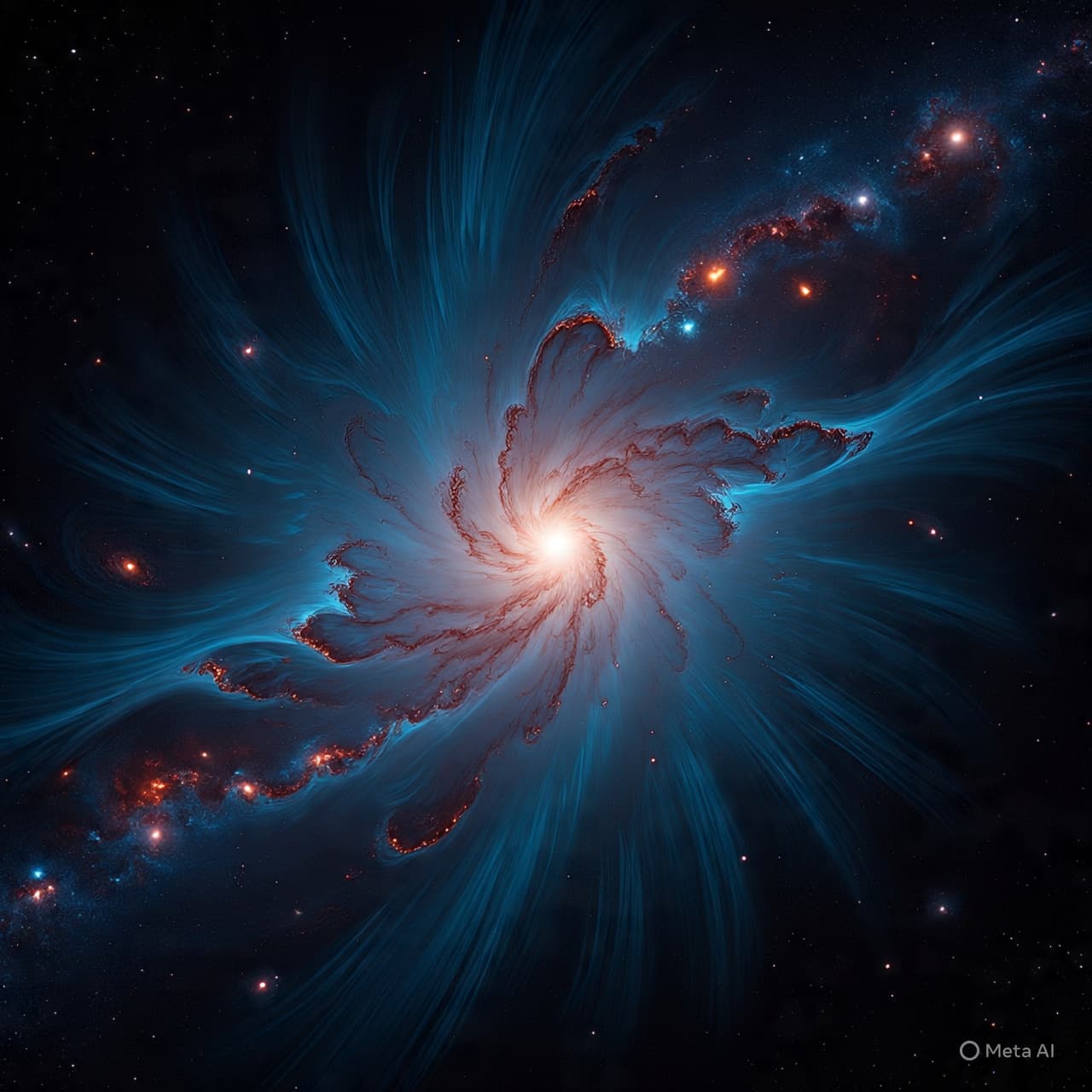
There are moments in astronomy when the universe seems almost musical.
Across immense distances, telescopes detect faint signals—patterns that rise and fall, pulse and fade, like distant notes carried through cosmic space. These signals are not sound, of course, but variations in light and energy. Yet to the scientists who study them, they sometimes resemble something strangely familiar: a chirp, a beat, a rhythm.
Such a pattern recently emerged from the fading remains of a distant stellar explosion.
The event began as a supernova, the brilliant death of a massive star whose final collapse scattered matter and radiation across space. But as astronomers continued to observe the aftermath, they noticed something unexpected: a rapidly repeating signal embedded within the light.
This “chirping” pattern, detected in emissions from the explosion, appears to confirm a long-debated explanation involving one of the universe’s most extreme objects—a magnetar.
A magnetar is a rare type of neutron star, the dense remnant left behind after certain stars explode as supernovae. Though neutron stars themselves are already extraordinary—packing the mass of a star into a sphere roughly the size of a city—magnetars push the limits even further.
Their defining feature is a magnetic field of staggering strength, trillions of times more powerful than Earth’s. These fields can twist space around them, accelerate particles to enormous energies, and produce bursts of radiation detectable across the galaxy.
For decades, astrophysicists have proposed that some supernovae leave behind newly formed magnetars spinning at incredible speeds. In the moments after their birth, these objects may rotate hundreds of times per second, releasing energy into the surrounding debris like a cosmic dynamo.
But direct evidence has been difficult to capture.
The recently observed supernova changed that picture. As researchers monitored the explosion’s fading glow, they identified repeating pulses of radiation whose timing gradually shifted—a signal reminiscent of a chirp. The changing rhythm suggested a rapidly spinning compact object whose rotation was slowing over time.
That behavior fits closely with predictions for a newborn magnetar embedded within the expanding cloud of supernova debris.
In such a scenario, the collapsing core of the original star forms a neutron star with an extremely powerful magnetic field. As it spins, the magnetar injects energy into the surrounding material, altering the brightness and structure of the explosion’s aftermath.
The periodic signal detected by astronomers appears to match that mechanism. Each pulse corresponds to a rotation of the magnetar, while the gradual lengthening of the interval between pulses reflects the object slowly losing energy and spinning down.
Seen from Earth, the signal becomes a faint but measurable rhythm—a subtle trace of the hidden engine within the explosion.
The discovery offers a rare glimpse into a stage of stellar evolution that is normally concealed within thick clouds of debris. By tracking the changing pulses of radiation, scientists can study how magnetars form and how their powerful magnetic fields influence the surrounding environment.
In a sense, the supernova has become more than an ending. It is also the beginning of a new cosmic object—one that will continue spinning and emitting energy long after the explosion’s light has faded.
Astronomers say the unusual “chirping” signal observed in the aftermath of the supernova provides strong evidence that a rapidly spinning magnetar was created during the explosion. The findings support long-standing theoretical models that predict magnetars can power certain types of supernovae.
AI Image Disclaimer
Visuals are AI-generated and serve as conceptual representations of astrophysical phenomena.
Source Check
Credible coverage and/or reporting exist from: Space.com Nature Phys.org Scientis New Scientist Live Science
Published by Banx Network. This article is part of the Banx decentralized media programme, powered by the BXE token on the XRP Ledger.