Ontario held more than 400 municipal elections on Monday, and when the ballots were counted, the province told a story with two tellings. In some cities, the winds of change swept through council chambers with startling force. In others, the familiar faces returned, untouched by the restlessness that seemed to grip their neighbors. Democracy, it turns out, is not a single weather system but a collection of local climates.
The most striking result came in Milton, where Gordon Krantz—Canada's longest-serving mayor of a major municipality—lost the seat he had held since 1980. First elected to council in 1965, Krantz had sought a fifteenth term at the age of 89. He was defeated handily by George Minakakis, a former Ward 1 councillor, who took roughly 45 percent of the vote to Krantz's 25 . "I got caught up in a bit of a trend," Krantz said on election night. "Instead of me retiring on my own..." .
The trend was real. At least two dozen incumbent mayors lost their seats Monday, including nine who had served more than a decade . In Hamilton, Andrea Horwath—the former Ontario NDP leader—was denied a second term, finishing a distant third as Keanin Loomis, former head of the Hamilton Chamber of Commerce, nearly tripled her vote count . In Mississauga, Alvin Tedjo climbed from 12 percent in August polling to defeat incumbent Carolyn Parrish and former mayor Bonnie Crombie, becoming the city's first male mayor since 1978 . Oakville's Rob Burton, after twenty years, was unseated by Jeff Knoll. Niagara Falls' Jim Diodati fell after sixteen years .
But the wave did not reach everywhere. Toronto's Olivia Chow, despite polling that suggested a statistical dead heat, defeated Brad Bradford with relative ease, and will govern alongside a progressive council that includes several key allies . Ottawa's Mark Sutcliffe won a second term. Brampton's Patrick Brown was re-elected decisively. London's Josh Morgan returned, as did most of his council. "It could just be that he benefited from incumbency and also not really having any kind of scandals occur," said Western University political scientist Zack Taylor of London's quiet campaign .
The night also carried quieter milestones. Niagara Falls, Port Colborne, and North Bay each elected their first female mayors. Ottawa's council will have more women than men for the first time since amalgamation in 2001. The community of Merrickville-Wolford elected an all-female council . Women made up 32 percent of candidates province-wide. Lori Lococo, Niagara Falls' mayor-elect, downplayed the significance: "I always hope that people vote for people based on their experience and skills, not because of their gender" .
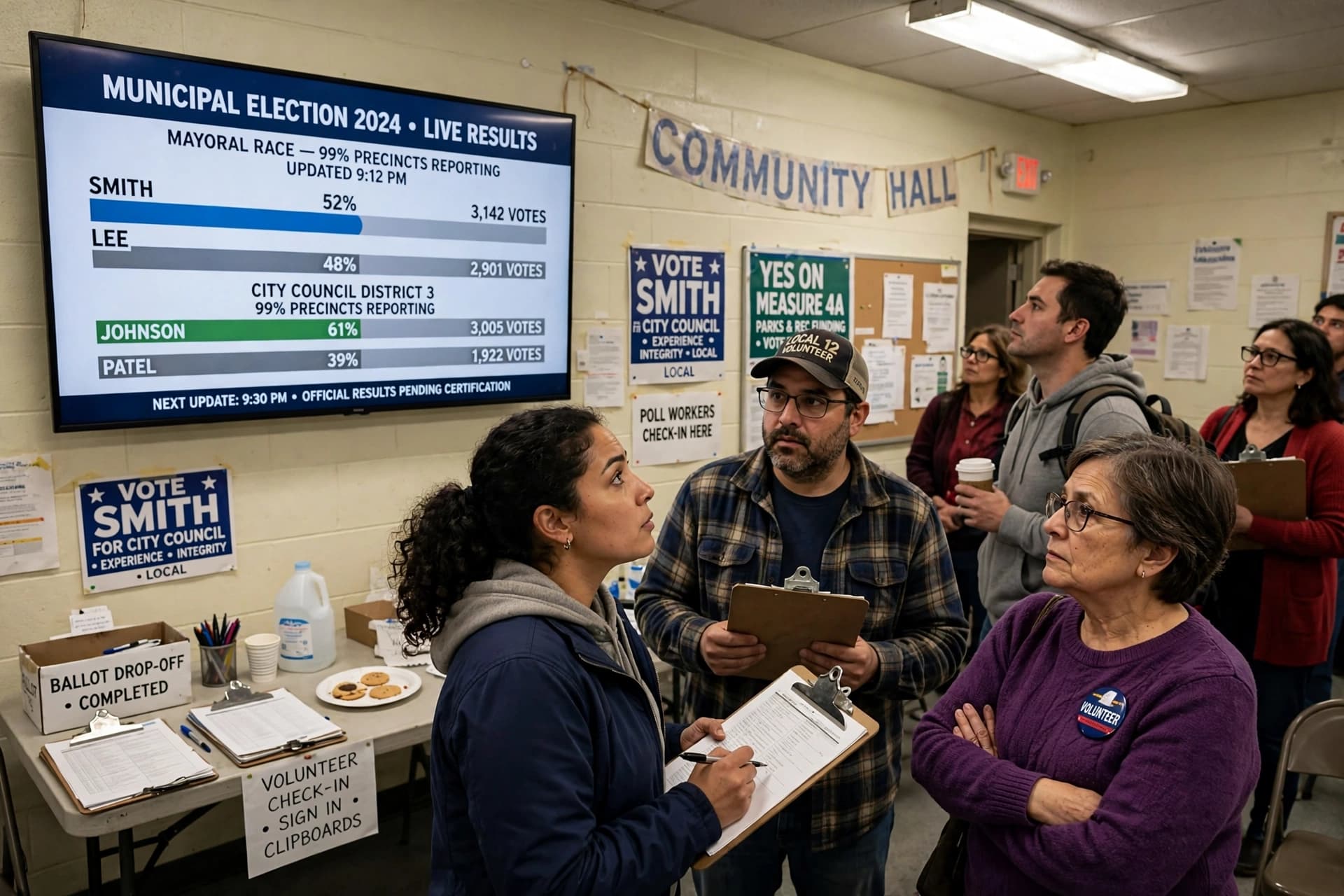
What emerges from Monday's results is not a single narrative but a mosaic of local judgments. Some communities chose to close long chapters. Others chose continuity. The decisions were made in community halls and school gymnasiums, by voters whose concerns were as varied as the municipalities themselves—taxes, growth, the character of a place, the sense that something needed to change or that something needed to stay.
The new councils will be sworn in over the coming weeks. The work of governing—the budgets, the zoning debates, the slow negotiation between what a city is and what it wants to become—begins again.
Images in this article are AI-generated and are not photographs of the candidates or events described.
Sources: CBC News, Toronto Sun, Mississauga.com, The Peterborough Examiner
Published by Banx Network. This article is part of the Banx decentralized media programme, powered by the BXE token on the XRP Ledger.