Deep within the human brain, there is a slow-spreading disorder of order itself. It does not travel by bacteria or virus, but through something more subtle: a small cluster of misfolded proteins that, like a stone dropped into still water, sends out ripples that cannot easily be stopped. For years, scientists have suspected that the tau protein involved in Alzheimer's disease and other neurodegenerative conditions has a prion-like "templating" ability, capable of inducing healthy proteins to change shape and continue the spread. But direct evidence was missing: no one had yet seen whether newly formed misfolded proteins truly copied the precise molecular structure of the original "seed."
A team at the MRC Laboratory of Molecular Biology in the United Kingdom, led by Sjors Scheres and Michel Goedert, together with Masato Hasegawa of the Tokyo Metropolitan Institute of Medical Science, has now filled that gap. They extracted abnormal tau from brain tissue donated by patients with Alzheimer's disease and corticobasal degeneration, or CBD, and injected it into the brains of healthy wild-type mice. These mice express their own normal mouse tau, not genetically modified human tau, a detail that matters because it rules out artificially accelerated pathology and allows researchers to observe the natural spread process.
The mice were monitored closely for up to 12 months after injection. Using antibodies able to distinguish human tau from mouse tau, the researchers found that the injected human tau almost completely disappeared within a week. Over the following months, however, the mice's own tau began to misfold. More strikingly, the Alzheimer's and CBD groups developed different pathological patterns: the former accumulated abnormal tau only in neurons, while the latter showed deposits in both neurons and supporting glial cells, resembling the pathology seen in human CBD patients.
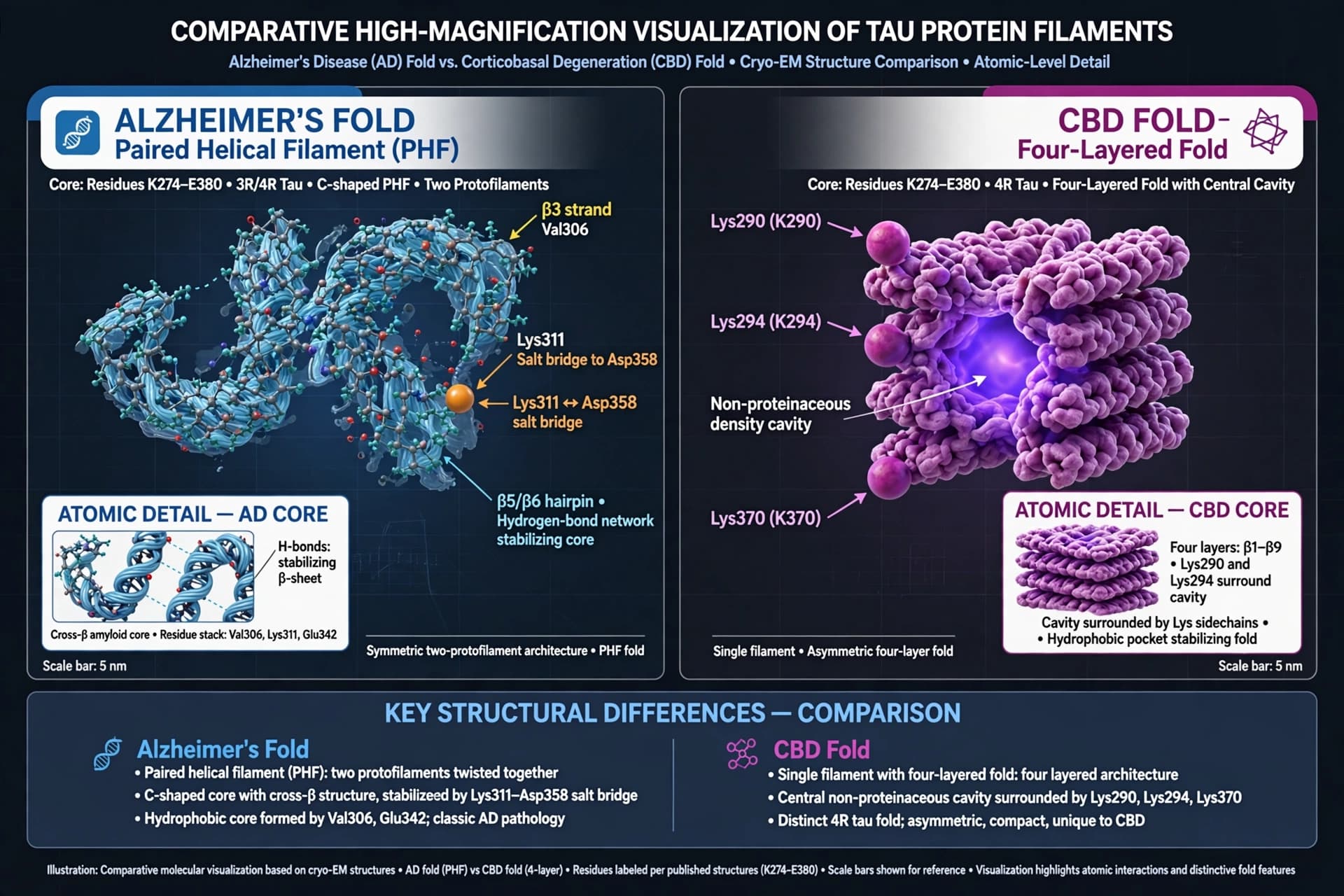
The decisive evidence came from cryo-electron microscopy. The team extracted newly formed tau filaments from the injected mouse brains and resolved their atomic structures. The results showed that mice injected with Alzheimer's tau folded their own tau into exactly the same structure as in human Alzheimer's disease, while mice injected with CBD tau replicated the CBD-specific fold. The original human tau had long since vanished, yet the "blueprint" it left behind was faithfully executed by mouse proteins. Published in Nature, the finding provides atom-level direct evidence for the prion-like propagation of tau.
The significance of this study is not that it immediately offers a treatment, but that it clarifies the fundamental mechanism of disease progression. If tau spread depends on this kind of template-directed conformational copying, then understanding how the "template" is recognized, internalized, and passed on could reveal new targets for intervention. It also strengthens a classification viewpoint: tauopathies perhaps should be divided according to their unique protein fold structures, not merely by clinical symptoms. Different folds correspond to different spreading patterns and cellular preferences, which explains why, though both are tauopathies, Alzheimer's disease and CBD present such different pathological pictures.
There is one more detail worth noting: although the mice accumulated abnormal tau, they remained outwardly healthy. It is not yet clear whether this is because the observation period was not long enough, or because the mouse nervous system has some tolerance for tau pathology. That question is left for future research to answer.
AI Image Disclaimer: The image materials used in this report were synthesized by artificial intelligence and are provided for auxiliary illustration only.
Sources: MRC Laboratory of Molecular Biology, Nature, ScienceAlert
Published by Banx Network. This article is part of the Banx decentralized media programme, powered by the BXE token on the XRP Ledger.