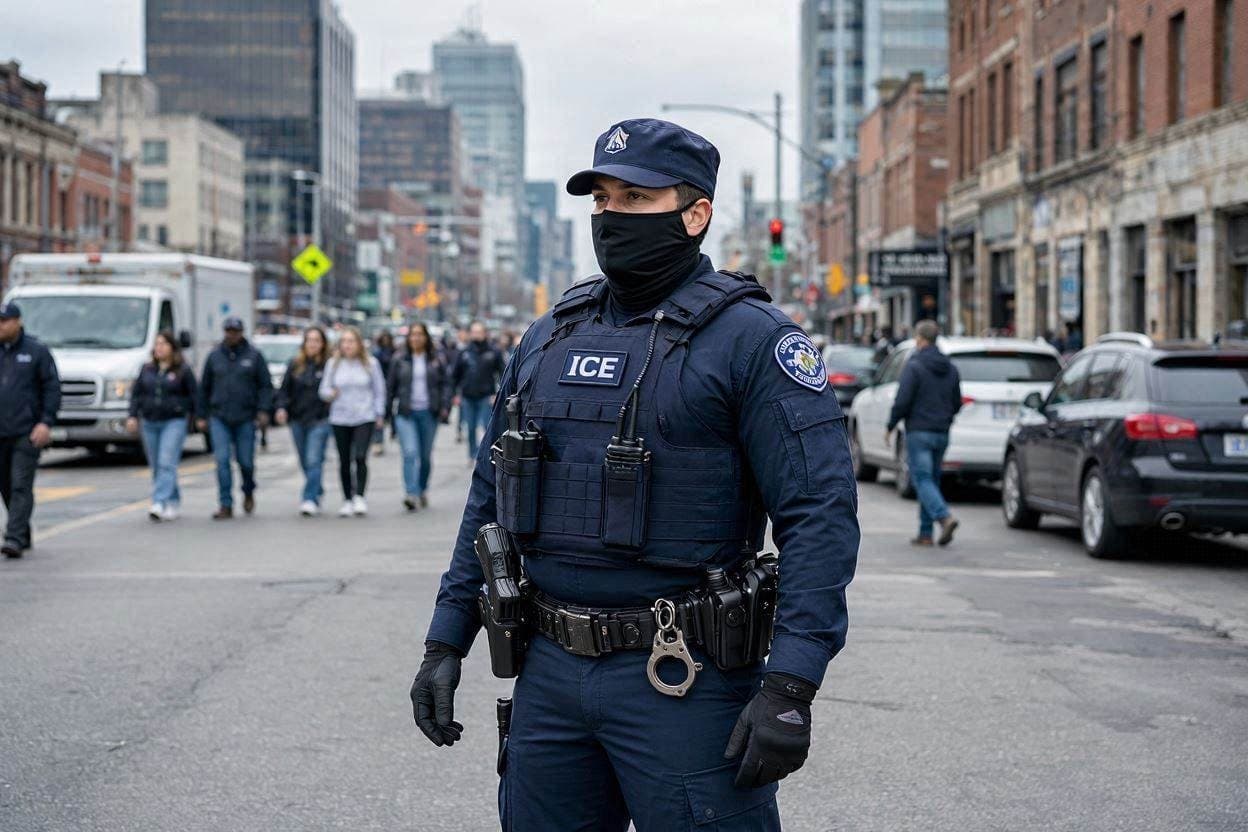
In the intricate dance between state authority and federal power, the line of jurisdiction is often drawn in subtle but significant ways. Recently, a federal judge in New York issued a preliminary injunction blocking the state’s law that prohibited Immigration and Customs Enforcement (ICE) officers from wearing face coverings while performing their duties. This decision highlights the ongoing tension between local efforts to ensure transparency and accountability, and the federal government’s assertion of operational security for its agents. It is a legal moment that reflects broader debates about visibility, safety, and the rule of law.
The New York law, enacted earlier this year, was designed to prevent federal agents from concealing their identities during arrests and other enforcement actions. State officials argued that masked officers created an atmosphere of fear and undermined public trust, making it difficult for citizens to identify those exercising police powers. The legislation required agents to display visible identification and refrain from using masks, aiming to protect civil liberties and ensure accountability in immigration enforcement.
However, the Department of Justice challenged the law, arguing that it interfered with federal operations and posed safety risks to agents. In her ruling, U.S. District Judge Mae D'Agostino agreed that the state likely overstepped its authority by regulating the conduct of federal employees. She noted that while states have broad police powers, they cannot impose restrictions that impede the execution of federal laws or compromise the security of federal personnel. The injunction effectively halts the enforcement of the mask ban while the legal battle continues.
For immigrant communities and advocacy groups, the ruling is a source of deep concern. Many argue that masked agents are more likely to engage in abusive behavior without fear of identification or repercussion. The inability to see an officer’s face can exacerbate trauma and erode confidence in law enforcement. Critics of the decision worry that it sets a precedent that allows federal agents to operate with a level of anonymity that is inconsistent with democratic principles of transparency.
On the other hand, federal authorities maintain that face coverings are sometimes necessary for agent safety, particularly in hostile environments or during high-risk operations. They argue that revealing identities could expose agents and their families to retaliation from criminal organizations or individuals opposed to immigration enforcement. The balance between protection and accountability remains a contentious issue, with valid arguments on both sides.
The legal challenge is part of a larger conflict between New York State and the federal government over immigration policy. The state has also banned local police from cooperating with ICE under the so-called 287(g) program, a provision that was upheld in the same ruling. This dual outcome suggests a complex judicial landscape where some state protections are preserved while others are struck down, reflecting the nuanced nature of federalism.
The block on New York’s mask ban for ICE officers underscores the enduring friction between state and federal jurisdictions. As the case proceeds, it will likely influence how other states approach similar regulations. For now, the decision leaves many questions unanswered, particularly regarding how to balance agent safety with the public’s right to know who is enforcing the law.
AI Image Disclaimer: The visual elements accompanying this report are AI-generated interpretations designed to reflect the legal and political context of the story.
Sources: Politico The New York Times Associated Press
Published by Banx Network. This article is part of the Banx decentralized media programme, powered by the BXE token on the XRP Ledger.