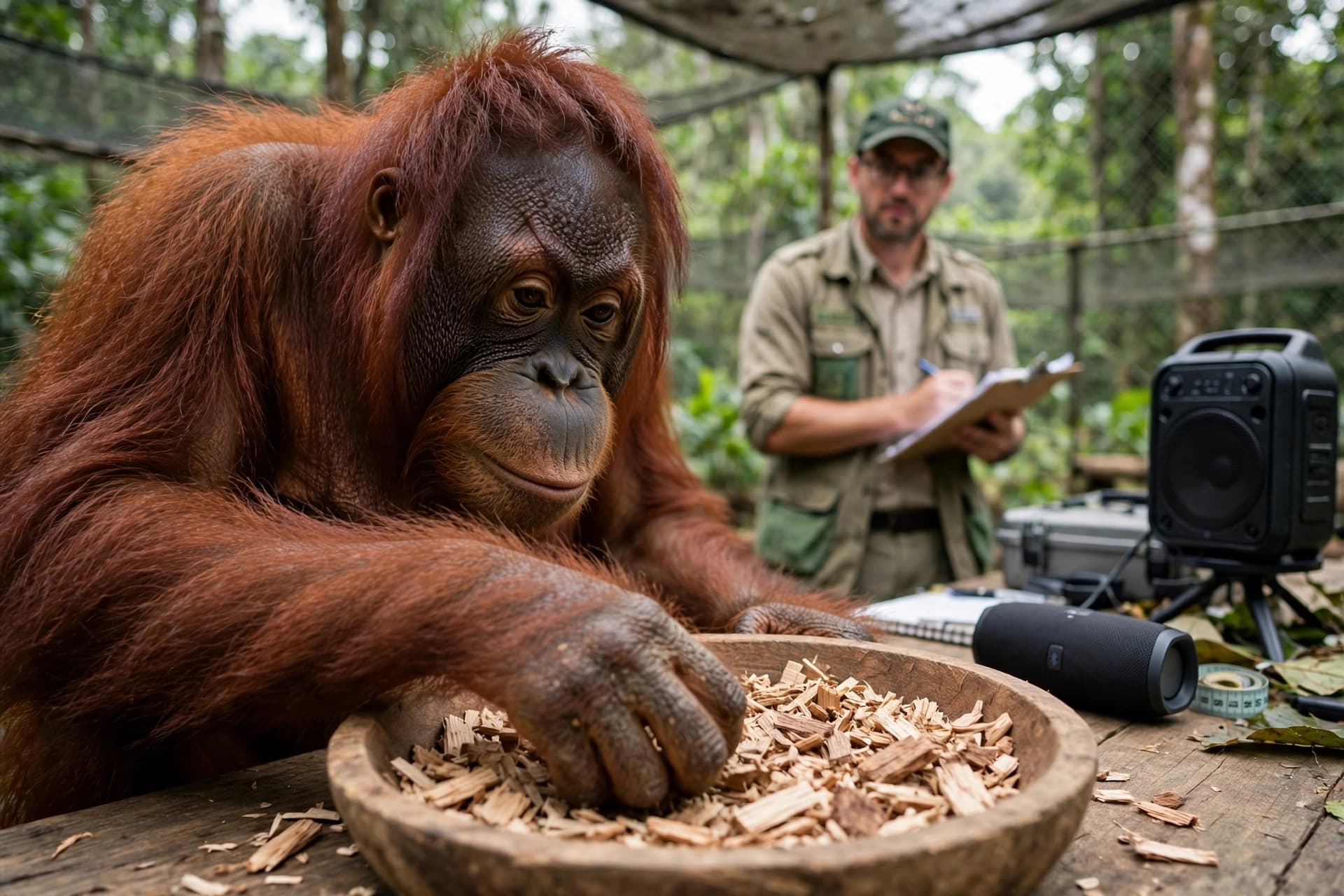
There is a particular kind of learning that happens not through instruction but through atmosphere, through the feeling that accompanies the lesson. A child might remember a grandmother's pancakes not because they were objectively the best, but because the kitchen was warm and the laughter was easy. A new study suggests that orangutans, the least social of the great apes, share this tendency. When they learned where food was hidden while listening to the sound of other orangutans laughing, they later preferred that food—even when the quantity was identical.
The experiment, published in Biology Letters and led by researchers at Indiana University, worked with six orangutans at two zoological institutions. The apes were trained to search bowls for food rewards. On some days, they dug through one material (like wood chips) to find a treat while hearing recordings of orangutan play vocalizations—laughter and squeaks. On other days, they dug through a different material while hearing a control sound, like wind. On the final day, both materials covered treats in equal amounts. The question was simple: which bowl would they choose?
Four of the six orangutans showed a clear preference for the material that had been associated with laughter. The group as a whole preferred it, too. The laughter had not changed what they learned, but it had changed how much they valued what they learned . "It is surprising to find these effects with orangutans, because they are the least social of all the great apes," said Daan Laméris, the study's lead author. "So even among relatively non-social animals, laughter is important" .
The finding adds to a growing body of research on how emotions shape cognition in animals. Erica Cartmill, the study's senior author, described the work as part of a larger project exploring whether animals feel joy and what those emotions mean for learning. "What our work is showing is that it's also about the state of the animal when they are learning that association," she said. "Who you are in that moment—the context, the emotional states—can influence how you remember these things" .
There is a human parallel that the researchers are careful not to overstate but that is difficult to ignore. Students might learn at similar rates whether they are in a good mood or not, Cartmill suggested, but they may value the information more if they learn it while feeling positive. A student who is anxious about math might avoid the subject later, not because they learned less but because the memory of learning was colored by the anxiety . The orangutans offer a simpler version of the same principle: the reward is sweeter when the moment was joyful.
For orangutans in the wild, the finding may have practical implications. These are solitary animals, and their social interactions are relatively rare. If laughter makes learning more valuable, then the moments when orangutans do gather—mothers and offspring, adolescents at play—may be more important for cognitive development than their frequency suggests. The sound of joy is not merely a signal of safety. It is a signal that what is happening now is worth remembering.
AI Image Disclaimer: The visuals in this article are generated by artificial intelligence and are intended for illustrative purposes only.
Sources: EurekAlert!, The Guardian, Biology Letters, bioRxiv
Published by Banx Network. This article is part of the Banx decentralized media programme, powered by the BXE token on the XRP Ledger.