There is a particular irony in the waste that accumulates after a harvest, the vines and stems left behind in fields, burned or discarded, carrying within them a chemistry that could solve a problem concrete has had for decades. Ecological porous concrete is designed to let water and roots pass through, making it useful for green walls, permeable pavements, and slope stabilization. But the same cement that gives it strength also makes it hostile to life. The pore solution of ordinary concrete sits at a pH above 11, sometimes approaching 13, a level that damages root cells and prevents plants from taking hold.
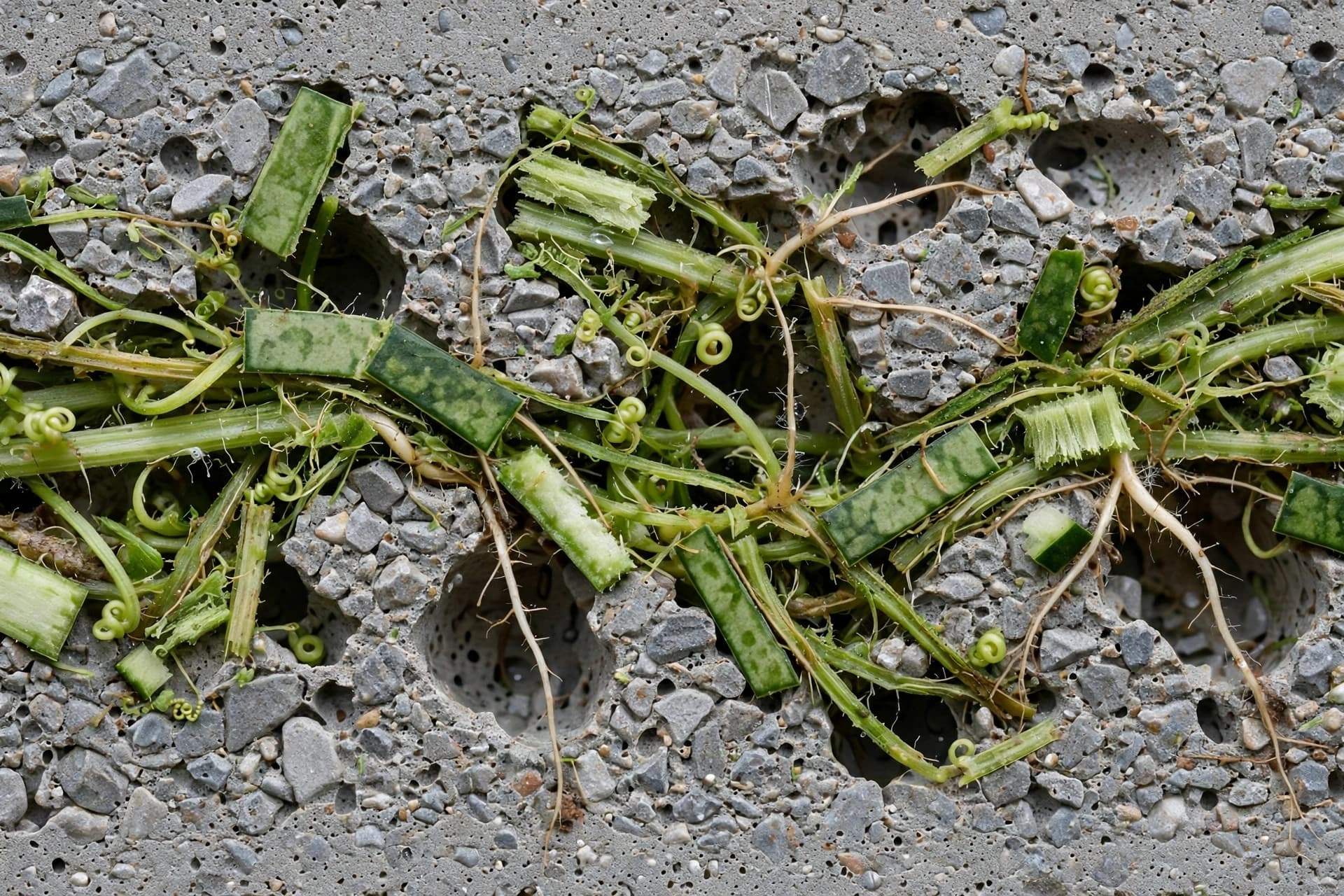
A study published in Scientific Reports has found an unlikely solution in watermelon vine waste, an abundant agricultural byproduct rich in cellulose and organic acids. When shredded and added to the concrete mix at a dosage of just 3 percent by weight of binder, the vine lowered the pore pH to 7.6 within fourteen days, a near-neutral level where plants can grow . The mechanism is an in-situ acid-base neutralization: the organic acids in the vine, particularly oxalic acid, react with the alkaline calcium hydroxide in the cement, forming calcium oxalate crystals that are visible under a scanning electron microscope .
The vine also serves a second function. Its fibrous skeleton acts as physical reinforcement, bridging microcracks and helping maintain the concrete's compressive strength even as the mix is engineered for high porosity. The optimized recipe—coarse aggregate of 16 to 20 millimeters, 20 percent fly ash, a water-to-binder ratio of 0.26, and 3 percent watermelon vine—achieved a compressive strength of 10.4 megapascals and an effective porosity of 27.7 percent, with strength remaining stable at sixty days . Plant germination tests showed vegetation coverage exceeding 80 percent within sixty days for drought-tolerant species .
The optimization itself required a sophisticated statistical framework. The researchers combined an orthogonal array design, response surface methodology, and entropy-weighted TOPSIS analysis to balance three competing objectives: strength, porosity, and pH. Watermelon vine content emerged as the dominant factor controlling pH, while the water-to-binder ratio governed strength and fly ash content influenced porosity . The result is a mix that sits in a useful window for load-bearing yet plantable concrete, a combination that conventional formulations struggle to achieve.
There is a broader significance in a material that turns agricultural waste into a resource for green infrastructure. In arid and semi-arid regions where water scarcity constrains conventional greening, plant-compatible concrete could support vegetation on slopes and walls that would otherwise be barren. The vine, which would otherwise be burned or left to decompose, becomes a functional additive, sequestering carbon and reducing methane emissions in the process . The circular economy, in this case, is not an abstraction but a mixture poured into a mold.
For now, the research is a proof of concept, published and peer-reviewed, awaiting the translation from laboratory to construction site. The vines that tangle in melon fields after harvest may one day be shredded and mixed into the concrete of living walls and green pavements. The concrete will still be concrete, strong and durable. But it will have learned, with the help of a waste product, to let life grow.
AI Image Disclaimer: The images accompanying this article are generated by artificial intelligence and are intended for illustrative purposes only.
Sources: Scientific Reports, AZoBuild, Scienmag
Published by Banx Network. This article is part of the Banx decentralized media programme, powered by the BXE token on the XRP Ledger.