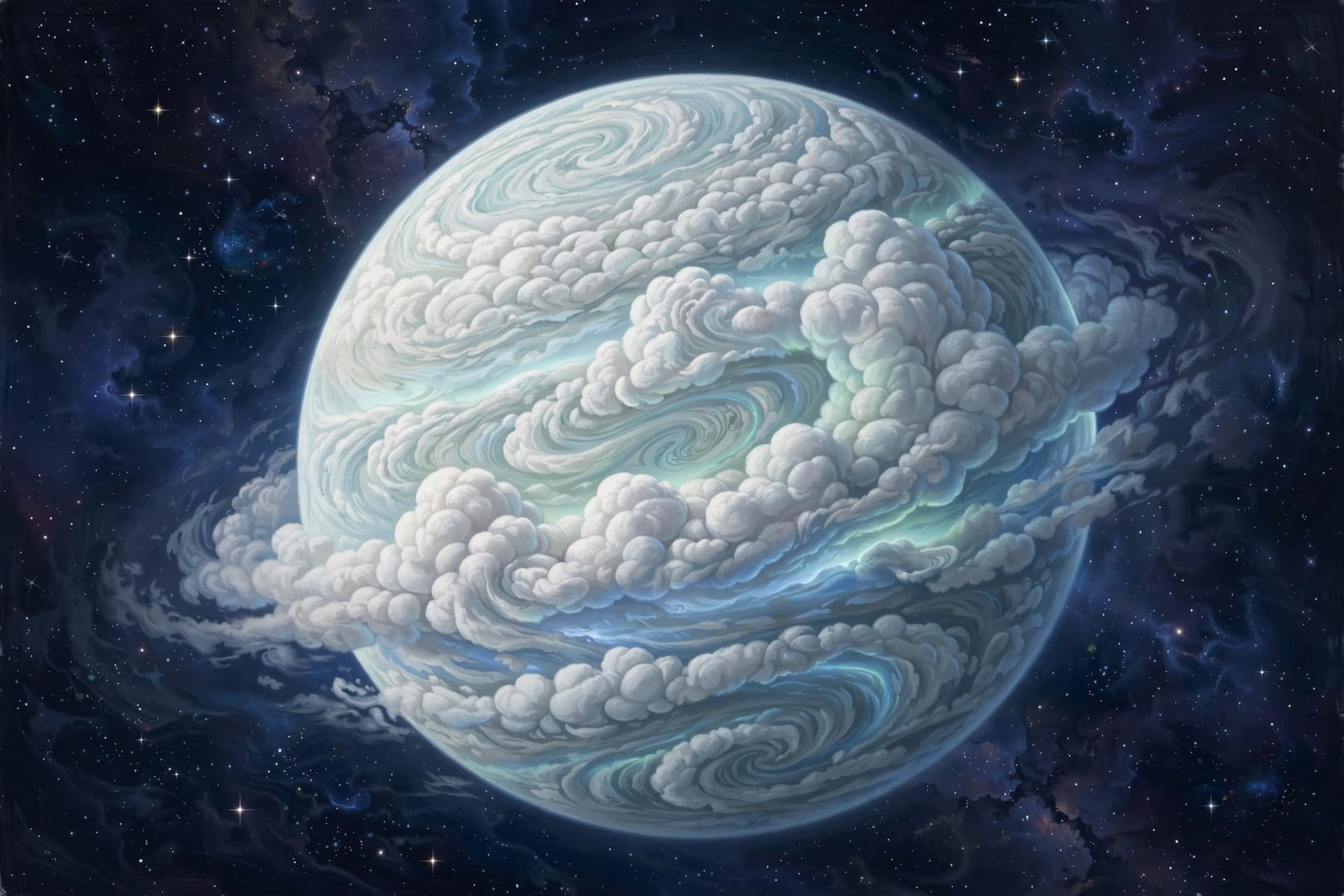
There are moments in science when patience feels almost poetic. Far beyond the orbit of Saturn, in a realm where sunlight thins into a pale whisper, a distant world tilts quietly on its side. For seventeen unbroken hours, the James Webb Space Telescope fixed its steady gaze upon Uranus, as if listening to a planet that rarely speaks. And in that long, patient watch, something strange shimmered into view.
Uranus has always been the eccentric of the solar family. It rolls through space at a dramatic angle, its axis tipped nearly sideways, as though caught mid-fall billions of years ago. Seasons there are extreme, sunlight pooling at one pole for years before retreating into darkness. In such a tilted world, even the sky behaves differently. Now, Webb’s infrared vision has revealed that its auroras—the luminous curtains born from charged particles colliding with atmospheric gases—are stranger still.
Auroras are familiar to us on Earth. We know them as soft veils of green and crimson dancing over polar skies, shaped by the embrace between our magnetic field and the solar wind. On Uranus, however, that embrace appears far less orderly. Webb’s 17-hour observation captured glowing emissions that suggest a magnetic field misaligned not only with the planet’s rotation, but also oddly offset from its center. The result is an auroral display that refuses to follow simple rules.
Earlier spacecraft, including Voyager 2 in the 1980s, offered the first hints of this magnetic oddity. Yet Webb, armed with advanced infrared instruments, has provided a clearer and more persistent look. The telescope detected emissions tied to the planet’s upper atmosphere, mapping how solar particles funnel along warped magnetic lines. Instead of neat ovals encircling the poles, Uranus appears to host auroral activity that shifts unpredictably, shaped by a magnetic geometry unlike any other known planet.
Scientists suggest that this unusual magnetosphere may be influenced by Uranus’ icy composition and internal structure. Unlike Earth’s molten iron core, Uranus likely generates its magnetic field within layers of superheated, electrically conductive “icy” fluids—water, ammonia, and methane under crushing pressure. If the dynamo lies off-center, as evidence suggests, the magnetic field would wobble and twist, creating auroras that seem almost untethered.
There is also timing to consider. Uranus is approaching its northern summer solstice, a seasonal shift that occurs only once every 84 Earth years. As sunlight angles differently across its atmosphere, researchers anticipate changes in how solar wind interacts with the planet. Webb’s extended stare offers not merely a snapshot, but a chapter in a longer seasonal story.
What makes this discovery resonate is not just the spectacle of distant lights. It is the reminder that even in the cold outskirts of our solar system, complexity thrives. Uranus, long considered a quiet ice giant, is revealing itself as dynamically alive. Its magnetic field is not a simple shield but a shifting labyrinth. Its auroras are not polite arcs but restless signatures of a deeper interior mystery.
And so, after seventeen hours of silent observation, Uranus has answered with questions of its own. In the language of light invisible to human eyes, it has shown that strangeness endures—even at the edge of sunlight.
The findings deepen scientists’ understanding of planetary magnetism and offer fresh data for models of ice giant atmospheres. As Webb continues its mission, further observations are expected to refine how Uranus’ magnetic field evolves with season and solar activity. For now, researchers note that the planet’s auroras appear more complex and dynamic than previously measured, adding new detail to the ongoing study of the outer solar system.
AI Image Disclaimer: Visuals are created with AI tools and are not real photographs.
Source Check: Credible mainstream and science-focused outlets covering this development include:
NASA ESA (European Space Agency) Space.com The New York Times (Science section) Scientific American
Published by Banx Network. This article is part of the Banx decentralized media programme, powered by the BXE token on the XRP Ledger.