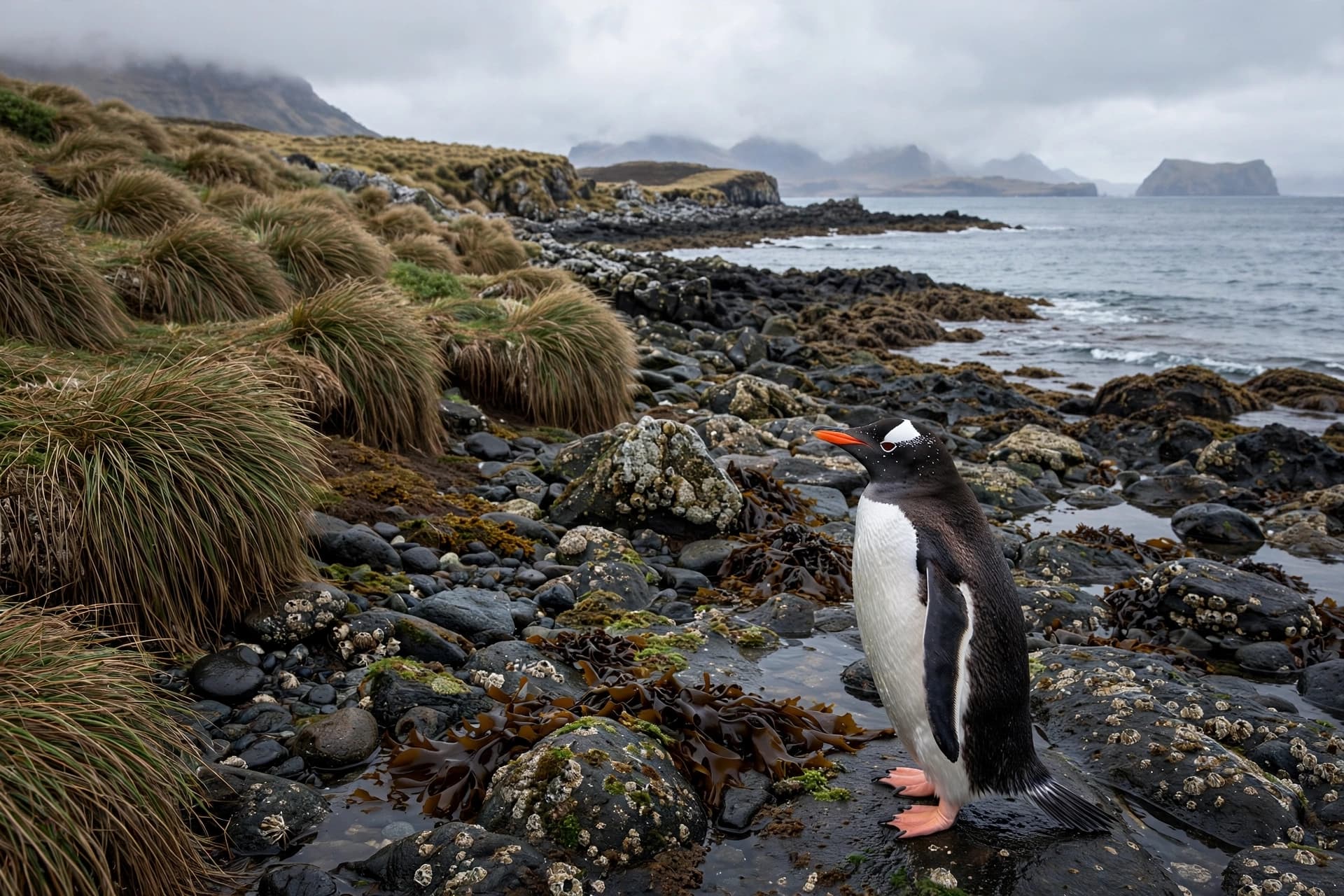
Some differences hide beneath feathers that look almost identical, accumulating silently over hundreds of thousands of years, until the language of genes finally names them. On the remote Kerguelen Islands in the southern Indian Ocean, a penguin looks nearly the same as any other gentoo—same black-and-white plumage, same orange-red bill, same gait. Yet within its DNA lies an identity science overlooked for more than a century.
An international team of researchers from the United States and Chile announced this week that they have confirmed a previously unknown penguin species, named Pygoscelis kerguelensis, commonly known as the southeastern gentoo. It is the first new penguin species described since the northern rockhopper was named in 1921—a gap of more than a hundred years.
The discovery did not come from an accidental encounter with a strange creature, but from a reconsideration of something already known. Gentoo penguins had long been classified as a single species, though debate over their taxonomy had persisted for decades. "There is probably no penguin whose classification has been more debated than the gentoo," said Laurie Bowie, a professor at the University of California, Berkeley. "For more than a hundred years, how many species or subspecies exist has been contested."
The team analyzed genomes from sixty-four individuals across ten breeding sites, covering nearly the entire geographic range of gentoo penguins. The results showed that gentoos actually diverged into four distinct evolutionary lineages: northern, southern, eastern, and the previously unknown southeastern gentoo. These lineages separated gradually over the past 300,000 to 500,000 years, a process accelerated by geographic isolation and the Antarctic Polar Front, an oceanic barrier.
The gentoo's eating habits may have indirectly driven this divergence. Unlike other penguins that are more selective about food, gentoos are generalists—fish, krill, squid, cuttlefish, whatever they can catch. That flexibility means they do not need to migrate long distances for food, returning instead to the same breeding grounds year after year. Over time, isolated island populations developed their own behavioral and ecological adaptations, which became fixed in their genes.
Genetic analysis also revealed specific adaptations among the species. The southern gentoo in Antarctica has more genes related to heat production and fat storage, helping it survive extreme cold. The eastern gentoo evolved stronger diving ability and more efficient energy metabolism, suggesting it may need to stay underwater longer when food is scarce.
For conservation, this reclassification has practical implications. Researchers warn that the three species living on subantarctic islands—the southeastern, northern, and eastern gentoos—may face severe habitat loss as the climate warms. The southern gentoo's range could expand, but the other three are in a precarious position. "These islands are very isolated, and these penguins cannot easily adapt to colonize other areas," said senior author Juliana Vianna. A species hidden for a million years, discovered at last, is being told at the same moment that its home is becoming fragile.
AI Image Disclaimer: The accompanying images in this report were created with artificial intelligence and are intended for conceptual representation only.
Sources: BBC, Washington Post, Communications Biology, UC Berkeley, Yahoo News, ThePrint
Published by Banx Network. This article is part of the Banx decentralized media programme, powered by the BXE token on the XRP Ledger.