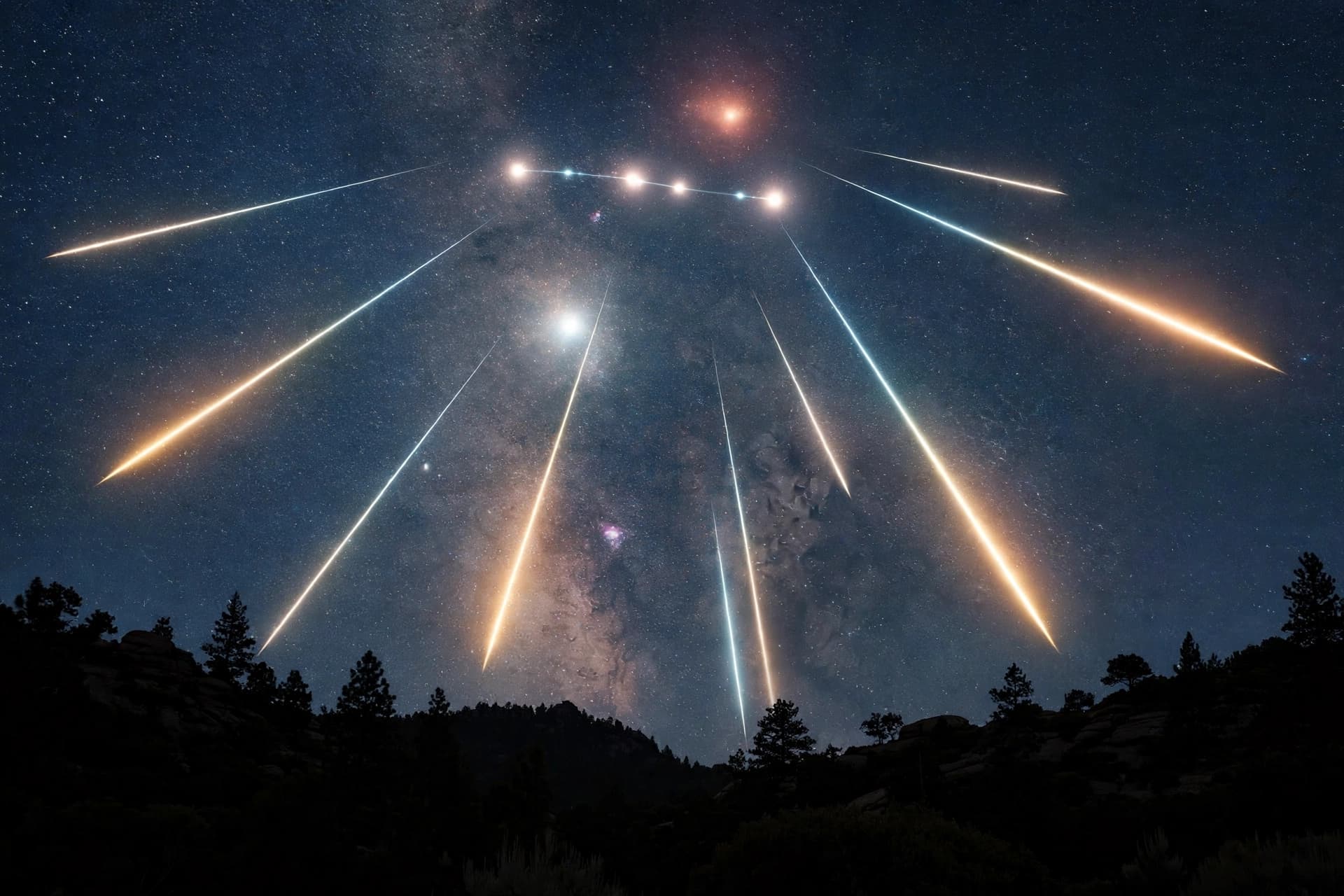
There are moments when the quiet night feels like a well-worn tapestry — familiar, calm, steady — and then, without warning, a single thread of light appears, sharp and shimmering, weaving a fleeting line across the dark. On a late January evening, such a streak appeared above the skies of New Zealand, where oceans whisper against land and people often look up, perhaps wondering at the vastness overhead. In an instant that lasted only seconds, a bright trail of light drew gasps, curiosity, and wonder from those who saw it.
Shortly before midnight on January 30, observers from Wellington to Nelson reported seeing a brilliant flash that briefly turned the night into a canvas of blue and green light. Cameras captured the moment a luminous streak carved its path across the sky — a spectacle that was as sudden as a comet’s kiss and as brief as a firefly’s glow.
The event quickly ignited questions. Was this a meteor — a piece of cosmic rock burning up in Earth’s upper atmosphere? Or could it be space debris, remnants of human-made objects returning from orbit? Scientists and skywatchers alike turned their thoughts to these possibilities, recognizing that both natural and artificial objects can produce brilliant trails when entering the atmosphere at high speed.
Meteors, sometimes called “shooting stars,” are fragments of stone and metal that have traveled through the solar system for eons. When they encounter Earth’s atmosphere, they heat up and burn, creating breathtaking streaks of light visible across wide distances. In this case, one such fireball — a term for an especially bright meteor — seemed to have lit up the night with its vibrant hue, at least according to many eyewitness reports and video recordings.
Yet the question of space debris remains in the conversation. Human activity has placed thousands of satellites and spent rocket components into orbit, and over time some of these inevitably re-enter the atmosphere. When they do, they can also produce brilliant light trails, though their paths and compositions differ from those of natural meteoroids.
For residents who saw the spectacle, the memory of that bright streak may linger like a photo’s imprint — a reminder of how small human life is beneath the dome of sky, yet how connected we remain to the wider universe. Lightning-quick as the event was, it touched both scientific curiosity and simple human awe.
In the days after the sighting, experts continued to review footage and data, but the phenomenon had all the hallmarks of a bright atmospheric entry. Authorities reported no damage or danger to people on the ground, and no fragments were confirmed to have reached the surface. Whether a natural visitor or an echo of human engineering, the bright trail over New Zealand’s night sky stands as a gentle spectacle — a fleeting dance of light above the world’s edge.
AI Image Disclaimer “Illustrations were produced with AI and serve as conceptual depictions.”
Sources RNZ Online 1News.nz Orbital Today Times of India Watchers.News
Published by Banx Network. This article is part of the Banx decentralized media programme, powered by the BXE token on the XRP Ledger.