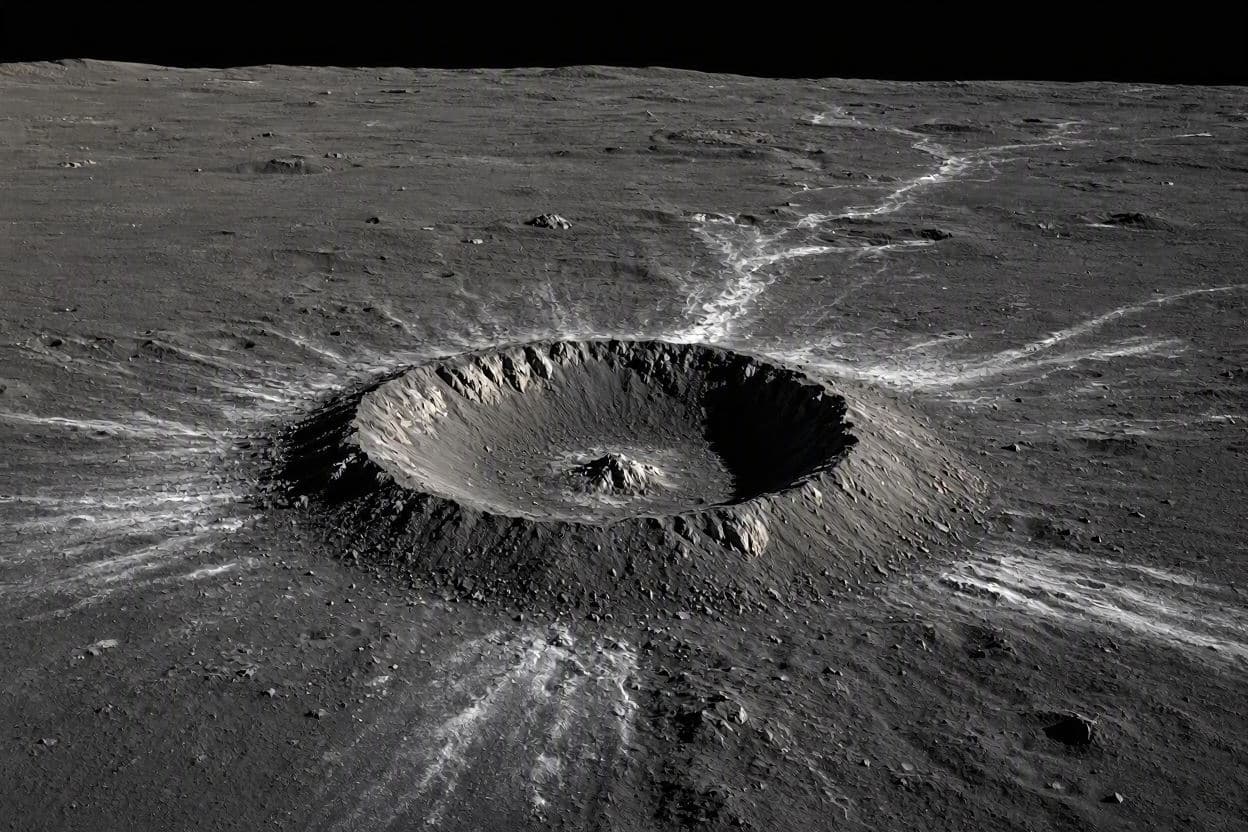
The Moon, a silent witness to billions of years of cosmic history, bears the scars of countless impacts. Each crater tells a story of violence and chance, a record of the solar system’s turbulent past. Recently, NASA’s Lunar Reconnaissance Orbiter (LRO) captured images of a massive new crater, formed by the impact of a SpaceX Falcon 9 upper stage. This fresh wound on the lunar surface, measuring approximately 60 feet wide, offers a rare opportunity to study the mechanics of impact in real-time and understand the risks posed by space debris.
The impact occurred in August 2026, when the discarded rocket stage, launched in early 2025, crashed into the Moon’s surface. Unlike natural impacts from asteroids or comets, this event was human-made, a consequence of the increasing activity in space exploration. The LRO, orbiting the Moon since 2009, was perfectly positioned to document the aftermath, capturing high-resolution images that reveal the crater’s structure and the surrounding ejecta blanket. These details provide valuable data for scientists studying impact dynamics.
The size of the crater is significant, comparable to those formed by natural objects of similar mass and velocity. By analyzing the shape and depth of the depression, researchers can refine their models of how energy is transferred during an impact. This knowledge is crucial for planning future lunar missions, particularly those involving landers and habitats that must withstand potential collisions with micrometeoroids or debris. Understanding the scale of damage helps engineers design more robust structures.
Moreover, this event highlights the growing issue of space junk. As more satellites and rockets are launched, the likelihood of accidental impacts increases. The Moon, lacking an atmosphere to burn up incoming objects, serves as a graveyard for space debris. Studying these impacts helps quantify the risk and informs policies for responsible space operations. It is a reminder that our activities in space have lasting consequences, even on distant celestial bodies.
The LRO’s ability to detect such changes demonstrates the value of long-term monitoring. Since its launch, the orbiter has mapped the entire lunar surface, identifying thousands of new craters. This continuous observation allows scientists to track the rate of impacts and understand the current environment of the Moon. It provides a baseline for comparing past and present activity, offering insights into the stability of the lunar surface.
For the public, the image of the new crater is a striking visual reminder of our presence in space. It connects the technological achievements of companies like SpaceX with the scientific goals of NASA. The collaboration between commercial and government entities is becoming increasingly common, driving innovation and expanding our reach into the cosmos. This impact, while accidental, is a testament to that expanding footprint.
As we look to the future of lunar exploration, with plans for bases and regular traffic, managing debris will become a critical challenge. The lessons learned from this impact will help shape strategies for mitigation and cleanup. It underscores the need for international cooperation and sustainable practices in space. The Moon, once a distant dream, is now a neighborhood we must care for.
In the end, the new crater is more than just a scar; it is a data point in our ongoing relationship with the Moon. It reminds us that every action has a reaction, and that even in the vacuum of space, our presence leaves a mark. By studying it, we learn to navigate the cosmos with greater wisdom and responsibility.
AI Image Disclaimer: The images accompanying this article are AI-generated artistic interpretations of the lunar surface and the impact event, not the actual raw images from the LRO.
Sources: NASA Science Space.com Scientific American
Published by Banx Network. This article is part of the Banx decentralized media programme, powered by the BXE token on the XRP Ledger.


.jpg&w=3840&q=75 "New Wild Cat Species Identified for First Time in 100 Years, Researchers Say")