
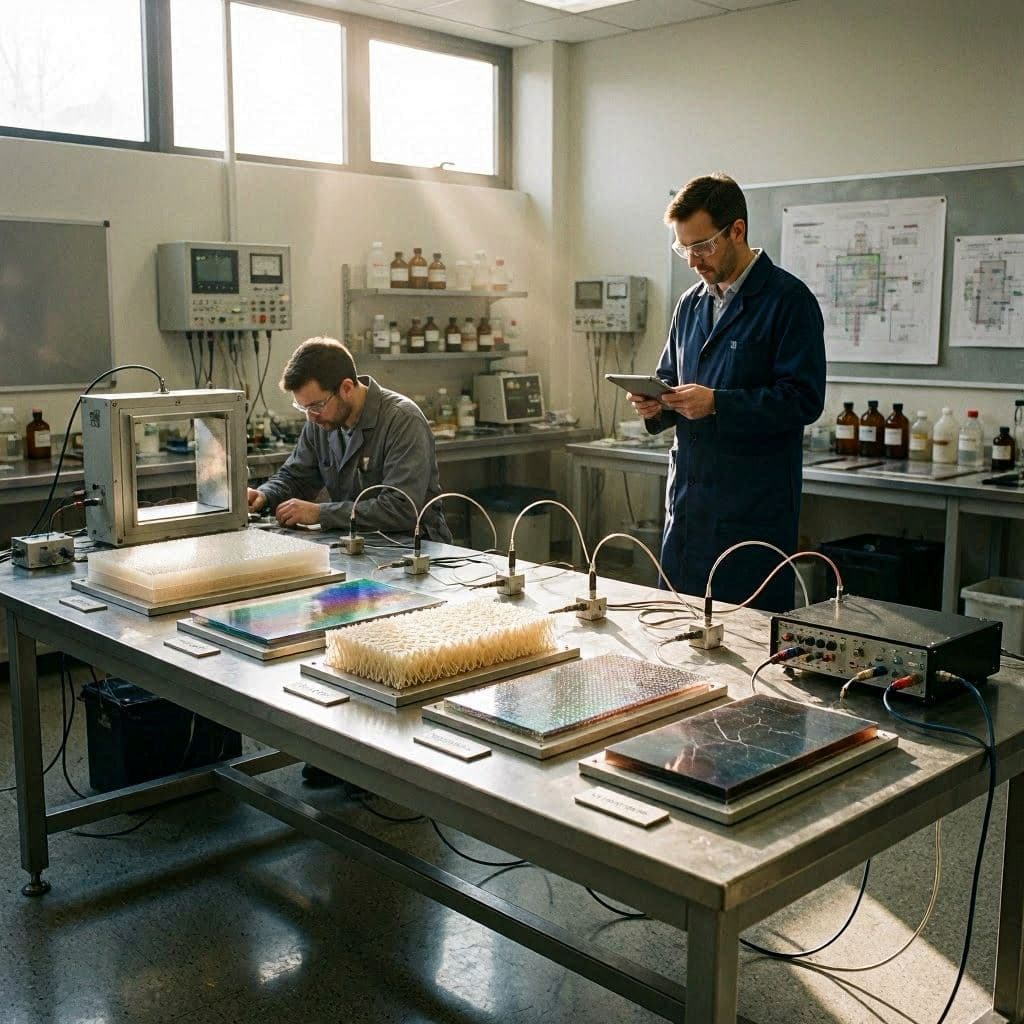
Sunlight has illuminated human civilization since its earliest days, warming landscapes and sustaining life across the planet. Even after centuries of scientific inquiry, researchers continue discovering new ways to harness the energy carried within those familiar rays.
A team of scientists has developed an innovative material capable of converting ordinary sunlight into ultraviolet light, potentially opening new opportunities in environmental technology, manufacturing, and chemical processes.
The breakthrough relies on advanced material engineering designed to alter the wavelength of incoming solar energy. By transforming lower-energy visible light into higher-energy ultraviolet radiation, researchers hope to improve the efficiency of several industrial applications.
Ultraviolet light plays a critical role in areas such as water purification, sterilization, chemical synthesis, and environmental remediation. Traditional UV generation methods, however, often require significant energy inputs.
Scientists suggest that solar-driven ultraviolet production could provide a more sustainable alternative. If successfully scaled, the technology may reduce energy consumption while expanding access to UV-based applications.
Laboratory tests have demonstrated promising performance under controlled conditions. Researchers are now evaluating long-term stability, efficiency, and practical deployment possibilities outside experimental environments.
Materials science has become an increasingly important field in addressing global challenges related to energy, sustainability, and environmental protection. Innovations at the molecular level frequently lead to transformative industrial technologies.
Experts caution that additional research will be necessary before commercial implementation becomes feasible. Many scientific discoveries require years of refinement before reaching widespread practical use.
Even so, the development highlights how scientific curiosity continues to reveal unexpected possibilities within everyday natural phenomena, reminding us that even sunlight still holds discoveries waiting to emerge.
AI Image Disclaimer: The illustrations accompanying this article are AI-generated and intended solely to visually represent scientific concepts.
Source Verification Check: ScienceDaily, SciTechDaily, Nature Materials, Reuters, Phys.org
Published by Banx Network. This article is part of the Banx decentralized media programme, powered by the BXE token on the XRP Ledger.



