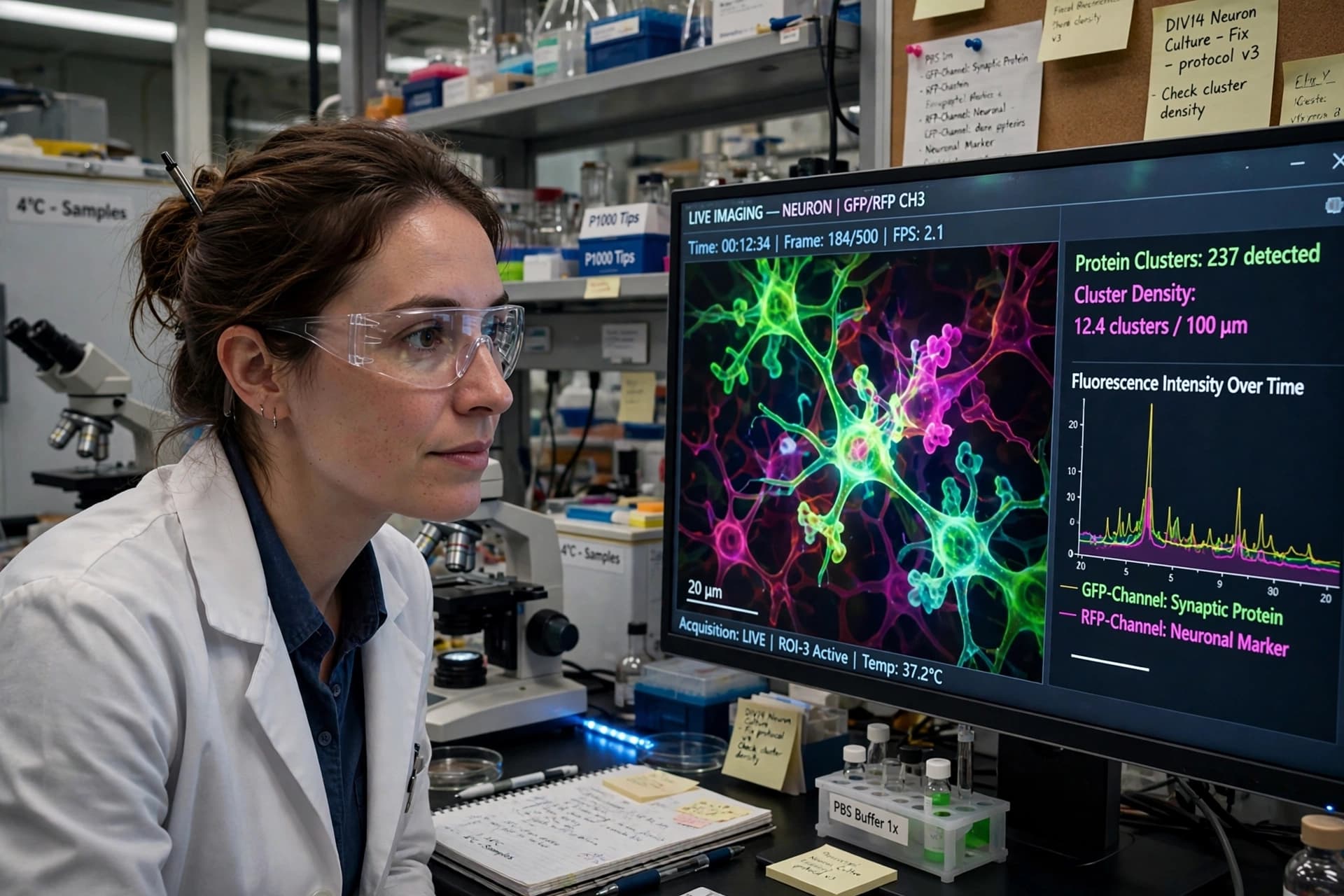
There is a particular frustration that has long defined the search for treatments against Alzheimer's and Parkinson's—the ability to see the disease only from the outside, to measure its symptoms and its aftermath, but never to watch its machinery turn inside the living cell. For decades, drug developers have made high-stakes decisions without a crucial layer of evidence: what a candidate molecule actually does once it is inside a neuron, in real time, at the scale where biology truly operates.
A technology developed at the University of Queensland is beginning to close that gap. The NASTIC platform—Nanoscale Spatiotemporal Indexing Clustering—allows scientists to observe how disease-related proteins move, cluster, and interact inside living neurons, and how potential drug candidates influence those behaviors . The platform is the result of more than two decades of research at UQ's Queensland Brain Institute, led by Professor Frederic Meunier, and has now been spun out into a Brisbane-based startup called Accretion Bio .
The significance of the technology lies in what it reveals. In neurodegeneration, proteins do not simply exist; they move, gather, and form clusters that drive pathology. Traditional methods could measure averages across millions of cells, or examine proteins after the cells had been fixed and killed. NASTIC allows researchers to track these processes as they happen, in living cells, at the single-molecule level . It is, as Accretion Bio CEO Phillip Craig described it, not an incremental improvement but "a new class of evidence" .
The timing of this capability matters. Drug development for Alzheimer's and Parkinson's has been marked by expensive failures in late-stage trials, often because the underlying biology was not fully understood before the investment was made. Craig noted that in neurodegeneration, the functional information gap is "one reason programs fail late and expensively in the clinic" . If researchers can see early whether a candidate actually changes the behavior of its target inside a living cell, they can make better decisions about which programs to advance and which to abandon.
Accretion Bio is backed by global venture firm Antler and supported by UQ's commercialization company UniQuest. The company will work with pharmaceutical and biotechnology partners to apply NASTIC to their programs while advancing its own drug discovery efforts . While the initial focus is neurodegeneration, the platform could also be adapted to study receptor clustering in immunology and oncology, where similar dynamics drive cell signaling .
The technology has already drawn interest from global pharmaceutical companies, and industry-funded research using the platform is underway at QBI . Accretion Bio will present at the AusBiotech 2026 conference on the Gold Coast, seeking to position itself within a global drug discovery landscape that is increasingly attentive to the need for better mechanistic data . The platform's underlying science has been published in Nature Protocols, providing a foundation of peer-reviewed validation .
What the press release does not capture is the human weight of the problem it addresses. Alzheimer's and Parkinson's are diseases that strip memory, movement, and dignity, often over years, while families watch and wait for treatments that have not arrived. The NASTIC platform will not cure these diseases on its own. It is a tool, a lens, a way of seeing. But in a field where so much has been tried and so little has worked, a better way of seeing may be the most valuable contribution of all.
AI Image Disclaimer: The images accompanying this article were generated by artificial intelligence and are intended for illustrative purposes only.
Published by Banx Network. This article is part of the Banx decentralized media programme, powered by the BXE token on the XRP Ledger.