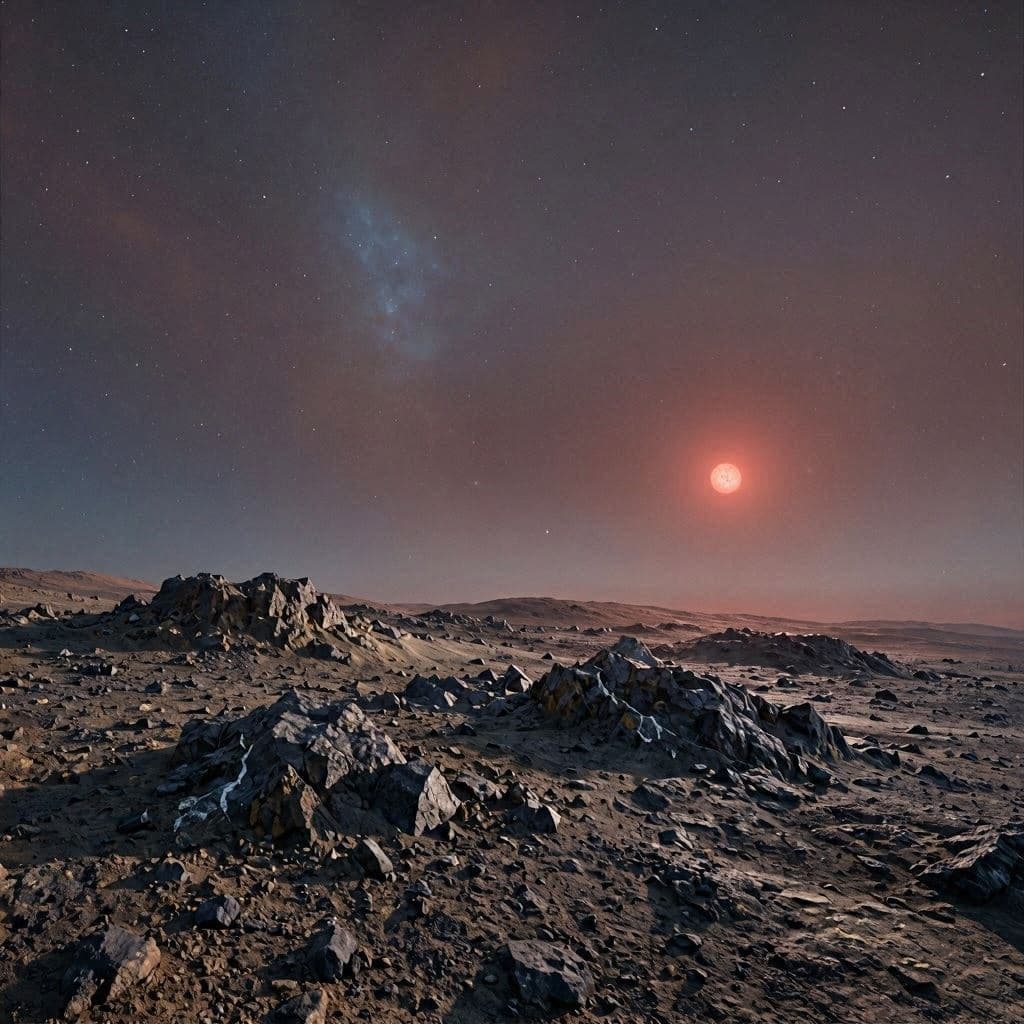
The universe often reveals its greatest discoveries one quiet observation at a time. Each new point of light recorded by a telescope carries the possibility of reshaping humanity's understanding of its place among the stars. Occasionally, that search uncovers not a distant curiosity, but a nearby world that invites scientists to ask whether conditions beyond our Solar System might resemble those that allow life to flourish on Earth.
An international team of astronomers has identified a newly recognized exoplanet considered one of Earth's closest known planetary neighbors. The planet orbits a nearby star within a distance that has drawn considerable scientific interest because preliminary observations suggest it may lie within or near the system's habitable zone, where temperatures could allow liquid water to exist under suitable atmospheric conditions.
Researchers emphasize that the designation "potentially habitable" does not mean the planet has been shown to support life. Instead, it indicates that certain characteristics—including its orbital distance from its host star and estimated environmental conditions—justify further scientific investigation. Many additional factors, such as atmospheric composition, surface pressure, magnetic fields, and geological activity, determine whether a planet can actually sustain life.
The discovery was made using advanced observational techniques that detect subtle changes in a star's motion or brightness caused by the gravitational influence of an orbiting planet. By combining repeated observations with sophisticated data analysis, astronomers were able to estimate the planet's mass, orbital period, and other key properties.
Nearby exoplanets are especially valuable because their relative proximity allows more detailed study with current and future telescopes. Scientists hope that next-generation observatories will be able to analyze the atmospheres of nearby rocky planets, searching for gases such as oxygen, carbon dioxide, methane, and water vapor that can provide insight into planetary environments.
Over the past three decades, astronomers have confirmed the existence of thousands of exoplanets across the Milky Way. Each new discovery contributes to a broader understanding of how planetary systems form and evolve. Rather than searching for an exact duplicate of Earth, researchers seek to understand the remarkable diversity of worlds that populate our galaxy.
The newly identified planet also highlights the rapid progress of astronomical technology. Improvements in telescope sensitivity, precision instrumentation, and computational analysis now enable scientists to detect increasingly smaller and more Earth-like planets around nearby stars. Future missions are expected to refine these observations and reveal additional details about the planet's atmosphere and composition.
Although many questions remain unanswered, the discovery adds another promising destination to the growing catalog of nearby exoplanets. As observations continue, astronomers hope to learn whether this neighboring world offers conditions that resemble our own or presents an entirely different chapter in the story of planetary evolution. Either outcome will deepen humanity's understanding of the universe and the many worlds that share it.
AI Image Disclaimer: The accompanying illustrations are AI-generated artistic visualizations based on current scientific observations and are intended solely for editorial purposes.
Sources University of California, Irvine The Astrophysical Journal EurekAlert New York Post
Published by Banx Network. This article is part of the Banx decentralized media programme, powered by the BXE token on the XRP Ledger.