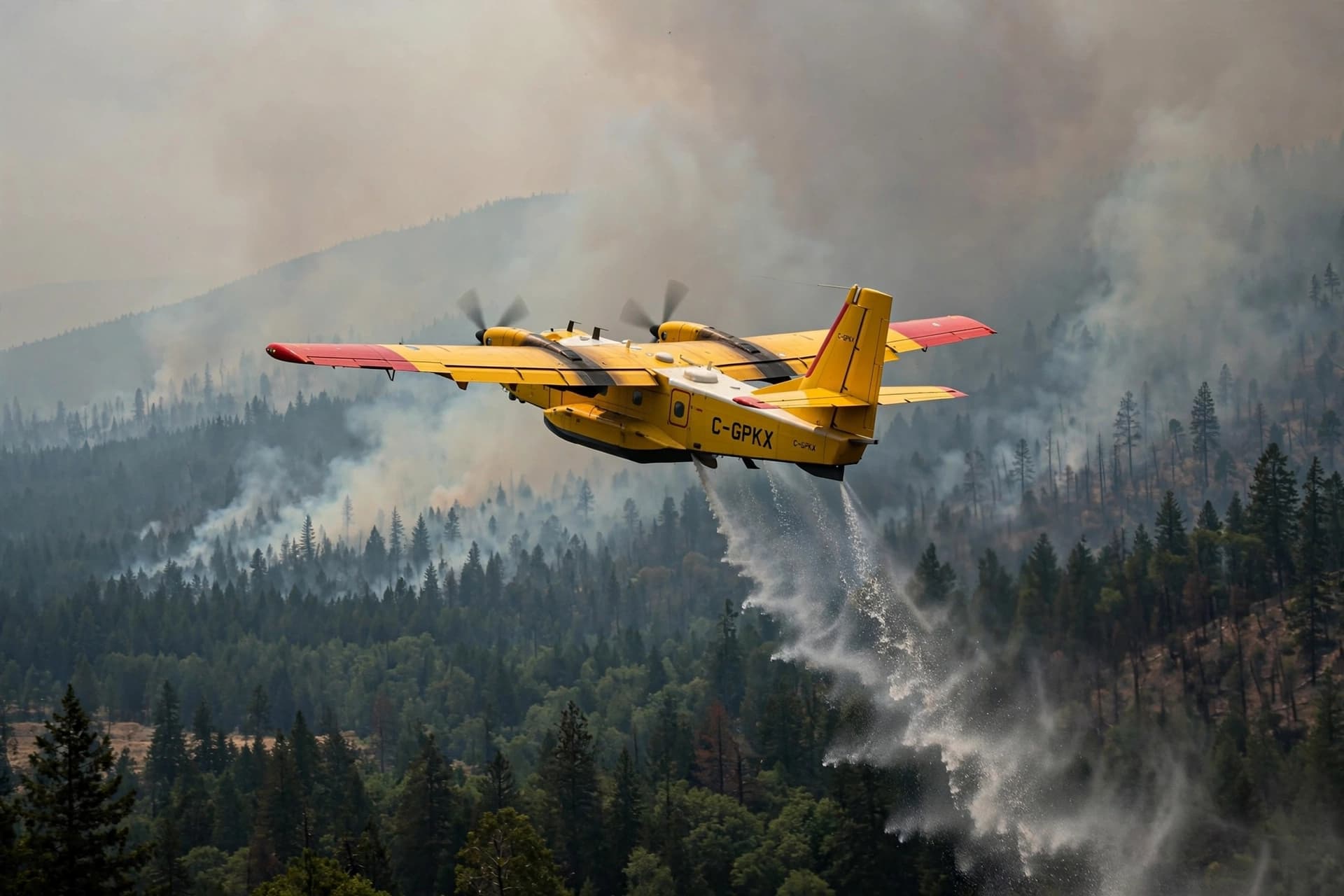
There is a particular irony in the fact that the country that builds the world's most recognizable water bomber does not have enough of them for its own forests. The Canadair, with its mustard-yellow body and ketchup-red wingtips, has become a symbol of aerial firefighting from France to Greece, scooping water from rivers and dropping it on flames that are growing more frequent and more ferocious. In Canada, those same planes are in demand, and the company that makes them says the time for a national fleet is now.
De Havilland Aircraft of Canada is calling for a national fleet of water bombers, arguing that a firm order of 50 aircraft from the federal government or the provinces would give it the financial runway—hundreds of millions of dollars—to launch a second production line at its assembly plant east of Calgary . The company revived production of the Canadair in 2024 after a hiatus that began in 2015, but the supply chain for the aircraft's 60,000 parts had evaporated, pushing the projected delivery date for the first DHC-515 to early 2028 .
Neil Sweeney, De Havilland's vice-president of corporate affairs, framed the argument in terms of both prevention and consequence. "If we want to stop fires from becoming large and becoming megafires, we need to get on them quicker," he said. "And the only way to get on them quicker is to have the infrastructure to do so" . He pointed to wildfires that destroyed about 400 structures in Jasper in 2024, fires in northern Ontario that blanketed parts of the United States in smoke, and blazes in British Columbia that forced tens of thousands from their homes .
The political support is building, though unevenly. Ontario Premier Doug Ford has said Canada needs at least 60 water bombers and a coast-to-coast wildfire strategy . Alberta Premier Danielle Smith is reportedly working with other provincial leaders and the federal government to support a firm order . The Senate's agriculture and forestry committee recommended in June that the federal government create and fund a national firefighting aircraft fleet . But Ottawa has not formally committed to a national program, and the company has 38 orders for water bombers, with the first 22 destined for European countries like Greece and France .
What makes the push urgent is not only the fires but the competition. Aerospace companies in France and Italy are developing their own water bombers, and if De Havilland's backlog grows too long, buyers will look elsewhere. "The danger of a slow ramp-up here is that the scarcity creates its own competition," said Christopher Read, former director of corporate development at Air Canada . There is even a risk, one former defense official noted, that "somebody's going to steal or re-engineer their planes" .
For the communities that have watched fire seasons grow longer and more destructive, the debate in Ottawa and the boardrooms of Calgary may feel distant. But the planes that drop water on a burning hillside are built somewhere, by someone, on a schedule that does not bend to the urgency of a given summer. The question is whether Canada will decide to have enough of them before the next evacuation order is issued.
AI Image Disclaimer: The visuals in this report were produced using artificial intelligence and serve an illustrative purpose only.
Sources: The Canadian Press, Skies Magazine, The Globe and Mail, L'actualité
Published by Banx Network. This article is part of the Banx decentralized media programme, powered by the BXE token on the XRP Ledger.