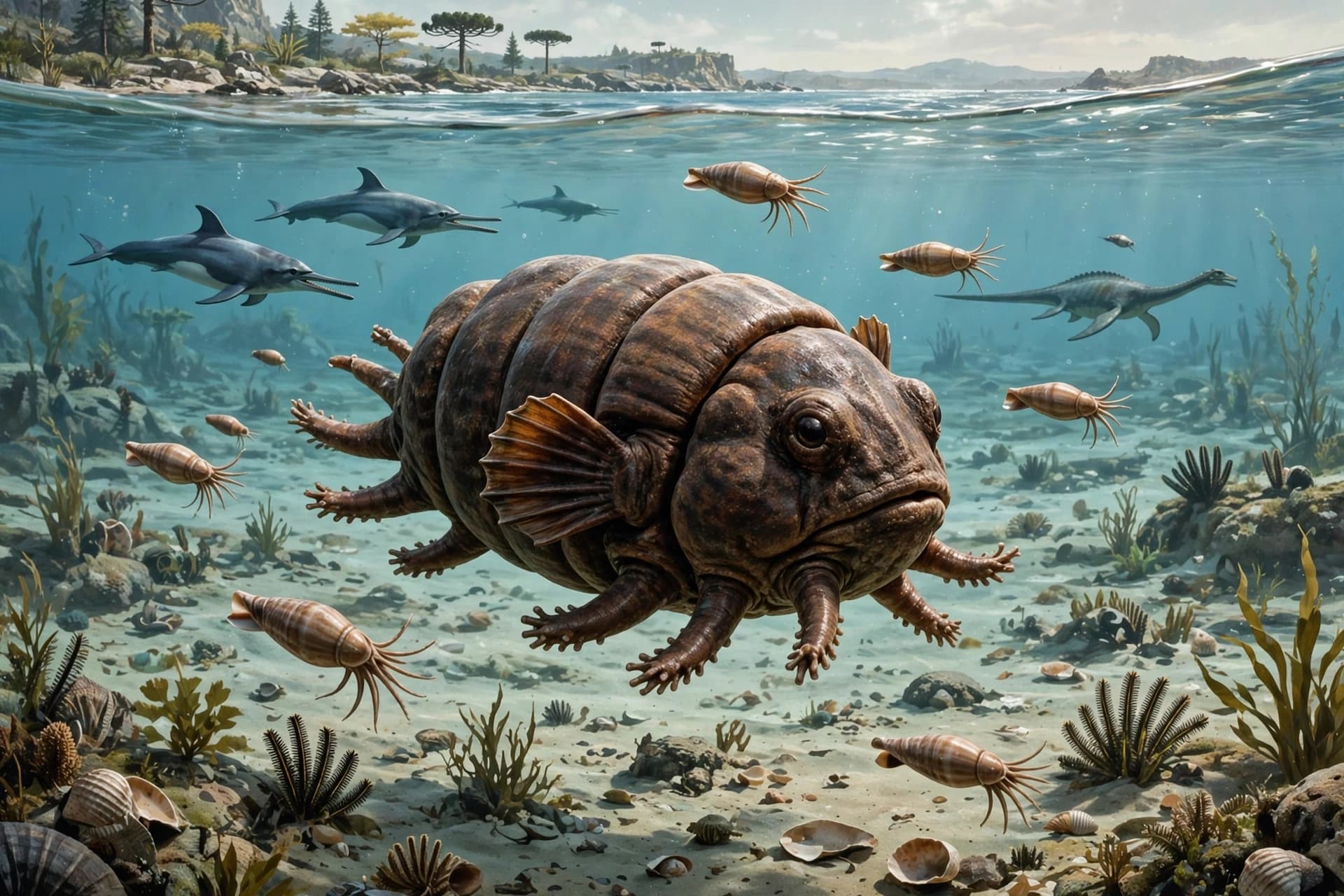
There is a particular rarity in a fossil that arrives not as a familiar shape but as an anomaly, one that sits in a museum drawer for decades because no one quite knows what to make of it. In Wyoming, that anomaly was a belemnite—a squid-like creature from the Jurassic—but not like any belemnite anyone had seen. Most of its kind left behind bullet-shaped fossils the size of a thumb, the ones fossil hunters affectionately call "squid butts." This one was different. It was barrel-shaped, thick, and round, a fossil that stuck out like a sore thumb among the millions of its slender relatives in the Sundance Formation.
The species has now been formally described as Wyoteuthis linsterorum, a new genus and species dating back about 160 million years. Its rostrum—the hard internal shell that fossilizes—measures roughly 10 centimeters long and up to 6 centimeters wide, making it the thickest belemnite ever recorded. With soft parts included, the living animal would have reached around 60 centimeters in total length, about the size of a skateboard, but built with a girth that no other known belemnite possessed . The research, published in Papers in Palaeontology, involved an international team from the United States, the United Kingdom, and New Zealand .
The path to recognition was slow. The first specimen was found in the late 1990s by Dr. Burkhard Pohl, founder of the Wyoming Dinosaur Center, who spotted a belemnite far larger than any he had encountered. It sat unstudied for years. Then, in 2019, fossil collector Cliff Linster discovered a second specimen near Ten Sleep, Wyoming, and donated it to the center. Together, the two fossils provided enough evidence for the team to confirm they belonged to something entirely new . The species name honors Linster and his family; Linster passed away in June 2026, knowing the research was underway .
Using computed tomography, the researchers examined the fossils without damaging them, revealing internal features that confirmed the animal belonged to an ancient family of belemnites previously thought to have disappeared millions of years earlier . The discovery was, in the words of co-author Alexey Ippolitov, "deeply surprised"—a find that rare after more than two centuries of studying this well-documented group .
Why the creature grew so thick is a matter of inference. One possibility is that its larger size gave it an advantage when hunting smaller belemnites of the genus Pachyteuthis, which were abundant in the same waters. Modern squid, after all, are hardly picky eaters; they readily prey on other cephalopods, sometimes even their own kind . Co-author Jessica Lippincott also suggested the shorter, fatter body plan may have contributed to buoyancy or helped the animal occupy a particular place in the water column .
The fossils are rare—only two specimens are known to science—and their position among the common Pachyteuthis remains a question. Whether Wyoteuthis was a predator that lived alongside its smaller relatives or simply a strange outlier in the same ecosystem, the discovery serves as a reminder that the fossil record is far from complete. "Paleontologists have really only cracked the surface of finding life from millions of years ago," Lippincott said .
For now, the chunkiest belemnite on record has a name, a place in the literature, and a family honored in its designation. It is not a giant in length, not a monster of the Jurassic seas. It is simply, stubbornly, and unexpectedly different—a reminder that even in a formation that has yielded millions of fossils, there are still shapes waiting to be recognized.
---
AI Image Disclaimer: The visuals in this article are generated by artificial intelligence and are intended for illustrative purposes only.
Sources: EurekAlert!, IFLScience, Popular Science, Cowboy State Daily, Papers in Palaeontology
Published by Banx Network. This article is part of the Banx decentralized media programme, powered by the BXE token on the XRP Ledger.