There are distances in the universe so vast that even movement feels like stillness. Galaxies drift, light travels, and yet everything unfolds at a pace that asks for patience rather than urgency. But every so often, the quiet reveals something more dramatic—a meeting set in motion long before human eyes ever turned upward.
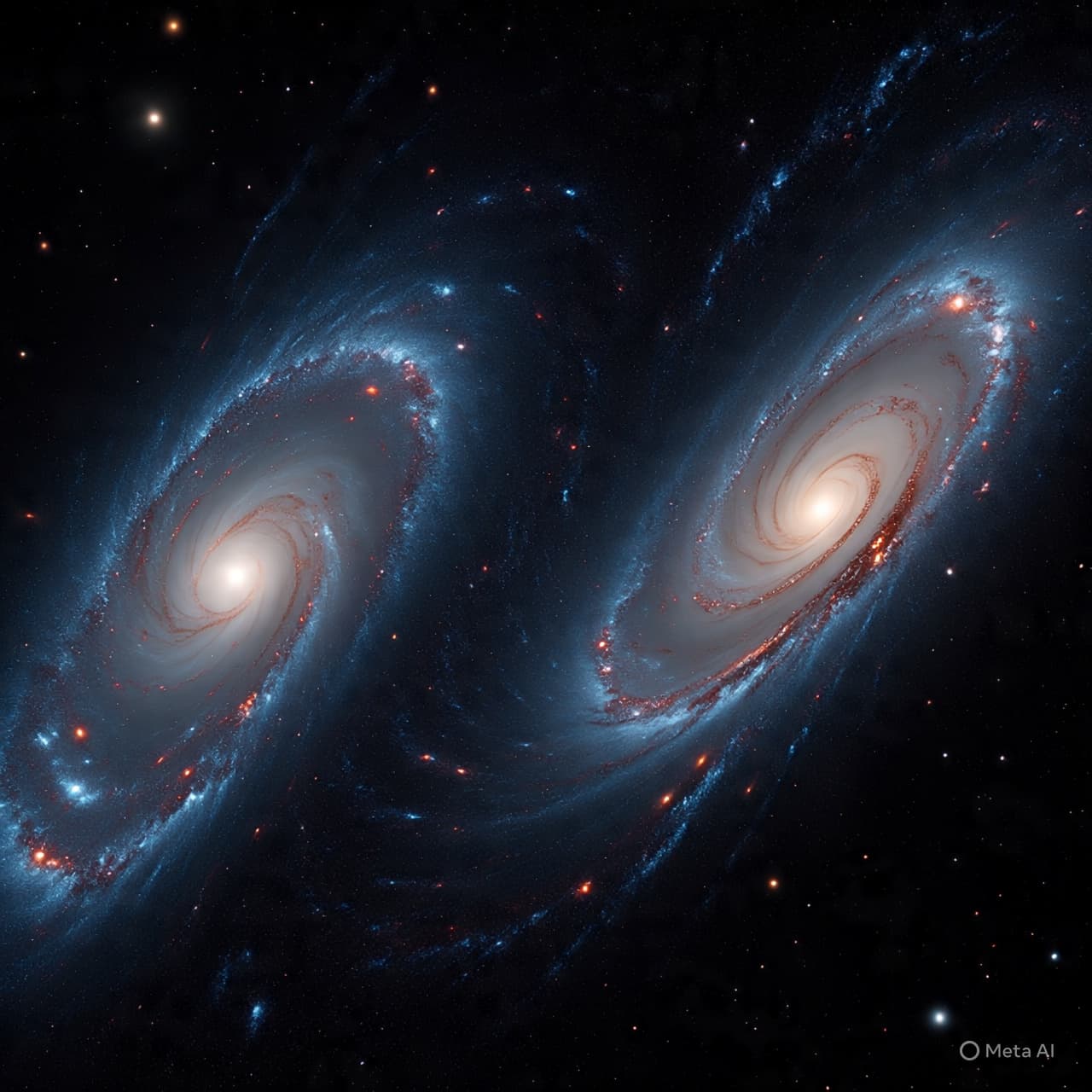
Astronomers have recently captured a striking deep-space image showing two galaxies on a gradual collision course, a moment suspended in time yet shaped by forces billions of years in the making. These galaxies, bound by gravity’s persistent pull, are not rushing toward impact in any familiar sense. Instead, they are engaged in a slow, inevitable approach—one that will unfold over millions, if not billions, of years.
In the language of astronomy, such encounters are neither rare nor catastrophic in the way they might seem. Galactic collisions are a natural part of cosmic evolution. When galaxies meet, they do not simply crash like solid objects. Rather, they begin a complex interaction—stars passing by one another, gas clouds compressing, and new stars often forming in the process.
The image itself, likely captured by advanced observatories working across multiple wavelengths, offers more than visual beauty. It provides data—subtle distortions in shape, faint bridges of light stretching between the galaxies, and hints of gravitational influence already at work. These features allow scientists to understand not only where the galaxies are, but how they are moving and what may come next.
Such observations also invite a broader reflection on scale. The distances between stars within galaxies are so immense that direct collisions between individual stars are unlikely. Instead, it is the structure of the galaxies—their arms, their halos, their interstellar material—that undergo transformation. Over time, the two galaxies may merge into a single, larger system, reshaped by their interaction.
Events like these are not distant curiosities alone. They offer insight into the history of our own cosmic neighborhood. The Milky Way, for instance, is expected to merge with the Andromeda Galaxy in the far future. In that sense, the image of these two galaxies becomes not just a snapshot of elsewhere, but a quiet preview of what may one day unfold closer to home.
There is also a certain stillness in how such images are received. A moment that spans millions of years is captured in a single frame, allowing human observers to see what would otherwise be imperceptible. It is a reminder that astronomy often compresses time, bringing distant processes into view in ways that feel both immediate and distant at once.
And perhaps that is where the true significance lies. Not only in the scientific data or the visual impact, but in the perspective it offers—a sense of motion that exists beyond urgency, a transformation that unfolds without haste.
Closing The captured image of two galaxies on a collision course adds to a growing body of observations that help scientists understand how galaxies evolve over time. While the process itself will continue far beyond human timescales, such images provide valuable insight into the dynamics shaping the universe.
AI Image Disclaimer Visuals are created with AI tools and are not real photographs.
Source Check (Credible Media Identified):
NASA ESA (European Space Agency) Space.com Sky & Telescope Scientific American
Published by Banx Network. This article is part of the Banx decentralized media programme, powered by the BXE token on the XRP Ledger.