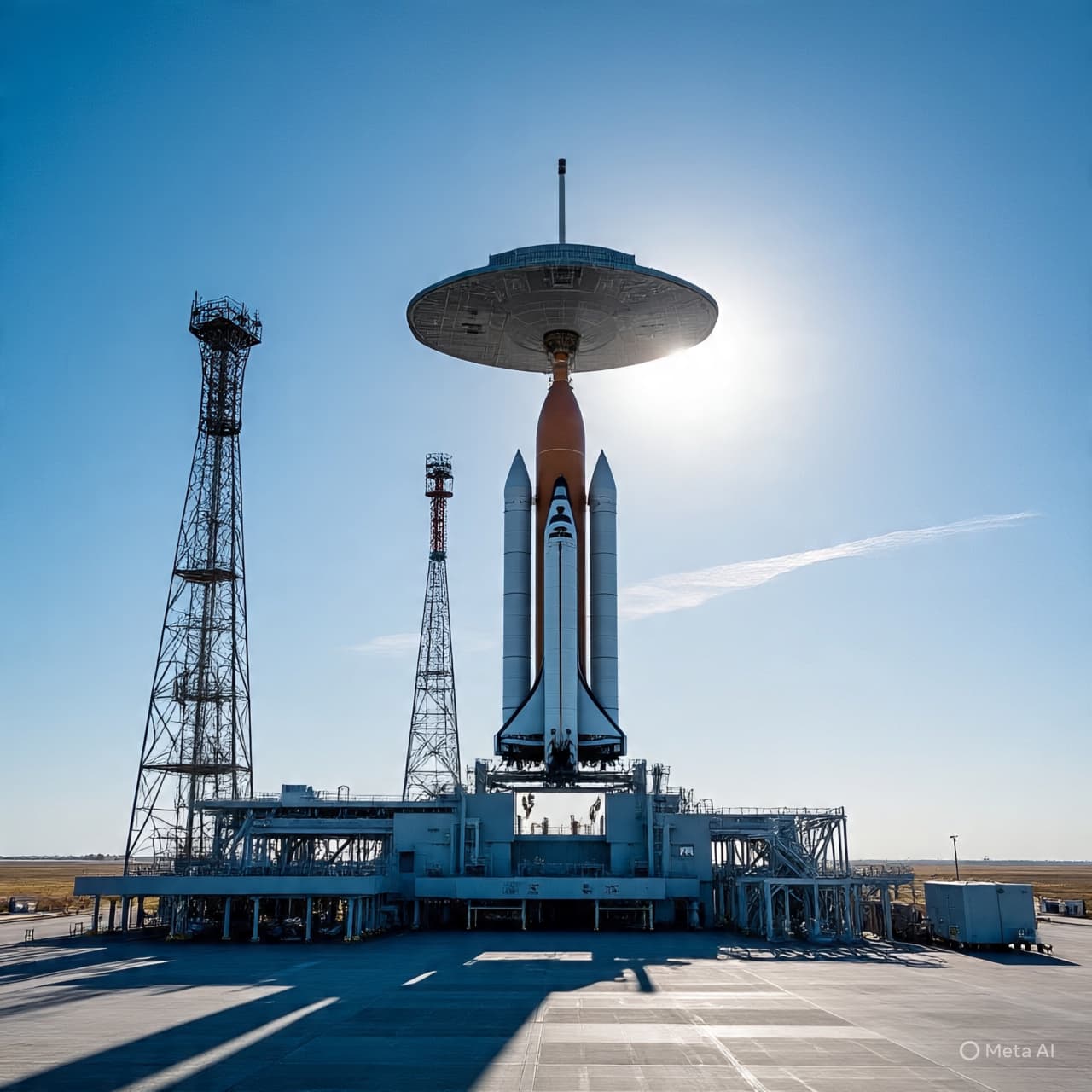
In the quiet expanse of space exploration, a new chapter is preparing to unfold: four astronauts are set to leave Earth’s orbit and travel around the Moon for the first time in more than half a century. As the Space Launch System rocket and the Orion spacecraft sit poised on the launchpad, a blend of excitement and thoughtful concern hangs in the air, much like a sky at dusk where light and shadow gently intermingle.
The mission, known as Artemis II, represents a symbolic and practical bridge between humanity’s Apollo‑era lunar journeys and the possibilities of sustained deep‑space exploration. Scheduled for launch early in February 2026, this roughly 10‑day journey will carry four astronauts — including veterans of Earth orbit and newcomers to deep space — on a trajectory that will take them farther from our planet than any human has traveled since 1972.
Yet alongside the anticipation, there is a conversation among scientists and engineers that resembles a careful exchange between seasoned climbers preparing for a rugged ascent. At its heart lies the Orion spacecraft’s heat shield, a piece of hardware engineered to protect astronauts when the capsule returns through Earth’s atmosphere at blistering speeds. During the uncrewed Artemis I mission in 2022, the heat shield experienced more wear and charring than engineers expected, prompting intense study and debate about the material’s performance.
NASA has stated that it understands the issue well enough to move forward, adapting the spacecraft’s reentry path to reduce stress on the shield and asserting confidence in crew safety. Agency leaders also emphasize that every system — from life support to launch abort mechanisms — has been subjected to rigorous testing and review.
But not all experts share the same degree of assurance. Some former NASA personnel and materials specialists have described the heat shield as “deviant” in its behavior and question whether the mission should proceed as planned without a fully redesigned shield. For these critics, the concern is not that the mission will fail catastrophically, but that unresolved subtle risks could compromise astronaut safety or validate design choices that warrant deeper scrutiny.
The debate underscores a profound tension that has accompanied human spaceflight since the earliest days of rocketry: models and simulations can predict a great deal, yet the reality of space — with its extreme temperatures, vacuum, and high velocities — still surprises us. Like explorers in centuries past, NASA’s engineers must balance caution with forward motion, recognizing that every milestone in space comes with inherent uncertainties.
As Artemis II draws near, with names of millions of people around the world symbolic tucked aboard the spacecraft, the mission takes on both technical and emotional resonance. It invites us to reflect on not only how far we can go, but also how wisely we prepare to get there.
In this interplay between aspiration and caution, the mission’s outcome — when it arrives — will add another layer to the long story of human spaceflight. Whether Orion’s journey becomes a testament to prudent engineering or a catalyst for deeper design improvements, it will surely shape future steps toward the lunar surface and beyond.
AI Image Disclaimer (Rotated Wording) “Images in this article are AI‑generated illustrations, meant for concept only.”
Sources (Credible Mainstream/Niche) CNN Digg / aggregated news Vocal.media summary Wikipedia KSL News
Published by Banx Network. This article is part of the Banx decentralized media programme, powered by the BXE token on the XRP Ledger.