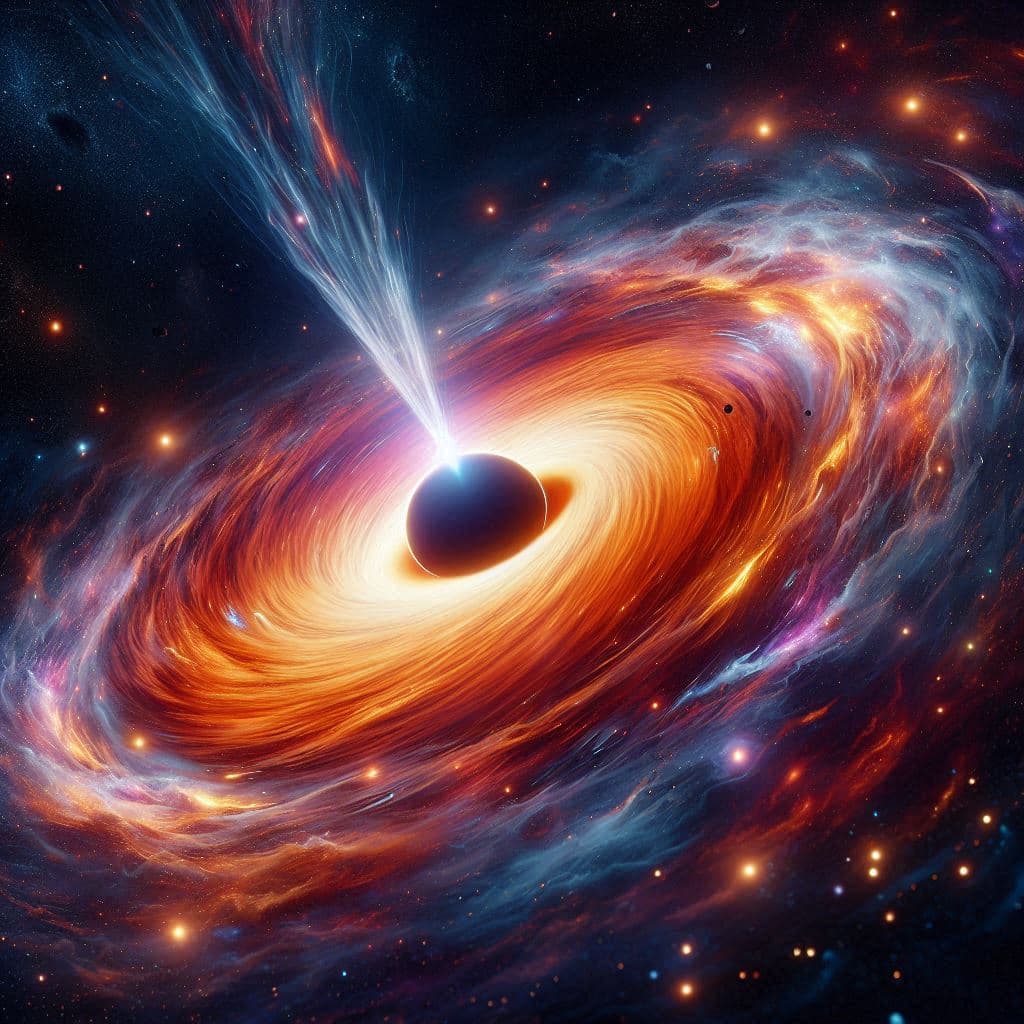
Sometimes the universe sends a message so strange that it feels less like an answer and more like a question. In 2023, a single particle reached Earth carrying an energy so extreme that it briefly unsettled the calm confidence of astrophysics. It arrived quietly, detected not by sight but by instruments designed to listen for the faintest whispers of the cosmos. Almost immediately, speculation followed, drifting toward one of space’s most enigmatic residents: the black hole.
Black holes are known for their restraint. They consume, they bend, they silence. The idea that one could explode runs against their very definition, like imagining a shadow suddenly casting light. Yet the particle detected in 2023, a neutrino with extraordinary energy, does not fit easily into existing explanations. Its path appears to trace back to a distant, violent region of the universe, where matter and gravity interact at their limits.
Scientists are careful with their language. No telescope recorded a black hole tearing itself apart, and no theory currently allows such an event in a literal sense. Instead, researchers suggest the particle may have been born near a black hole, not from its destruction but from the extreme environments surrounding it. Jets of material accelerated close to light speed, collisions near accretion disks, or interactions involving magnetic fields could all produce such a traveler.
Neutrinos themselves are elusive messengers. They pass through galaxies, stars, and planets almost untouched, carrying information from places light cannot escape. Detecting one of such high energy offers a rare glimpse into cosmic processes that operate beyond ordinary scales. It is this rarity that fuels the question: what kind of engine could produce something so powerful?
The discussion now unfolding is less about spectacle and more about refinement. Each hypothesis is tested against models, observations, and the quiet discipline of mathematics. Rather than rewriting the rules of black holes, the event may deepen understanding of how matter behaves in their vicinity. It may also point toward previously unseen cosmic accelerators, expanding the map of extreme phenomena.
For now, astronomers describe the finding as provocative but unresolved. The particle remains a clue rather than a conclusion, one data point among many still to come. Whether it ultimately reshapes theories or simply sharpens them, its arrival has reminded scientists that the universe still holds the capacity to surprise, even through a single, fleeting visitor that crossed unimaginable distances to reach Earth.
AI Image Disclaimer Illustrations were produced with AI and serve as conceptual depictions.
Sources Nature Science NASA Space.com New Scientist
Published by Banx Network. This article is part of the Banx decentralized media programme, powered by the BXE token on the XRP Ledger.