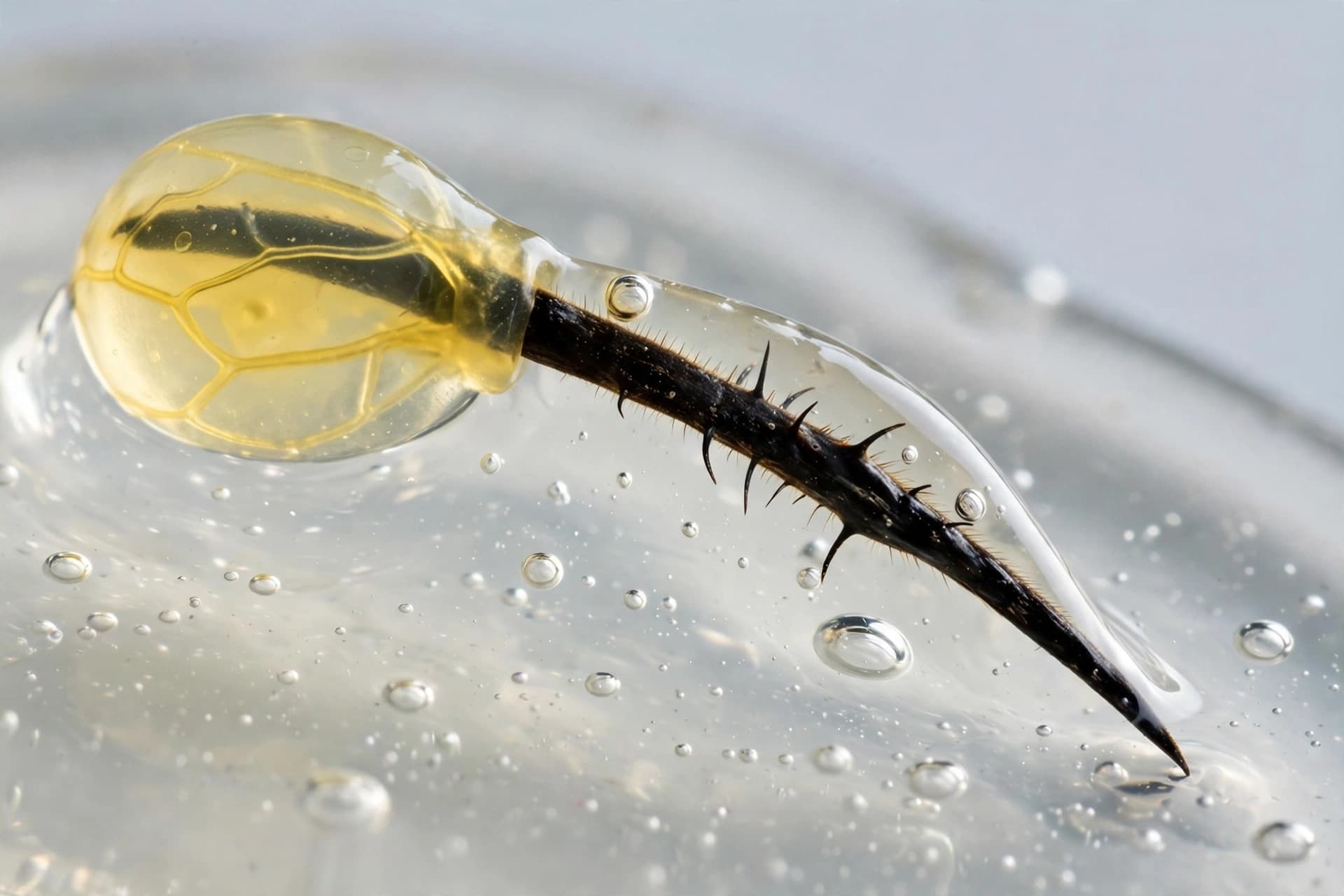
In the deep ocean, where food is scarce and the darkness stretches in every direction, survival is not a matter of elegance but of opportunity. When a meal presents itself, there is no time for moderation, no room for the luxury of portion control. This is the world of the black swallower, a fish no longer than a school ruler that has evolved to swallow prey up to ten times its own mass—a feat that seems to defy the basic geometry of the natural world.
Recently, scientists exploring the waters near Trinidad and Tobago captured something rarely seen: a black swallower, alive and swimming at 1,259 meters below the surface, its stomach so distended that its skin had stretched nearly transparent . The remotely operated vehicle SuBastian, part of a Schmidt Ocean Institute expedition led by Dr. Diva Amon, recorded the fish carrying its enormous meal through the darkness, its internal organs visible through the stretched belly .
“They are notoriously rare to spot in the wild,” Amon said. “I saw my first nearly a decade ago in the Gulf of Mexico. I never imagined I’d get a second chance” . The footage is unusual not only because the fish was alive—most specimens have been found dead at the surface—but because the distension was more extreme than in previous live sightings .
The black swallower’s ability to consume prey far larger than itself comes from two remarkable adaptations. Its jaw can dislocate, opening wider than its body would seem to allow. Its stomach, meanwhile, stretches like a balloon, accommodating meals that would otherwise be impossible . The combination allows the fish to take advantage of rare feeding opportunities in an environment where a meal might not appear again for weeks.
But this strategy carries risk. If the fish cannot digest its meal quickly enough, the food begins to decay, releasing gases that can force the fish toward the surface—a fatal ascent for a creature adapted to the crushing pressures of the deep . Most specimens have been found floating dead, their stomachs still swollen with undigested prey. One famous case from 2007 involved a 19-centimeter black swallower that had swallowed a snake mackerel measuring 86 centimeters, a meal 4.5 times its own length .
What the fish in the recent footage had eaten remains a mystery. The skin was too opaque with digestion to identify the prey, and the researchers had no way to scan the stomach contents. “If only we had a CT scanner at sea,” Amon said. “The mystery of what this little guy had for lunch may never be solved” .
The sighting adds to a small but growing body of observations about a creature that remains poorly understood. Scientists still do not know, for example, whether the black swallower typically eats its prey tail-first, as some have speculated based on the shape of its teeth, or whether it has other strategies for managing such oversized meals . Each rare encounter in the wild offers a fragment of a picture that is still largely incomplete.
For now, the image of that small fish swimming through the deep with its impossible burden serves as a reminder of how little we know about the ocean’s quieter corners—and how strange and ingenious the solutions to survival can be.
AI Image Disclaimer: The imagery in this article was created using artificial intelligence for illustrative purposes and does not depict the actual fish or expedition footage described.
Sources: ScienceAlert, Schmidt Ocean Institute, A TARDE
Published by Banx Network. This article is part of the Banx decentralized media programme, powered by the BXE token on the XRP Ledger.

.jpg&w=3840&q=75 "September 2026 Was the Second-Warmest on Record, With Global Temperatures Above 1.5°C for a Second Month")