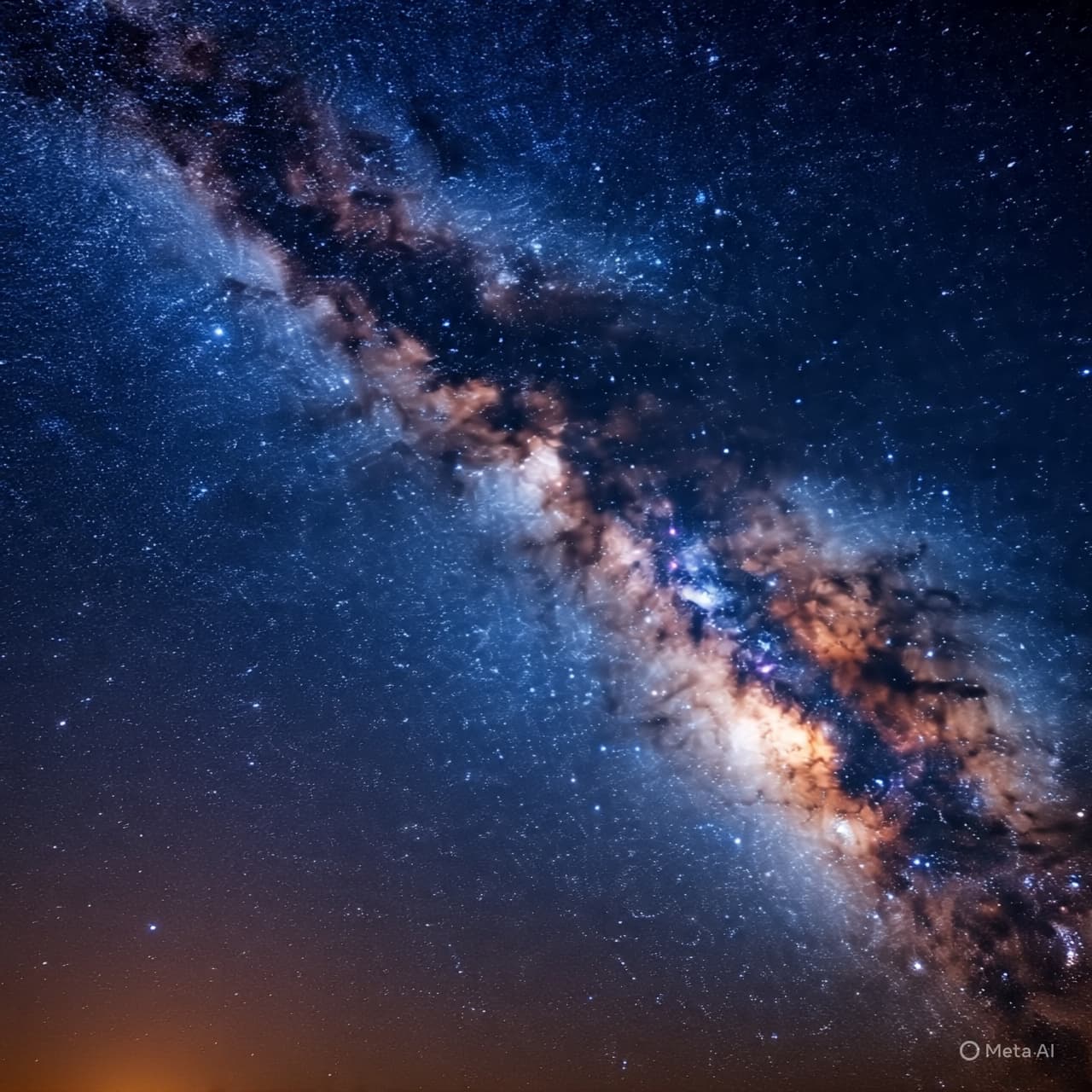
The night sky has always felt like a vast curtain, drawn gently across the stage of our questions. For centuries, humanity has tilted its head upward, wondering what stories shimmer in the quiet river of stars we call the Milky Way. Now, a newly released image offers not just beauty, but clarity — a luminous “window” into how stars are born, evolve, and quietly reshape the galaxy we inhabit.
The new photograph, captured through advanced astronomical instruments sensitive to wavelengths beyond visible light, reveals intricate details of dense molecular clouds within the Milky Way. These clouds — vast, cold regions composed primarily of hydrogen gas and cosmic dust — are the birthplaces of stars. Though they appear as dark silhouettes in ordinary images, specialized observations allow astronomers to peer through the obscuring dust and uncover what lies within: glowing filaments, embryonic stars, and pockets of turbulent gas slowly collapsing under gravity.
Scientists describe the image as a kind of galactic window because it allows researchers to trace the earliest stages of star formation. Within these stellar nurseries, gravity gently gathers material until pressure and temperature rise high enough to ignite nuclear fusion. When that ignition occurs, a new star begins to shine. The newly published photo captures several of these early formations, some still cocooned in gas, others already illuminating their surroundings.
What makes the image particularly significant is its resolution and depth. By combining data from multiple observatories operating at infrared and radio wavelengths, researchers can see through cosmic dust that would otherwise block the view. Infrared light, in particular, penetrates dense clouds more effectively than visible light, revealing structures that were once hidden. The result is not merely a beautiful portrait, but a scientific map of dynamic processes unfolding over millions of years.
Astronomers note that understanding how stars form is central to understanding galaxies themselves. Stars are not isolated actors; they influence their surroundings through radiation, stellar winds, and eventually supernova explosions. These processes distribute heavier elements — carbon, oxygen, iron — into space, enriching future generations of stars and planets. In that sense, studying star formation is also a way of tracing the origins of planetary systems, and perhaps even the building blocks of life.
The Milky Way, our home galaxy, contains hundreds of billions of stars. Yet despite that abundance, the act of star formation remains delicate and complex. Not every cloud becomes a star; turbulence, magnetic fields, and nearby stellar activity can accelerate or halt the process. This new image offers scientists an opportunity to test theoretical models against observable detail, refining our understanding of how gravity and energy interact on a galactic scale.
There is something quietly humbling in recognizing that these glowing knots of light, captured in a distant spiral arm of the Milky Way, represent beginnings. Our own Sun was once such a spark within a cloud, indistinguishable from countless others. In studying these distant nurseries, astronomers are, in a sense, studying our own origin story written across the sky.
The release of this photograph provides researchers with fresh data to analyze and compare with existing simulations of star formation. As observatories continue to collect higher-resolution images across different wavelengths, scientists hope to deepen their understanding of the complex cycles that shape galaxies. For now, this new window into the Milky Way stands as both a scientific milestone and a reminder that the night sky still holds revelations waiting patiently in the dark.
AI Image Disclaimer Illustrations were produced with AI and serve as conceptual depictions.
Source Check — Credible Media Coverage Found:
Space.com Live Science BBC Science Focus ScienceAlert The Guardian
Published by Banx Network. This article is part of the Banx decentralized media programme, powered by the BXE token on the XRP Ledger.