There is a quiet persistence in the pursuit of understanding the Sun, a star so familiar that we rarely pause to consider how little we truly know about its moods. It warms us, lights our days, and occasionally throws tantrums of charged particles that disrupt satellites, power grids, and radio communications. For decades, solar physicists have dreamed of an instrument capable of seeing the Sun's magnetic turbulence in unprecedented detail—a telescope that could trace the emergence of magnetic fields from the solar surface and follow their energy as it flows into the atmosphere. That dream has now taken a significant step forward.
The European Solar Telescope (EST) has been granted ESFRI Landmark status by the European Strategy Forum on Research Infrastructures, a designation that recognizes projects that have reached an advanced stage of implementation and demonstrated strategic relevance for European science . The decision was made at ESFRI's 97th meeting in Cork, Ireland, on September 23 and 24, 2026. EST had been included in the ESFRI Roadmap as a project since 2016; the upgrade to Landmark status acknowledges the maturity the project has achieved after years of design and development .
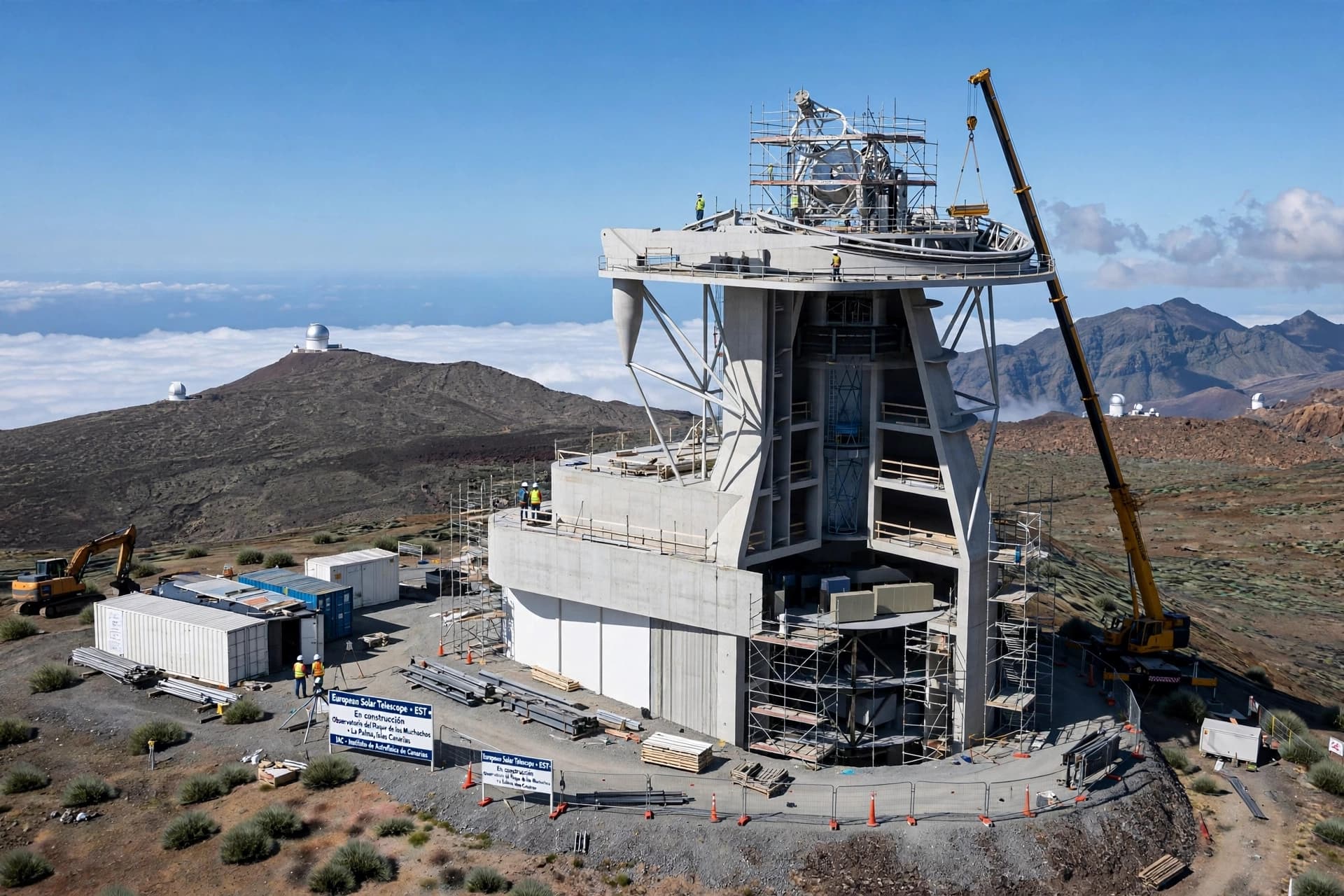
The telescope will be built at the Roque de los Muchachos Observatory on La Palma in the Canary Islands, a site already home to numerous astronomical instruments . Its primary mirror will measure 4.2 meters across, and its suite of instruments is designed to observe the solar atmosphere at multiple heights simultaneously and across different wavelengths . This capability will allow researchers to follow the emergence and evolution of magnetic fields at the solar surface and investigate how energy is transported through the solar atmosphere—processes fundamental to understanding solar activity and the eruptions that drive space weather .
The Sun is the only star whose surface and lower atmosphere can be observed in such detail, making it a unique laboratory for studying fundamental physical processes that occur throughout the universe . EST's observations will complement those from solar space missions, providing a more complete picture of how the Sun works . As Manuel Collados, EST Coordinator, explained, "EST is, by its very nature, a European project. No single institution or country could undertake an infrastructure of this scale and ambition alone" .
The project brings together institutions from across Europe, coordinated by the EST Foundation with strong support from the Instituto de Astrofísica de Canarias . The UK Universities Consortium, led by the University of Sheffield, includes researchers from Sheffield, Aberystwyth, Durham, Exeter, Glasgow, Queen's University Belfast, University College London, and Rutherford Appleton Laboratory . Professor Robertus Erdélyi of Sheffield described the milestone as "the result of years of excellent work by many people and institutions in the UK and across Europe" .
Landmark status does not, in itself, guarantee construction. As the UK Solar Physics community noted, achieving this status was "a necessary, but not sufficient, condition" for the telescope to be built . The designation strengthens the case for funding and places EST in a significantly stronger position as it moves toward the construction phase. Héctor Socas-Navarro, Director of the EST Foundation, said the recognition "acknowledges the maturity and strategic relevance that the project has now reached within the European research infrastructure landscape" .
For solar physicists, the promise of EST is the promise of clarity. The Sun's magnetic fields are tangled and dynamic, and the mechanisms that drive solar eruptions remain incompletely understood. An instrument capable of observing the solar atmosphere at multiple heights simultaneously would provide the data needed to constrain and improve theoretical models, bringing researchers closer to understanding the star that shapes the space environment around Earth . The path from Landmark status to first light is long, but the direction is now clearer than it has ever been.
AI Image Disclaimer: The imagery in this article is AI-generated and serves an illustrative purpose only.
Sources:
· UK Solar Physics · INAF (Italian National Institute for Astrophysics) · University of Sheffield · University of Exeter
Published by Banx Network. This article is part of the Banx decentralized media programme, powered by the BXE token on the XRP Ledger.