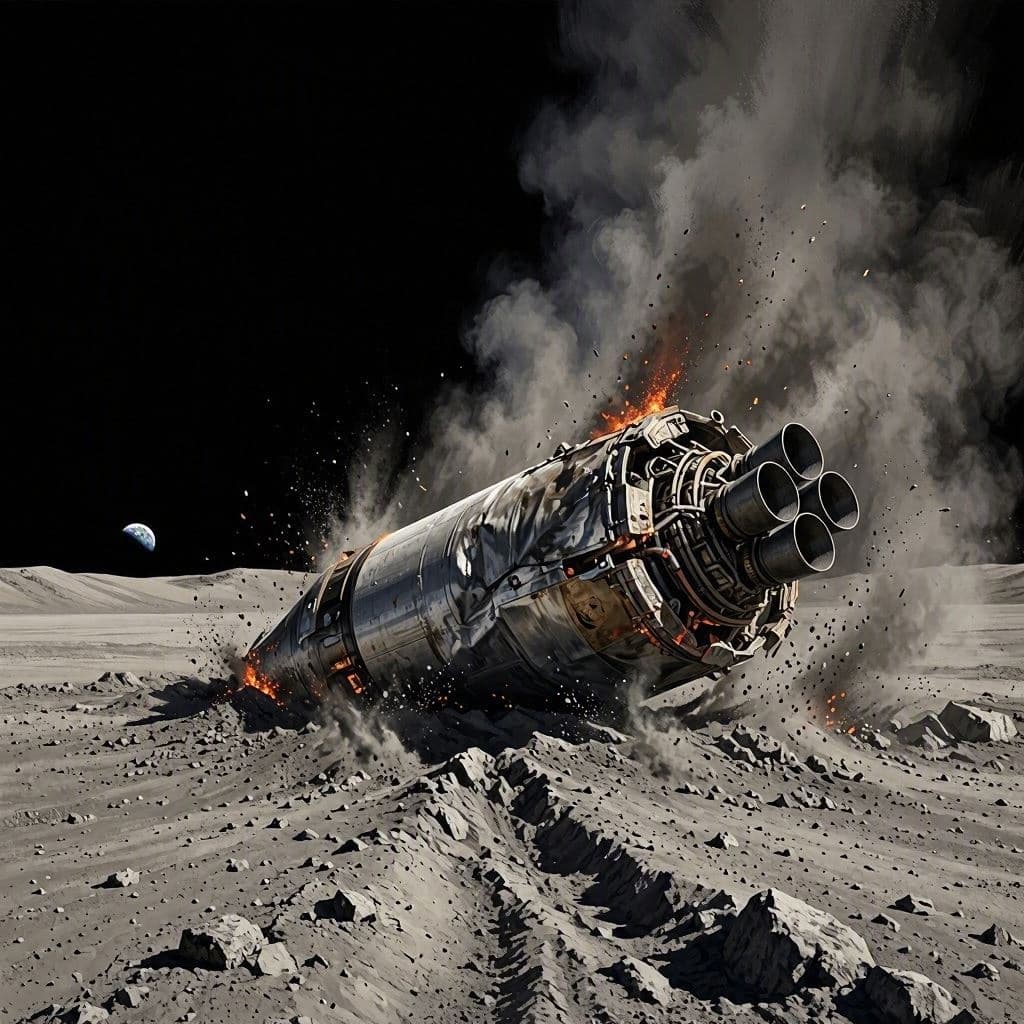
In the silent vacuum of space, objects travel on paths dictated by gravity and momentum, often for years after their useful life has ended. Recently, one such object—a discarded upper stage from a SpaceX Falcon 9 rocket—completed its long journey by colliding with the Moon. Astronomers had tracked its trajectory for months, predicting the impact with precision. When the moment arrived, the collision confirmed their calculations, offering a rare opportunity to study the effects of human-made impacts on lunar surface.
The rocket part, identified as catalog number 2025-010D, weighed several tons and struck the Moon at approximately 5,400 miles per hour. The impact occurred near the crater Einstein on the western lunar limb, a remote area not visible from Earth. While no telescopes could directly observe the crash due to its location, scientists used seismic data and orbital imagery to confirm the event. The certainty of the impact highlights the advanced tracking capabilities of modern astronomy.
This was not the first time a rocket stage has hit the Moon, but it is one of the most well-documented. Previous impacts, such as those from NASA’s LCROSS mission, were intentional and designed to search for water ice. The SpaceX impact, however, was accidental, a result of orbital decay after the rocket delivered its payload to space. Despite its unintentional nature, it provides valuable data for understanding how kinetic energy transfers to lunar regolith.
Researchers are analyzing the resulting crater to estimate the size and depth of the impact. This information helps refine models used for future lunar missions, particularly those involving landings and construction. Understanding how the surface reacts to high-speed collisions is crucial for ensuring the safety of astronauts and equipment. The accidental crash thus serves as an unplanned experiment in planetary science.
SpaceX has acknowledged the incident, noting that the company follows international guidelines for space debris mitigation. However, the event has sparked discussion about the growing amount of junk in orbit and the need for better end-of-life protocols for rocket stages. As commercial spaceflight expands, managing debris becomes increasingly important to protect both Earth and celestial bodies.
For the scientific community, the impact is a reminder of the interconnectedness of space activities. Every launch leaves a trace, and every trace can have consequences. By studying these events, scientists gain insights that benefit future exploration. The Moon, our closest neighbor, continues to be a laboratory for understanding the cosmos.
The confirmed impact of the SpaceX rocket stage on the Moon is a testament to the precision of orbital mechanics. While accidental, it provides valuable scientific data and raises important questions about space sustainability. As we look to the stars, we must also care for the paths we leave behind.
AI Image Disclaimer: The images provided are AI-generated to visually represent the astronomical and space exploration aspects of the story.
Sources: CNN Space.com ABC News
Published by Banx Network. This article is part of the Banx decentralized media programme, powered by the BXE token on the XRP Ledger.