At the foundation of the universe, beneath the solidity of objects and the certainty of weight, lies a question that has long resisted simple answers. Why does matter possess mass at all? It is a quiet mystery, woven into every atom, yet seldom visible in everyday experience.
Physicists are exploring the possibility that an exotic particle, not yet fully confirmed, may help explain how matter acquires mass. The idea builds upon the framework established by the Higgs boson, discovered in 2012, which provided a mechanism for particles to gain mass through interaction with a pervasive field.
While the Higgs boson answered many questions, it did not resolve all inconsistencies within particle physics. Researchers have continued to investigate whether additional particles or forces might refine or extend the current model.
The proposed exotic particle could interact with known particles in subtle ways, potentially accounting for discrepancies observed in experimental data. Such findings often emerge from high-energy experiments conducted in particle accelerators, where conditions approximate those just after the Big Bang.
Scientists emphasize that the particle remains hypothetical, supported by indirect evidence rather than direct detection. Careful verification is required, often involving repeated experiments and independent confirmation from multiple research teams.
If confirmed, the discovery would not overturn existing theory but rather complement it, filling gaps that have persisted for decades. This incremental approach reflects the nature of scientific progress, where each advancement builds upon prior understanding.
The implications extend beyond theoretical physics. A deeper grasp of mass could influence fields ranging from cosmology to materials science, offering new ways to interpret the structure of the universe.
For now, the research continues with measured optimism, guided by data rather than assumption.
The search for answers about mass remains ongoing, but each step brings science closer to understanding one of its most fundamental questions.
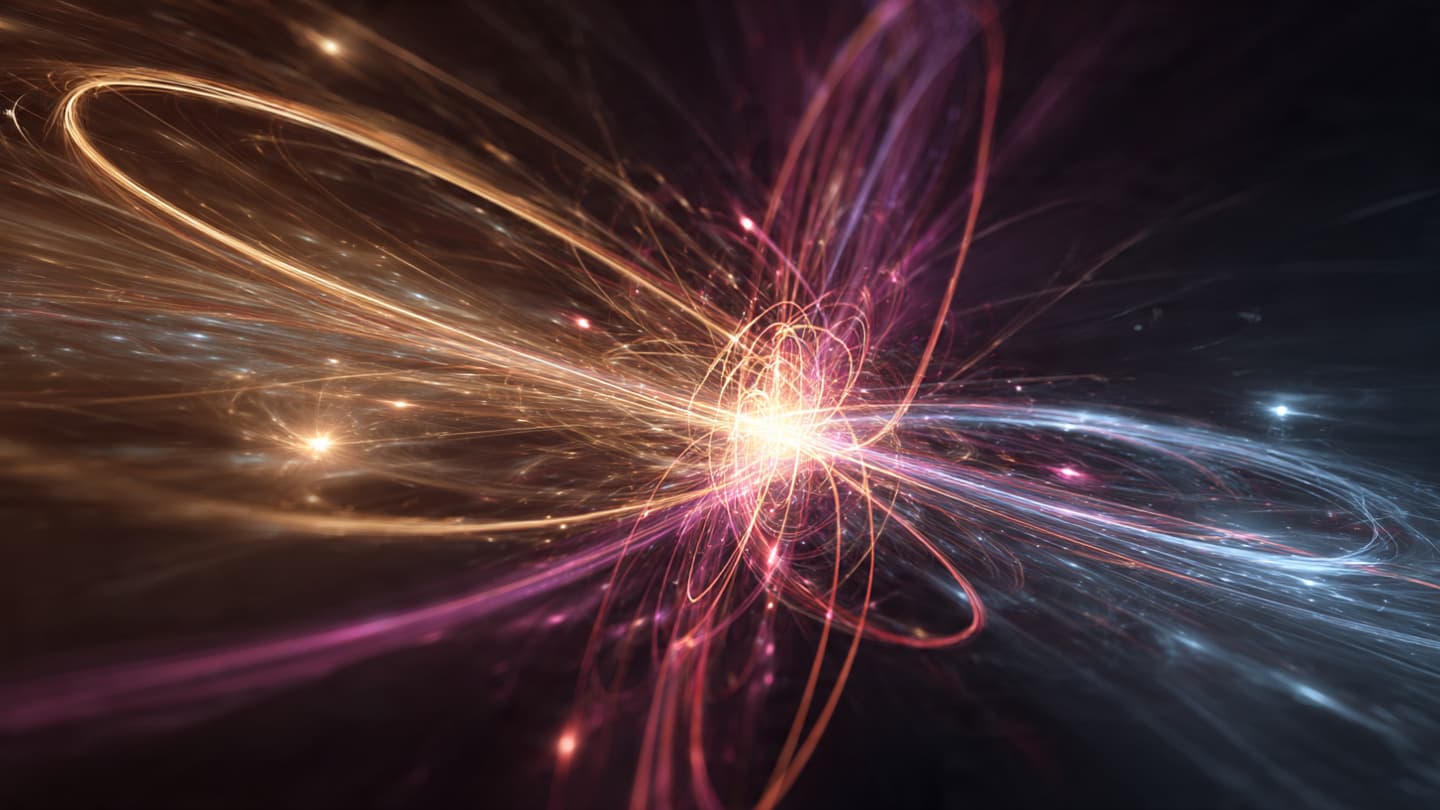
AI Image Disclaimer: Images are AI-generated and serve as conceptual representations of particle physics phenomena.
Sources: CERN, Nature Physics, Science Magazine, BBC Science, The Guardian
Published by Banx Network. This article is part of the Banx decentralized media programme, powered by the BXE token on the XRP Ledger.