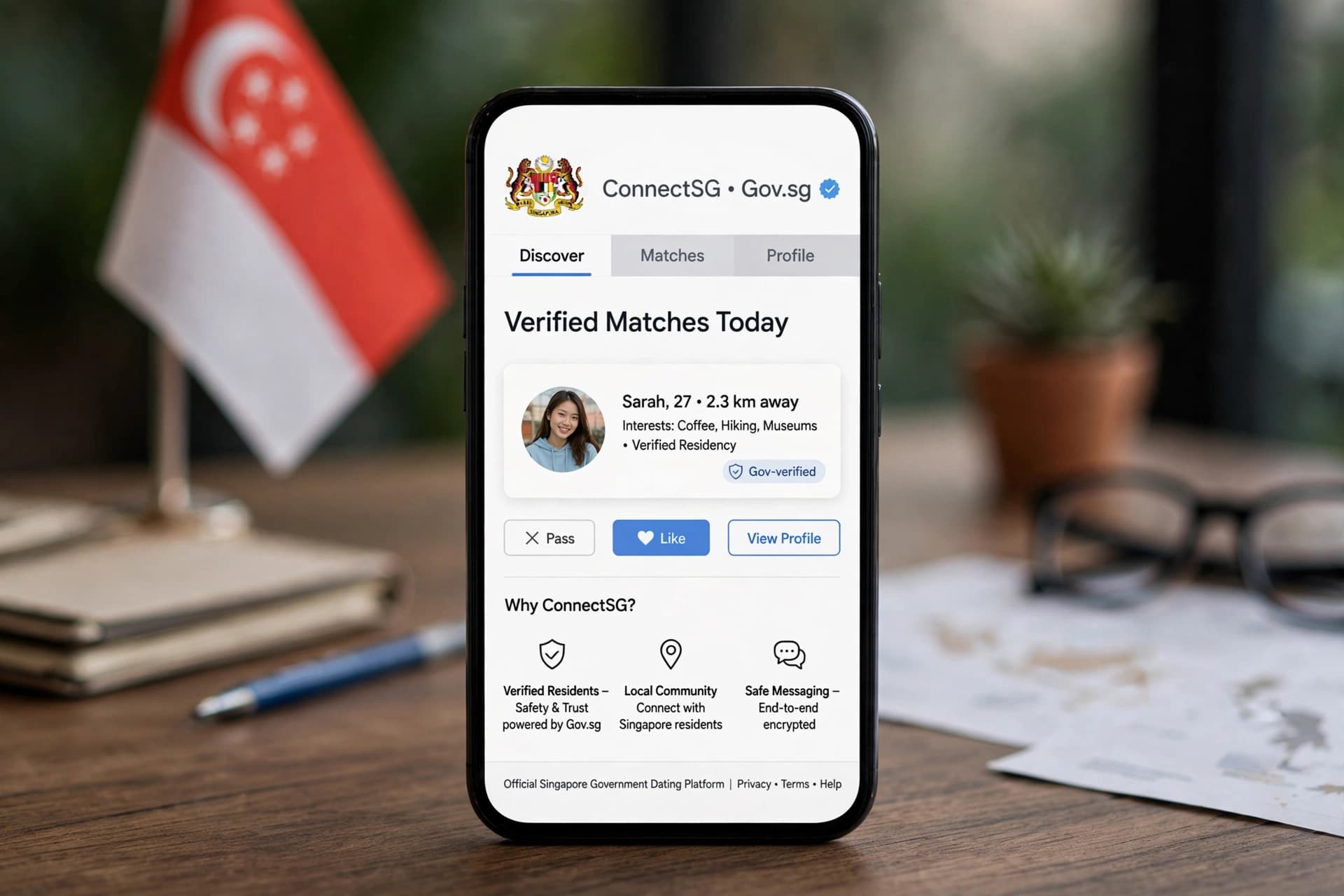
There is a quiet, actuarial sadness in the way a nation measures its own future—not in grand speeches or sweeping policy, but in the cold precision of birth statistics and the slow arithmetic of an aging population. In Singapore, those numbers have become difficult to ignore. For the first time in sixty years, fewer than 30,000 babies were born in 2025. The total fertility rate fell to 0.87 children per woman, far below the replacement level of 2.1 needed to maintain a stable population. Deaths, meanwhile, climbed to roughly 26,500 . Into this demographic quiet, the government has now introduced something both practical and peculiar: a state-backed dating app, exclusive to its own employees, designed to help them find partners and, eventually, perhaps, have children.
The app is called FirstDate. It launched this week for public servants aged 21 to 35, using Singapore's national digital identity system for sign-in and a questionnaire about interests, habits, and values to build profiles . What distinguishes it from the crowded field of commercial dating apps is not merely its government provenance but its underlying logic. FirstDate is built on the Gale-Shapley Stable Marriage algorithm, a mathematical framework that earned Lloyd Shapley a Nobel Memorial Prize in Economic Sciences in 2012. The algorithm pairs two equally sized groups based on their preferences, ensuring that no pair would rather be matched with each other than with their assigned partners. Instead of endless swiping, users receive one match at a time. "Swipe fatigue ends here," the website declares .
For some young civil servants, the appeal is not romance but reassurance. Elizabeth, a 29-year-old defense ministry employee who plans to try the service, told the BBC that the experience of meeting someone through an app does not change much across platforms. "But it is nice to know that the likelihood of being scammed is much lower," she said. "We're all public servants looking for a partner, right?"
The reaction beyond the public service has been more mixed. On social media, some Singaporeans described the initiative as "dystopian," while others criticized its restriction to government workers and its age cap. One Reddit user wrote that the government was only doing this to raise the total fertility rate, and that since there are higher risks in having children at 35 and older, "the government just writes [the older singles] off" . The Straits Times reported that applications for the pilot close on October 5 .
This is not Singapore's first attempt to play Cupid. In 1984, the government established the Social Development Unit to organize social events for university graduates, a program later criticized as elitist and eventually phased out. A separate agency was created the following year to promote marriage among non-graduates . The new app arrives alongside other measures: in August, Prime Minister Lawrence Wong announced nearly S$70,000 in financial support for each child by age 17, part of a broader effort to shift from supporting birth alone to supporting the entire arc of raising a family .
Whether FirstDate can meaningfully alter demographic trajectories remains uncertain. Tokyo's government launched a similar AI-powered dating app in September 2024, and by July 2026, government data showed it had resulted in 265 marriages . For a nation as small and as carefully governed as Singapore, every marriage counts. The app is, in its way, an acknowledgment that the state cannot legislate love, but it can at least try to make the introduction a little easier—and, perhaps, a little more stable.
AI Image Disclaimer: The images accompanying this article were generated by artificial intelligence and are for illustrative purposes only.
Sources: BBC, NDTV, EFE, Malay Mail, The News International
Published by Banx Network. This article is part of the Banx decentralized media programme, powered by the BXE token on the XRP Ledger.