
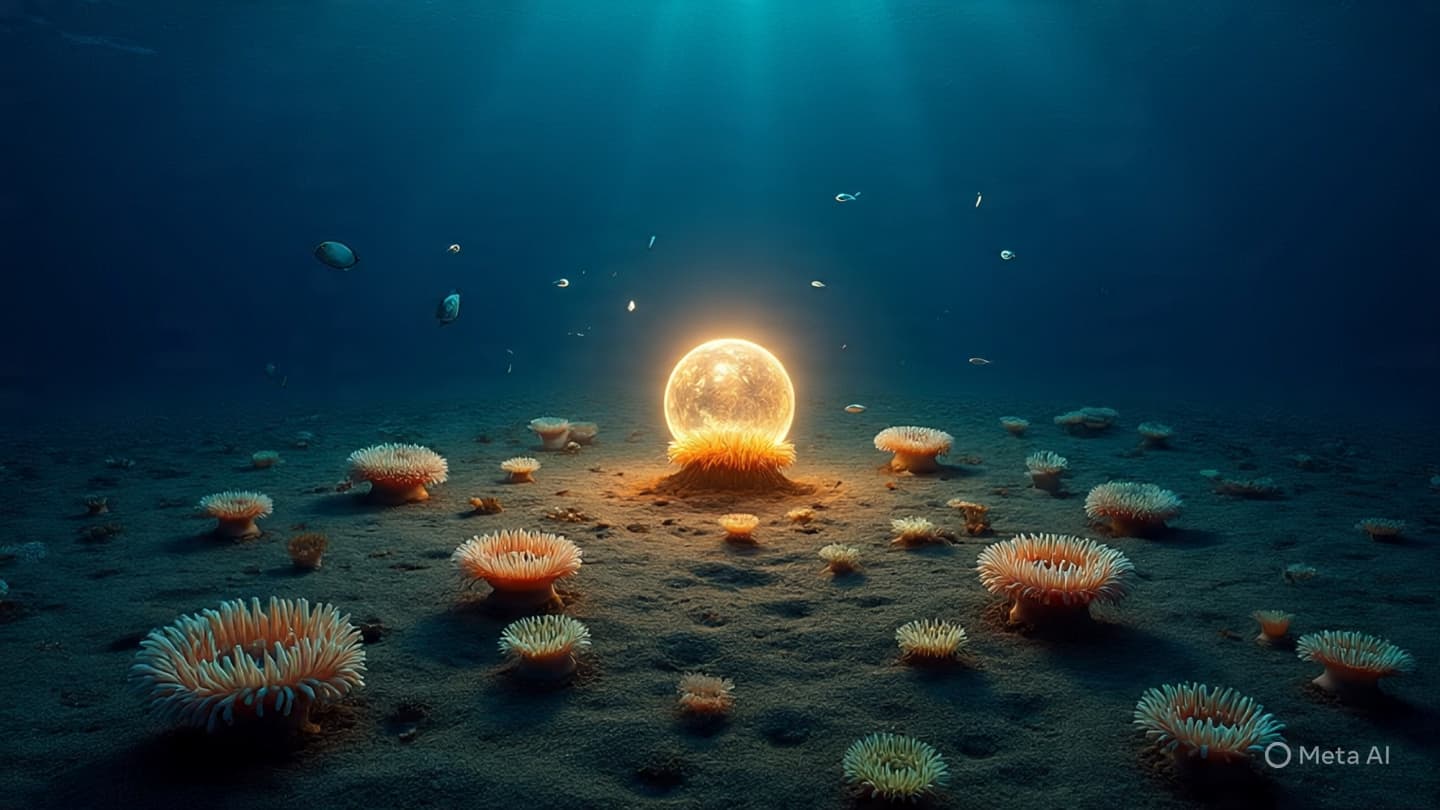
In the quiet, lightless depths of the ocean, where sunlight fades into memory, discovery often arrives not with clarity but with curiosity. It was in such a place, deep beneath the waters of the Gulf of Alaska, that scientists encountered a small, golden sphere—an object as delicate as it was perplexing, shimmering faintly against the dark seabed like a question waiting to be answered.
The object, informally referred to as a “golden orb,” was discovered during a deep-sea expedition led by researchers using remotely operated vehicles. Resting on the ocean floor, the sphere measured only a few centimeters across but immediately drew attention due to its unusual appearance and texture.
Initial observations suggested that the orb was organic in nature. Its smooth, slightly translucent surface and the presence of a small opening hinted that it might be a biological structure—possibly an egg casing or a form of marine organism. However, its exact identity was not immediately clear, prompting careful collection and further laboratory analysis.
Scientists emphasized the importance of deep-sea exploration in uncovering such mysteries. Much of the ocean floor remains uncharted, and each expedition has the potential to reveal species or structures never before documented. The golden orb serves as a reminder of how much remains unknown in Earth’s largest habitat.
Subsequent analysis pointed toward the possibility that the orb could be an egg case belonging to a marine species, perhaps a type of sponge or a yet-undocumented organism. The small opening may indicate where an organism emerged or where biological exchange occurred. Still, researchers have been cautious in drawing definitive conclusions.
The discovery also highlights the technological advancements that make such findings possible. High-resolution cameras, robotic arms, and deep-sea submersibles allow scientists to observe fragile objects in their natural environment before retrieving them, preserving critical context for study.
While the orb itself is small, its implications are expansive. Each unidentified object invites new questions about biodiversity, adaptation, and the resilience of life in extreme conditions. It underscores the ocean’s role as a frontier of scientific inquiry, not unlike space.
As research continues, the golden orb remains both an object of study and a symbol of the unknown. In the depths of the Gulf of Alaska, it quietly reminds us that discovery often begins with a single, unanswered question.
AI Image Disclaimer: Images accompanying this article are AI-generated visual interpretations and may not reflect the exact real-world object.
Sources: NOAA Schmidt Ocean Institute National Geographic BBC Science
Published by Banx Network. This article is part of the Banx decentralized media programme, powered by the BXE token on the XRP Ledger.



